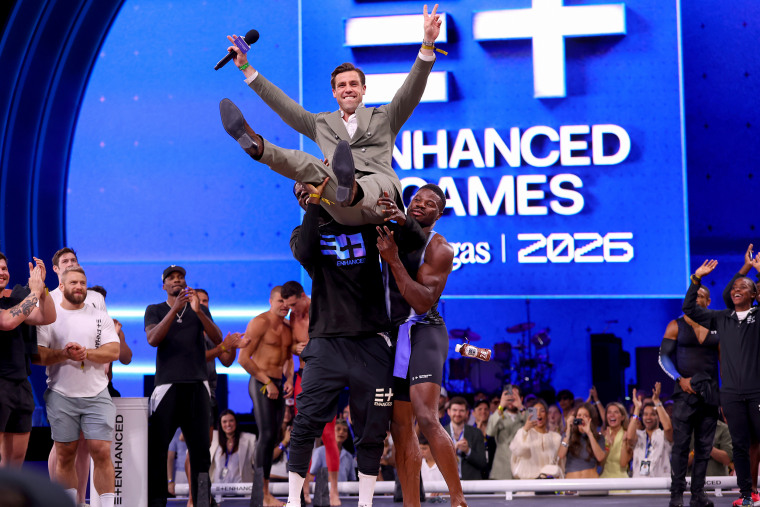
Las Vegas — Shania Collins once felt apprehension about performance-enhancing drugs. In 2023, she even consulted her parents, Drug Enforcement Administration agents, when faced with the decision. With moderate success as a sprinter for Puma and Adidas, Collins retired at 29. Disenchanted with her stalled career, she looked toward a DEA future. But then came an enticing offer from the Enhanced Games, a sports startup encouraging doping, along with a promise of substantial financial reward.
The Enhanced Games, held in Las Vegas, focused on sprinting, swimming, and weightlifting. Athletes like Collins could earn six-figure salaries and compete for prize money up to $250,000 per event, with $1 million for world records. The money outweighed potential downsides regarding drug effects and DEA career prospects. After discussing with her parents, Collins joined under careful medical supervision.
Organizers, like CEO Max Martin, claim allowing doping unlocks human potential, while co-founder Christian Angermayer compares it to basic safety equipment for workers. However, anti-doping advocates argue the games send a dangerous message, risking athletes’ health for entertainment. The World Anti-Doping Agency positions this as irresponsible and immoral.
Ivan Rojas, a coach at the games, embraces transparency, noting enhancement’s historic role in weightlifting. The Games offers controlled environments for drug use, with FDA-approved substances only.
Among the athletes, 91% used testosterone, 79% human growth hormone, and 62% stimulants like Adderall. EPO, known for enhancing endurance, found use with 41%. Enhanced’s medical board studied the effects during a trial, with athletes signing up for a five-year observation.
Despite initial apprehension, athletes reported benefits from the drugs, like increased energy and training capacity, while some experienced side effects. British swimmer Ben Proud, for instance, described his transition as emotionally taxing yet positively impactful on training. Australian swimmer James Magnussen faced muscle gain issues, while Colombian swimmer Isabella Arcila took precautionary steps regarding fertility.
Money’s allure is undeniable. U.S. sprinter Marvin Bracy-Williams, under a doping ban, still signed with Enhanced for a lucrative deal. Contracts often diminish when performances decline, but Enhanced promised significant payouts. Greek swimmer Kristian Gkolomeev even earned $1 million for breaking a world record, although not officially recognized due to unsanctioned event status.
Olympic Conflict
U.S. swimmer Hunter Armstrong took home $375,000 despite non-doping participation, amid potential threats to Olympic eligibility. Enhanced’s legal struggle against World Aquatics aims to prevent bans on participating athletes. Fred Kerley, a clean competitor, won a 100-meter race, emphasizing the unfulfilled potential of doping athletes. Tristan Evelyn also highlighted skill’s role alongside chemistry.
Doping and Sports Evolution
The Enhanced Games seek legitimacy in a landscape reshaping sports like collegiate athlete compensation and technological rule adaptations. Yet doping stirs moral and ethical debates. Enhanced’s venture backing pushes its marketing of related drugs. Critics argue this creates risky imitation among youth, though Martin counters with prescription safeguards.
Cody Miller, a coach and former Olympian, advises young swimmers with honesty. He distinguishes recovery aids for older athletes, discouraging teen PED use by underscoring their natural abilities. Many athletes, like Miller, stepped out of retirement for the Enhanced Games, drawn by substantial financial incentives, despite potential career risks.
Inaugural Event’s Impact
The first Enhanced Games showcased an extravagant Las Vegas venue for select guests. Organizers allowed flexibility, like additional attempts for weightlifters or repetitive false starts. Non-doping sprinters claimed victories, raising questions about doping’s extent at the event. Gkolomeev’s record-breaking swim underlined the blurred lines between enhanced and unaided achievements.
Enhanced CEO Max Martin acknowledged ambitions to break multiple records, yet focused on individual achievements and digital reach. The inaugural event, viewed online, centered around capturing public attention, encapsulating Enhanced’s vision of a new sports paradigm.
Gkolomeev, though skeptical of narratives, reaped financial rewards, illustrating Enhanced’s dual promise: performance and profit. His coach summed up the experience, highlighting the financial gain as a key takeaway.
 Lane Kiffin’s Dramatic Return to Oxford: A Memorable College Football Weekend
  Debate Over O.J. Simpson’s Omission from Buffalo Bills’ Wall of Fame
  Red Sox Remove Interim Tag, Appoint Chad Tracy as Manager
  Lane Kiffin Criticized After Ole Miss Loss While Florida Football Faces Social Media Fiasco
  Deion Sanders Enforces Discipline After Colorado’s Defeat to Northwestern
  Steve Lotysz: From Medinah’s Gates to Presidents Cup Artistry