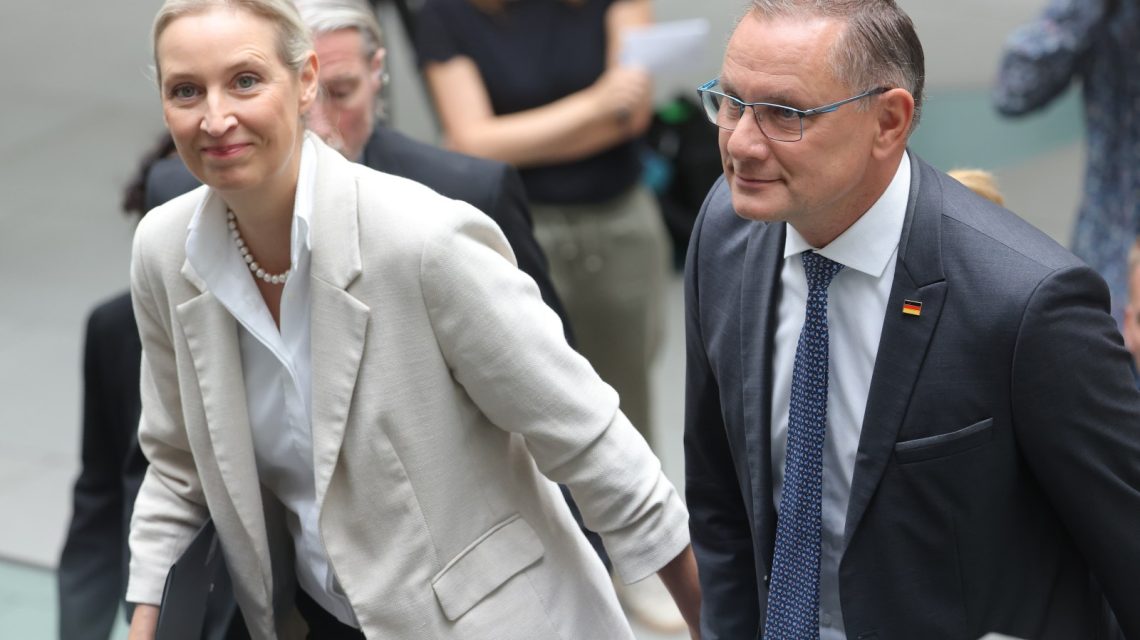
The far-right Alternative for Germany (AfD) party secured a strong position after its success in Saxony-Anhalt. The party gained 44 percent of the vote, significantly ahead of the Christian Democratic Union (CDU), which garnered 17 percent. This result positions the AfD well for upcoming elections in Mecklenburg-Western Pomerania and Berlin, where local elections are scheduled for September 20.
Elections in Mecklenburg-Western Pomerania and Berlin
In German state politics, the leading party typically gets the chance to form a governing coalition. However, many major parties refuse to align with the AfD to prevent it from taking power, an approach known as a “firewall.” In Saxony-Anhalt, the far-left Bündnis Sarah Wagenknecht (BSW), which received 5 percent of the vote, has shown interest in becoming a key player in coalition talks.
This development increases the likelihood of AfD’s Ulrich Siegmund becoming the first far-right state governor in Germany since World War II. In Mecklenburg-Western Pomerania, recent surveys indicate the AfD is leading its rivals. The state chamber requires 36 seats for a majority. According to polling data from PolitPro, AfD holds 35 percent support as of September 6, compared to the SPD’s 30 percent and Die Linke’s 11 percent.
The polling firm Insa provided different figures, showing AfD at 30 percent and SPD at 23.2 percent. Prediction markets have favored AfD, with Polymarket putting their chances of being the biggest party at 82 percent, while Kalshi offers a slightly lower probability at 79.4 percent.
Berlin’s Upcoming Vote
Berlin voters will also participate in elections on September 20. The city operates as one of Germany’s 16 federal states. At least 130 seats in the chamber are contested, with a requirement of 66 for a majority.
PolitPro’s average polling data indicates a competitive field, with Die Linke leading at 19.8 percent, closely followed by CDU at 19.6 percent and AfD at 17.9 percent. The Greens have 16.1 percent, SPD 12.9 percent, and BSW 3.6 percent support. Polymarket suggests Die Linke has a 45 percent chance of winning, CDU 32 percent, and AfD 17 percent.
Louis Perron, political scientist and author of “Beat the Incumbent: Proven Strategies and Tactics to Win Elections,” mentioned that the AfD’s success in Saxony-Anhalt could energize the left, prompting them to mobilize against the AfD. Chancellor Merz is expected to avoid open responses until after the elections in Berlin and Mecklenburg-Western Pomerania, although behind-the-scenes discussions are likely ongoing.
 Economic Trends, Security Incident, and Cultural Icon Passing Impact on Society
 Robert C. White Jr. Resigns from D.C. Council to Run for U.S. House Delegate
 White House Engages Veterans Ahead of Court Clash
 Senate Race Forecasts Shift in Favor of Democrats Ahead of Midterms
 Pentagon Revises U.S. Military Casualty Figures Related to Iran Conflict
 Republicans in Defensive Mode Ahead of Midterm Elections