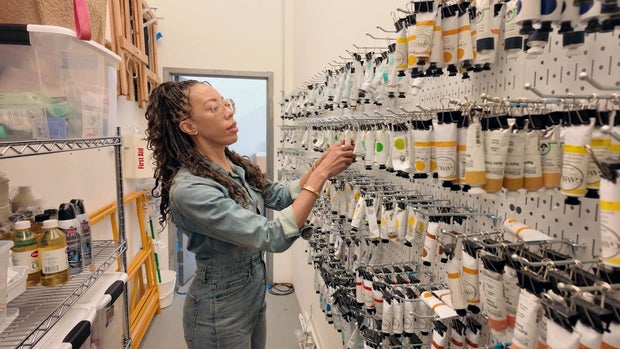
Amy Sherald, once little known in the art world, is now a celebrated painter in America. Nine years ago, she was chosen to paint Michelle Obama’s official portrait. At 52, she has gained recognition through major retrospectives and exhibitions, including those at the Smithsonian’s National Portrait Gallery.
Sherald’s art features Black Americans who engage viewers with their silent, knowing gazes. Her paintings, such as a farmer on a pristine tractor against a vibrant backdrop, reflect this style. Her subjects, unapologetic and bold, encourage viewers to connect with them.
During a conversation with Anderson Cooper, Sherald emphasized the importance of presence in her work. She sees her subjects as actively engaging the world by simply being present and meeting the viewer’s gaze. This silent connection is central to her paintings.
Sherald’s art is widely displayed in prestigious museums and private collections. Her show, “American Sublime,” at the Whitney Museum of American Art, was a personal dream realized. She had visualized exhibiting in the space for years and found the experience matched her expectations.
Her portraits tell visual stories without using the subjects’ names, beginning with photographs and evolving into painted narratives. The subjects can be friends, models, or strangers, selected when their energy resonates with hers.
Two notable paintings in her exhibition include a living portrait of Breonna Taylor and one of Michelle Obama. The latter, unveiled in 2018, significantly impacted her career. Sherald’s focus remained on the painting rather than its potential career implications.
Her painting style, American Realism, captures ordinary American life. Curator Sarah Roberts described Sherald’s ability to convey the majesty and tactile quality of her subjects, often lost in reproduction. Her work redefines Americana by ensuring inclusivity in its depiction.
At a young age, a painting by Bo Bartlett featuring a Black man inspired Sherald. It was her first time seeing a Black subject in artwork, fueling her desire to create similar art.
Despite her parents’ hopes for a medical career, Sherald pursued art. For over a decade, she painted by day and waited tables by night, determined amidst challenges, including a rare heart condition that led to a heart transplant at 39.
Sherald’s artistic journey involves her medical journey, acknowledging her donor, Kristin Lin Smith, in significant moments of her life and work. Her heart transplant experience intertwines with her art’s themes of life and presence.
Her studio in New Jersey produces about six new paintings yearly. Sherald mixes her colors, including unique grays for skin tones, to emphasize humanity over racial identifiers.
Her choice to use gray for skin tones stems from a desire to shift focus from race to the subject’s humanity. Enabling different entry points to her art, the grayscale invites viewers to contemplate beyond phenotypic identifiers.
Sherald faced reluctance in painting brown skin for fear of her work being marginalized. Her paintings now reach the heights of American Realism, compared to Edward Hopper, Andrew Wyeth, and Norman Rockwell.
She prepared for an “American Sublime” exhibition at the Smithsonian, which she canceled, fearing censorship under political pressures against a work featuring a trans person. She later displayed it at the Baltimore Museum of Art and the High Museum in Atlanta.
Sherald views her work as both art and political commentary. Her paintings, though not overtly political, engage with the world, transforming in context.
Her commitment to depicting an inclusive America reflects her personal view of patriotism. Sherald claims an integral role in American history and identity, emphasizing the contributions of Black Americans. She sees her work as a testament to this inclusive definition of Americanism.
 Artistic Chronicle of Communities’ Recovery Post-Hurricane Helene
  Chicago History Museum’s Latin American Exhibit Sparked by Student Protests
 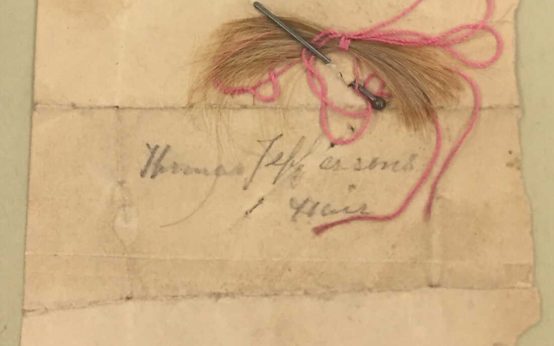 DNA Links Jefferson to Hemings Descendants
  Ari Emanuel’s Memoir: A Business-Centric Narrative
 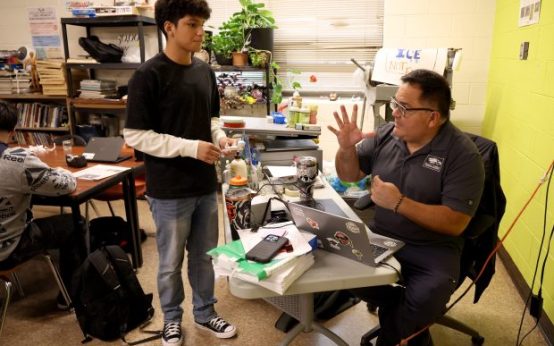 Celebrating Day of the Dead: Students Craft Calaveras in Pilsen
  Controversial Revelations from Charles Spencer’s New Book on Princess Diana