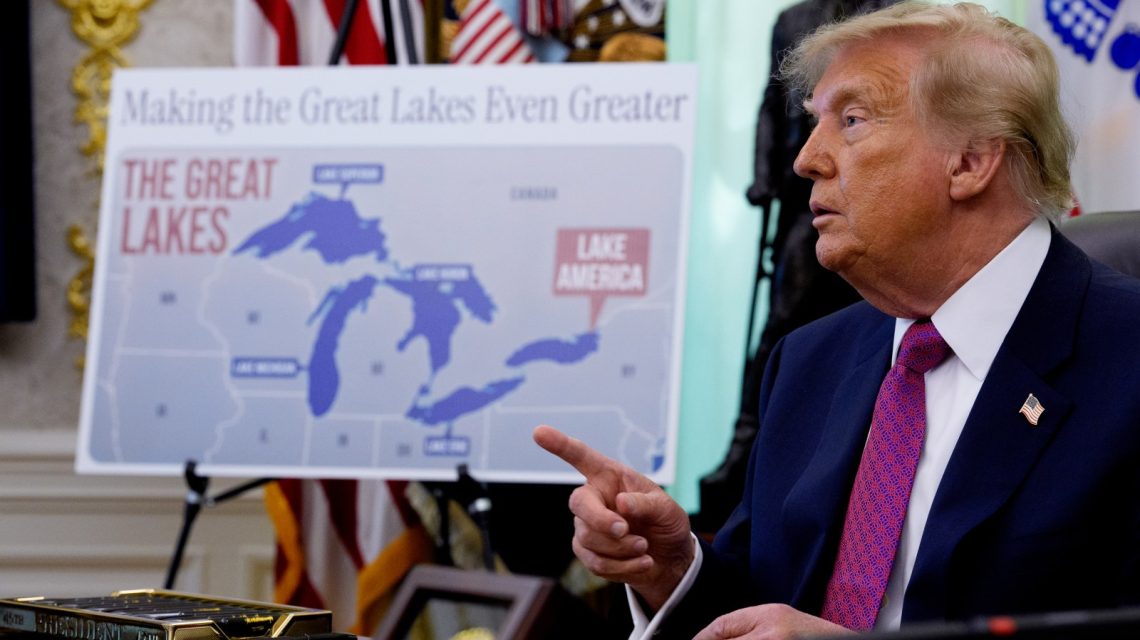
President Trump’s Executive Order on Lake Naming
President Donald Trump issued a controversial executive order, renaming Lake Ontario as “Lake America.” This action has sparked debates on the extent of presidential power in changing geographic names and reshaping maps.
Signed on August 27, the order directs the federal government to update the name in all official records. Interior Secretary Doug Burgum is tasked with amending the Geographic Names Information System, which ensures place name consistency across U.S. government agencies. Although applicable to federal use, the directive does not bind Canada, international groups, or private mapmakers to adopt “Lake America.”
This renaming follows the replacement of “Gulf of Mexico” with “Gulf of America” nearly two years ago in U.S. records. During comments accompanying the recent order, Trump hinted at broader ambitions, including potentially renaming the Atlantic and Pacific Oceans.
The Possibility of Renaming Oceans
In his remarks, Trump joked about the potential to rename major oceans, suggesting that such changes could extend his naming spree further. Presidential authority generally includes directing federal names used in documents, databases, and maps.
The U.S. Board on Geographic Names aims to create consistency among government agencies. However, similar to past name changes, altering the names of oceans would remain symbolic within U.S. boundaries. As oceans aren’t owned by any country, their names in international waters are shared globally.
Despite any change in Washington’s nomenclature, foreign governments and international entities would not be required to accept new names. Coastal nations exercise sovereignty only over their territorial waters, extending 12 nautical miles offshore, while Exclusive Economic Zones reach 200 nautical miles.
Motivations for Renaming Lake Ontario
Trump’s order came amid heated trade tensions with Canada. Although he publicly suggested the name change earlier, the formal announcement was made during an Oval Office speech. When pressed, Trump claimed there’s “no message” intended for Canada, though he criticized its trade with the U.S.
This initiative mirrors Trump’s earlier executive action regarding the Gulf of Mexico and highlights his willingness to adjust federal naming conventions. However, the impact remains limited. Lake Ontario is a shared resource between the U.S. and Canada, forming part of an international boundary. The order mandates U.S. federal agencies to use the new name, but Canada and other international bodies are free to retain the original.
Presidential influence thus primarily affects federal nomenclature, not global naming.
Authority over Gulf of Mexico
Past executive orders, such as the 2025 renaming of the Gulf of Mexico, have similarly sparked debates on geographic authority. The Gulf borders three countries: the U.S., Mexico, and Cuba. The executive order did not alter jurisdiction or enhance America’s maritime claims.
Federal directives can change nomenclature within government databases but do not redefine ownership or sovereignty, which remain under international treaties and maritime boundaries. The National Oceanic and Atmospheric Administration made updates to regulatory references in line with the “Gulf of America” naming, yet Congressional statutory references were beyond executive alteration.
Such precedents underscore the distinction between naming powers and territorial authority. Oceans remain shared spaces outside any one nation’s control, making Trump’s renaming reach primarily symbolic.
 Russia Warns of Strikes Against British Targets Amid Tensions
  Hemp Regulation Faces Congressional Challenges Amid Funding Legislation
  Uganda Declared Ebola-Free Amid Congo Crisis
  Tate Brothers’ Wealth Claims Unveiled as Exaggerations in Court
  Kennedy Center Naming Dispute: Trump’s Influence and Legal Battles
  Flash Flooding in Himalayan Valleys Causes Devastation