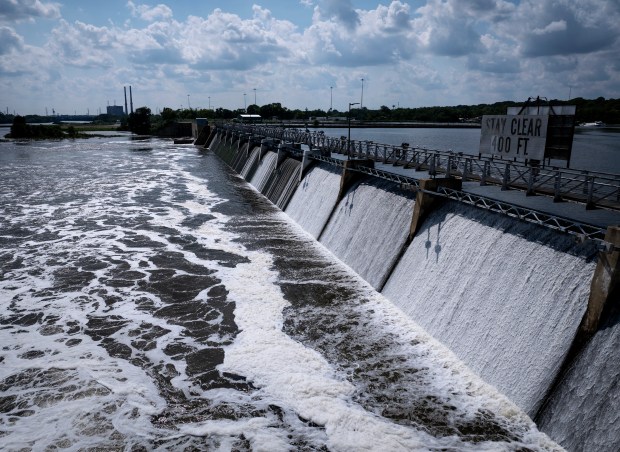
Construction will continue on the Brandon Road Lock and Dam near Joliet, after a pause by the U.S. Army Corps of Engineers. This project, costing $1.15 billion, aims to prevent invasive carp from entering the Great Lakes.
The halt began on July 24 with a stop-work order from the Army Corps’ Rock Island District. Advocates expressed surprise, citing the project’s ‘administrative review’ as the reason. Shortly after the order, hundreds of small silver carp were found 80 miles from Lake Michigan, indicating a potential spawning event closer to the lake.
In light of the halt, President Donald Trump urged the continuation of the project with urgency. The construction began in 2025 and is essential to protecting the Great Lakes’ native species and its economic activities. Current electrical barriers near Romeoville serve as the last defense against the invasive fish.
Joel Brammeier, CEO of the Alliance for the Great Lakes, highlighted the delay’s risks, emphasizing widespread support for the project across the region, including bipartisan Congressional backing. This support contrasts with funding disagreements between Trump’s administration and the governors of Illinois and Michigan.
Following discussions between President Trump and Michigan Governor Gretchen Whitmer, work resumed. Brammeier stressed the importance of maintaining the project’s momentum to safeguard the region’s ecological and economic interests.
Late August saw environmental groups from several states advocating against further interruptions to the project. Brian Gill from the Shedd Aquarium noted the lasting impact of invasive species on ecosystems, stressing proactive measures over costly cleanups.
Jennifer Walling of the Illinois Environmental Council and Spencer Dirrig of the Ohio Environmental Council emphasized the bipartisan nature of the project and the urgency of preventing carp from invading the Great Lakes.
Illinois and Michigan have committed $64 million and $50 million, respectively, to the initiative. In May 2024, Congress increased the federal cost share for maintenance post-construction to 90%. The federal government covers 90% of construction costs, with $274 million already allocated for initial phases.
Phase one includes preparing the site, removing bedrock, and installing deterrents like a bubble barrier and acoustic signals. These are designed to prevent carp from advancing further. Subsequent phases will implement electric barriers and additional deterrents. The final phase introduces a flushing lock to redirect larval fish and eggs downstream.
Invasive carp, such as silver and bighead carp, entered U.S. waterways in the 1960s and 1970s. They spread following flooding events, escaping into the Mississippi River basin, where they have since proliferated across 31 states. Their presence poses significant threats to native species due to their efficient feeding habits.
Monitoring efforts remain underway in the Illinois River. Biologists utilize electrofishing to monitor and remove juvenile carp. In May, surveys in Lake Calumet found no bighead or silver carp, but microchemistry studies continue to trace the origins of carp captured recently.
Commercial fishing efforts will resume in known carp habitats, focusing on adult populations. Although invasive carp are established in parts of the Illinois River, efforts persist to prevent their expansion into the Great Lakes.
 Managing Drying Rivers: The Need for New Approaches
  Coastal Damage from Kelvin Waves and Rising Sea Levels in Southern California
  Heat Dome Tightens Over South-Central US with Triple-Digit Temperatures
  Impact of Halting U.S. Air Quality Monitoring on Global Pollution Levels
  Persistent Legislative Inaction on Climate Change
  Potential Formation of Tropical Storm in the Atlantic