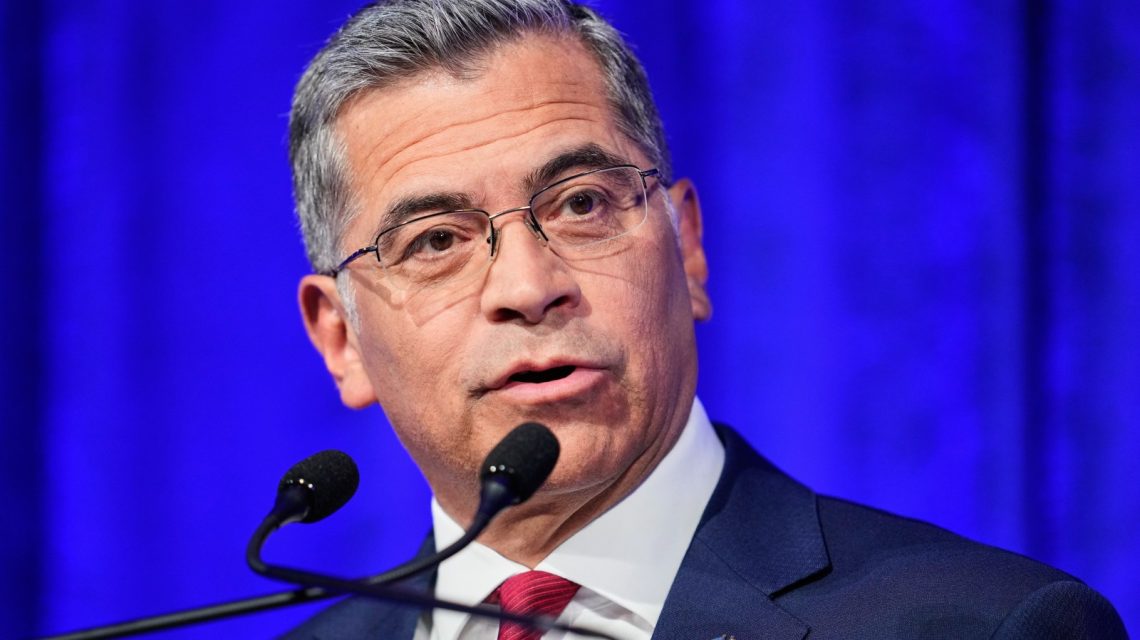
With the California gubernatorial election approaching, candidate Xavier Becerra announced his intention to overhaul the current high-speed rail plan to ensure timely completion. The bullet train project aimed to facilitate travel from Los Angeles to San Francisco at 220 miles per hour. However, long delays, funding issues, and increased costs have plagued its progress. Originally supported by voters in 2008, completion was expected by 2020; yet recent updates suggest the project may not finish until early 2038. This timeline hinges on continued backing by the governor succeeding Gavin Newsom.
Becerra, a Democrat and former Secretary of Health and Human Services under President Joe Biden, has previously served as California’s Attorney General and U.S. Representative. He emphasized commitment to meeting deadlines and budget constraints without detailing specific plan changes. Newsweek sought additional comments from Becerra’s campaign. As reported by Fox 26 News, Becerra addressed voters in Fresno, affirming his goal to complete the project.
The High-Speed Rail Project: Delays and Costs
Over 17 years ago, Californians narrowly endorsed Proposition 1A, supporting $10 billion in bonds for an 800-mile high-speed rail system connecting San Francisco and Los Angeles. Costs have since exceeded initial estimates, and the completion deadline has been extended by more than ten years. The $10 billion initially approved was deemed insufficient; in 2006, costs were approximated at $45 billion before inflation.
The project received support from the Obama administration, but faced setbacks when Donald Trump canceled nearly $1 billion in federal funds in 2019 after disagreements with Newsom. Joe Biden reinstated $3.1 billion through the Infrastructure Investment and Jobs Act, yet a $7 billion shortfall remained for the initial segment between Merced and Bakersfield. After being informed of the impossibility of meeting deadlines without laying any track, Trump canceled $4 billion in federal grants in July 2025 and cut another $175 million in August 2025. Although California sued over these cancellations, legal action was dropped, citing unreliability from the federal government.
Part of the project’s high expenses stem from its route through California’s agricultural regions, necessitating complex navigation of stringent environmental laws. The High-Speed Rail Authority spent over $765 million on environmental reviews in fiscal years 2024 and 2025. Legislative reforms, praised by Newsom, adjusted California Environmental Quality Act (CEQA) requirements to enable project advancement without compromising environmental standards. Currently, 463 of the 494-mile system’s environmental reviews are complete and construction-ready.
Political Views on California’s High-Speed Rail
In the upcoming nonpartisan ‘jungle’ primary on June 2, multiple Democrats, including Becerra, and two Republicans are contending. Recent polls show Republican Steve Hilton ahead with varying margins, whereas a May Emerson College poll places Becerra slightly in the lead.
Party lines largely define opinions on the rail project. Democrat Antonio Villaraigosa opts for project expansion rather than cancellation. Katie Porter, despite skepticism, supports completion. Republican candidates exhibit stronger opposition; Chad Bianco labeled it “a train to nowhere,” and Tony Strickland called it a “mismanaged failure.” Despite criticism and skepticism, a POLITICO-Citrin Center-Possibility Lab poll revealed 62 percent of Californians would continue funding the project without federal assistance last year.
 JD Vance’s Mother Responds to Critics; Bob Brooks Resolves Debt Issue
  Voter Fraud and Border Protection Initiatives Detailed
  Former Roanoke Swimmer Criticizes Virginia’s Policy Shift on Transgender Athletes
  Rep. Young Kim Targets Congressional Self-Enrichment with New Resolution
  Trump’s Influence on 2020 Election Claims Continues to Affect GOP
  Republican Strategy in Upcoming Elections Amid Democratic Socialist Presence