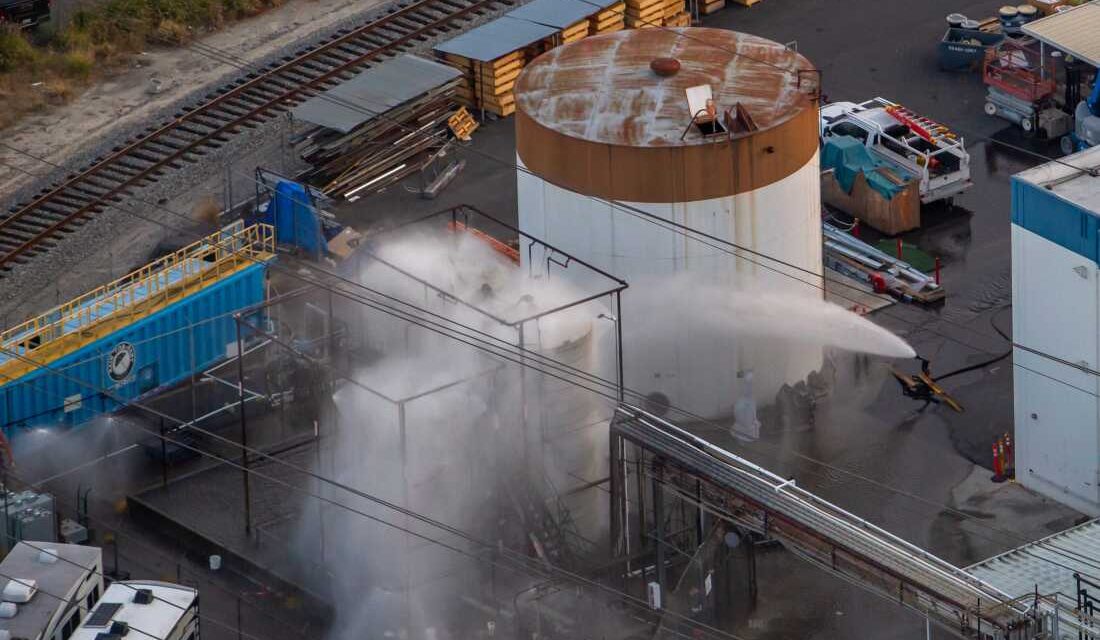
An aerial view from May 23, 2026, shows water sprayed onto a 34,000-gallon tank at GKN Aerospace, located in Garden Grove, California. A malfunction at the plant threatens a chemical leak or explosion, posing significant risks to nearby residents. Photo by Apu Gomes/Getty Images.
On Sunday, about 50,000 residents in Garden Grove remained under evacuation orders due to an escalating emergency at a local aerospace manufacturing facility. Emergency teams are hard-pressed to manage a precarious situation involving a chemical tank at risk.
Situation Overview
Overnight, a potential crack was found in the chemical storage tank. This particular tank, situated in the southeast corner of GKN Aerospace’s facility, contains around 7,000 gallons of methyl methacrylate. This chemical is toxic and flammable, commonly used in the production of resins and plastics.
Interim county fire chief TJ McGovern from the Orange County Fire Authority reported through social media that a team had approached the tank late Saturday to assess the situation. Their inspection revealed a potential crack.
The Lesser of Two Evils Scenario
The incident began Thursday, with the chemical tank surpassing safe temperature limits. Methyl methacrylate is a volatile, clear liquid that can generate energy exothermically. If reactions occur inside a confined space, sudden pressure buildup can result, potentially causing an explosion.
Historically, similar incidents have had catastrophic consequences. In October 2009, an explosion in a UK resin plant involving methyl methacrylate devastated the facility and surrounding structures, damaging windows as far as 600 feet away.
Craig Covey, incident commander at Orange County Fire, noted bulging of the tank and continuous water spraying to cool it. Two adjacent tanks have been stabilized; one drained and neutralized, while the other remains unaffected.
On Friday, Covey explained to the press that a slow leak from the cracked tank might be preferable. It’s far from ideal but prevents explosive pressure buildup. “In a weird world, a slow leak is the best-case scenario,” he stated. “Once it leaks, the hazard changes from explosive to environmental.”
Environmental and Health Concerns
GKN Aerospace assured on Sunday that efforts are ongoing to mitigate leak risks. The substance poses multiple hazards: skin and eye irritation, respiratory problems, neurological symptoms like headaches, and potential prolonged exposure effects such as lung and organ damage.
While environmental impacts remain uncertain, they’re anticipated to be negative. Covey emphasized preemptive measures, including containment barriers. Sand and other materials have been deployed to hinder chemical entry into drains and waterways.
Continued Evacuation of Residents
On May 22, evacuees arrived at shelters as tens of thousands were directed to leave their homes due to the tank leak threat and potential explosion releasing toxic emissions over densely populated zones. Photo by Blake Fagan/AFP via Getty Images.
Fire Chief McGovern communicated through a video statement addressing displaced residents. The priority is ensuring safety before any return. Evacuation protocols aim to protect against an explosion and unpredictable chemical emissions. Monitoring remains stringent, with no fume detection from firefighters or the EPA, which is actively stationing around the location.
McGovern’s recent analysis indicates positive developments, with the tank crack potentially alleviating pressure. “An indication that we’re moving in the right direction,” he remarked. The situation is fluid, and further updates are anticipated soon.
 Helicopter Crash Claims Lives of Two Firefighting Pilots in Yosemite
  Remembering Chris Spatola: ESPN Analyst and Former Army Guard
  Controversy Surrounds Massachusetts’ Proposal for Nurse Home Visits
  Protests Emerge Following ICE Shooting of Venezuelan Man in Austin
  NYC Mayor Mamdani and President Trump Discuss Media Access and Criticism
  Presley Gerber, son of Cindy Crawford, passes away at 27