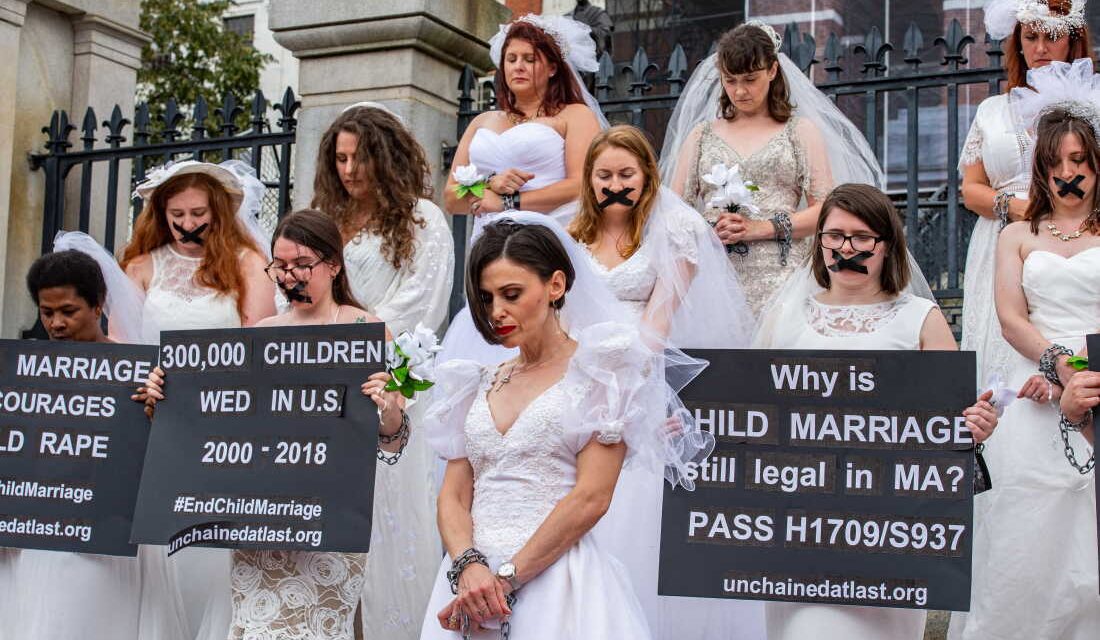
Advocates and survivors of child marriage recently convened in Boston to demand an end to child marriage practices. Currently, over two dozen U.S. states permit marriage under the age of 18 under specific circumstances. A proposed bill in Congress aims to establish a nationwide ban.
The United Nations identifies child marriage, where at least one partner is under 18, as a human rights violation. Concerns for underage brides include early pregnancy, social isolation, disruption of education, limited career opportunities, and heightened risk of domestic violence. Each year, the U.N. estimates 12 million girls become child brides. The issue affects boys too; child grooms may prematurely drop out of school to provide for a family. The U.N. intends to eradicate child marriage by 2030.
In 2023, renewed efforts to outlaw child marriage included a U.S. bill introduced in July and a U.N. resolution adopted on September 4. The resolution designates November 27 as the International Day to End Child, Early and Forced Marriage.
Our “Whatever happened to…” series invites Kamala Thiagarajan to explore the ongoing efforts to end child marriage.
About This Series
Over the next week, we’ll revisit past global health and development stories to understand “whatever happened to…” Various countries aim to meet the U.N.’s goal to end child marriage by 2030. Since 2021, nations like Sierra Leone, England, the Philippines, and the Dominican Republic have legislated 18 as the minimum marriage age without exceptions.
The U.S. drive for a national law faces criticism; some question the proposed legislation’s provisions and oppose it overall. Legislation does not guarantee a solution. For instance, India bans marriage under 18, yet a recent survey reveals one in five women aged 20 to 24 married before 18. UNICEF estimates the annual occurrence of at least 1.5 million underage marriages in India.
The U.S. Effort
On July 16, U.S. legislators introduced the Child Marriage Prevention Act, intending to enforce a nationwide minimum marriage age of 18. “In 34 states, including Wisconsin, child marriage is legal. Many of these marriages occur between girls and adult men. It’s time we end this predatory practice,” said Reps. Moore and senators Durbin, Schatz, and Gillibrand. The bill addresses prevalent marriage data, revealing more than 314,000 minors wed legally in the U.S. from 2000 to 2021, including girls as young as 10. Most underage brides married adult men.
Organizations like Unchained At Last, which campaigns to end forced and child marriage in the U.S., report that marital exemptions in statutory-rape laws often prevent prosecuting adult spouses in underage marriages. Additionally, married minors often face legal obstacles in seeking divorce or protection from abuse.
The Tahirih Justice Center has played a significant role in developing and supporting this legislation. Its director of public policy, Casey Carter Swegman, comments on difficulties advocates face when foreign politicians cite U.S. child marriage practices. They argue that the global movement would benefit from changes in U.S. laws.
Swegman emphasizes how apparent consent by minors doesn’t always mean the decision to marry was freely made, especially under familial pressure, as refusing could lead to punishment or violence at home. Pregnancy as justification for marriage raises concerns over statutory rape.
While many advocates support the proposed bill, others question sections that provide federal funding to study child marriage rather than outright banning it. Critics warn such provisions may undermine efforts to stop the practice.
How the U.S. Bill Compares to Other Global Efforts
As U.S. Congress debates the bill, other countries have implemented stricter national laws. Sierra Leone’s Prohibition of Child Marriage Act of 2024 sets the minimum marriage age at 18, voiding marriages and penalizing facilitators.
Countries like Columbia and Bolivia recently banned child marriage, eliminating exceptions such as parental consent. Effective legislation requires comprehensive enforcement, a challenge in certain jurisdictions like India and sub-Saharan Africa.
Deeply ingrained cultural customs drive early marriages in India despite laws. Young Lives India, a research program, indicates cultural, security, and dowry practices perpetuate this issue. Legal frameworks can’t solely address these nuanced challenges.
In addition to legislation, experts call for collective belief and behavior changes, supportive services, community engagement, and discussions to deter early marriages. The U.S. faces similar hurdles with entrenched gender norms and societal pressures supporting child marriage.
The push for robust U.S. laws ties into the larger international effort to spotlight child marriage on the global agenda. Establishing November 27 as a day to end the practice aims to hold governments accountable annually.
 Trump’s Influence on Israeli Politics Amidst Netanyahu’s Election Battle
  Canadian Man Faces Prison After Incident Involving Flamingo
  Dr. Vanessa Kerry Appointed WHO’s Special Envoy for Health Resilience
  Egypt Considers Military Support for Saudi Arabia Amid Houthi Threats
  France Uses Curfews to Address Violent Riots
  How to Approach End-of-Life Planning with Aging Parents