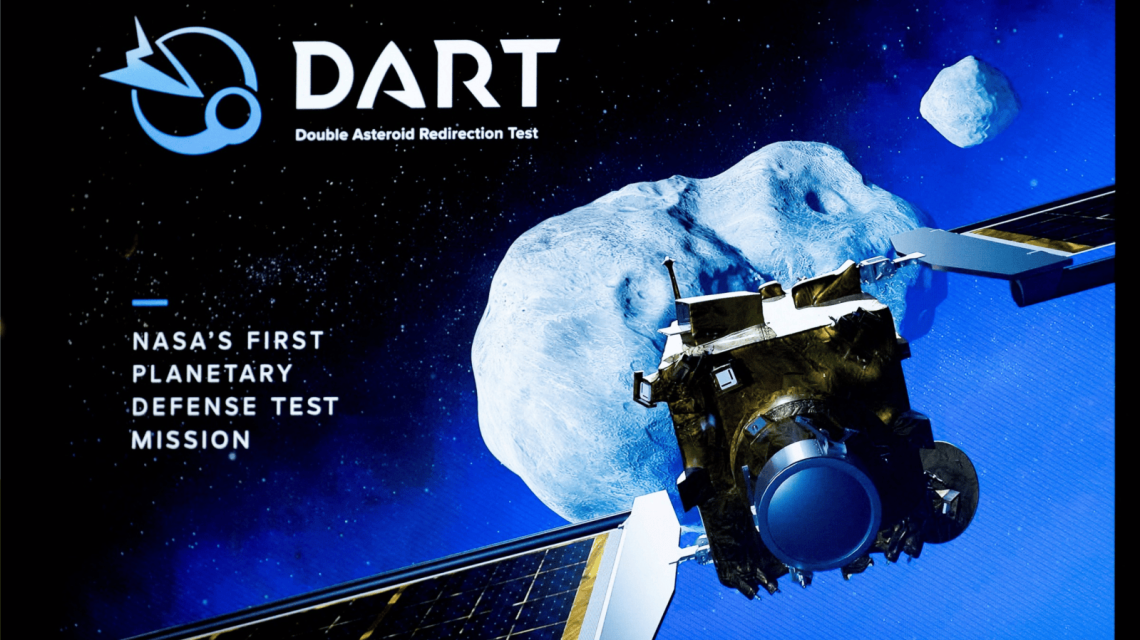
Humanity is on the brink of observing an asteroid closely for the first time since NASA purposefully crashed a spacecraft into it, altering its trajectory in space. The European Space Agency (ESA)’s Hera spacecraft has reached the Didymos asteroid system after a journey lasting around two years.
On Wednesday, November 25, ESA will release Hera’s inaugural close-up images of Dimorphos. This small asteroid was impacted in 2022 by NASA’s Double Asteroid Redirection Test, known as DART. These images could be pivotal for scientists aiming to comprehend the results of the DART mission and to assess if deliberately striking an asteroid could eventually protect Earth.
About the Hera Mission
Hera was launched on October 7, 2024. It aims to thoroughly examine Dimorphos and its larger companion, Didymos, while investigating the DART collision’s effects. ESA anticipates that these findings will potentially transform the DART experiment into a method that could be employed if an Earth-threatening asteroid surfaces in the future.
“DART and Hera were originally conceived on a coordinated double-spacecraft basis, with one mission to perform the deflection and the other to perform precision measurements of the result,”said Ian Carnelli, overseeing ESA’s Hera mission.
Dimorphos and Didymos create a binary asteroid system, where two asteroids travel together, with Dimorphos orbiting the larger Didymos.
Understanding the Asteroids
Didymos measures about 780 meters across, comparable to the size of the Burj Khalifa. Meanwhile, Dimorphos spans approximately 151 meters, resembling the Eiffel Tower’s dimensions. Dimorphos orbits Didymos from around three-quarters of a mile distance. Before DART’s impact, Dimorphos completed its orbit in 11 hours and 55 minutes.
Why Did NASA Crash Into an Asteroid?
On September 26, 2022, NASA purposely crashed the DART spacecraft into Dimorphos at about 14,000 miles per hour. The collision marked the first full-scale test of a technology designed to alter an asteroid’s path through space. The fundamental idea is straightforward: should scientists detect an asteroid on a collision course with Earth early enough, a spacecraft could be dispatched to impact it gently off course.
Neither Didymos nor Dimorphos posed any threat to Earth. NASA saw the asteroid system as an opportunity to test the feasibility of redirecting an asteroid by crashing a spacecraft into it.
This mission shows that NASA is trying to be ready for whatever the universe throws at us,said NASA Administrator Bill Nelson.
The experiment was successful. Observations indicated that the collision reduced Dimorphos’ orbit time by approximately 33 minutes, making it the first solar system object to have its motion measurably altered by human action.
The Aftermath and Further Questions
Scientists haven’t yet been close enough to assess the aftermath. NASA reported the DART collision tossed over two million pounds (around one million kilograms) of dusty rock into space, surpassing initial predictions. The Hera mission aims to understand why the impact was more effective than expected, its effects on the asteroid, and other lingering questions.
Researchers seek to discover the characteristics beneath Dimorphos’ surface, how the collision reshaped it, and the efficiency of movement transfer from DART to Dimorphos. ESA has previously suggested the collision might have created a crater around 20 meters in diameter, a theory Hera’s observations will help confirm.
Where to View the New Images?
ESA will livestream the reveal of the first close-up images of Dimorphos on Wednesday, November 25. Viewers can follow the event on ESA WebTV and ESA’s YouTube channel, with additional coverage available on ESA’s website. While close-up images of Didymos have already been received, Dimorphos has largely remained in shadow, making upcoming images the first detailed views since DART’s final moments.
 BepiColombo Mission: Reaching Mercury and Unveiling Mysteries
 Astronomers Observe Early Stages of Rare Supernova in Distant Galaxy
 NASA’s Voyager 1: A Journey Beyond
 Asteroid 2026 QQ8: Earth’s Temporary Mini-Moon
 Meteor Captured by NASA Cameras Over North Carolina and Tennessee
 Swift Observatory’s Final Journey Ends in Earth’s Atmosphere