From the heights of Millbank Tower in London, the U.K. Houses of Parliament lie conveniently close by. This iconic building, once the stronghold of Britain’s time-honored Conservative Party, now hosts Reform UK. Led by Nigel Farage, this right-wing populist party seeks to replace the Conservatives as the main player on Britain’s political right.
Across Europe, similar movements are challenging traditional parties. In France, Marine Le Pen’s National Rally has surpassed much of the traditional right. Meanwhile, Germany’s Alternative for Germany (AfD) has achieved historic electoral success, challenging the Christian Democrats. Comparable trends emerge in Italy, Spain, and Sweden, prompting established conservative factions to reconsider their strategies. They face a pivotal choice: align with populist stances on immigration and national identity or risk losing supporters.
“The great realignment of politics is focusing more on identity and nationalism rather than economics,” former British Conservative minister Steve Baker remarked to CBS News.
The European Commission anticipates EU growth of 1.1% in 2026, a decrease from 1.5% in 2025. Baker highlights this alongside President Trump’s election as evidence of broader frustrations with political and economic systems. Many find these systems unsatisfactory, and blame is increasingly directed toward ethnic and cultural minorities.
Britain’s Political Landscape
In Britain, the Conservative Party struggles to maintain its political footing after a decisive defeat in 2024. Reform UK has capitalized on discontent over immigration, accusing former Conservative governments of falling short in managing migrant numbers. Nearly a million net arrivals occurred during their final years. A recent poll indicated that 44% of Britons view immigration as a pressing national issue.
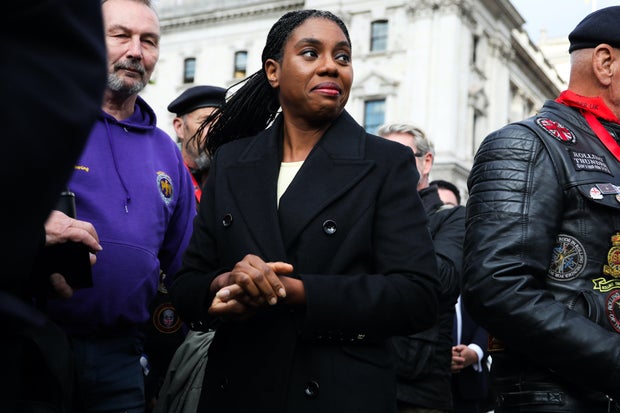
Beyond immigration numbers, the political debate extends to British identity and ethnicity. Research indicates rising support for definitions of citizenship based on ethnicity. Conservative leader Kemi Badenoch, herself from Nigerian heritage, counters arguments that narrow Englishness to ancestry. London’s Suella Braverman, affiliated with Reform UK, further fueled this debate by denying her own Englishness due to its ethnic connotations.
“I oppose letting these views take us back,” Badenoch asserted during a Conservative conference. She insists on moving forward without questioning the English identity of mixed-race individuals.
Steve Baker, representing Wycombe in southeast England, acknowledges residents’ concerns over demographic changes. Data shows white residents in some Wycombe areas have become minorities. Baker distances himself from ethnic nationalism, lamenting that these conversations have reached mainstream discourse.
Support for Reform UK peaked at 28% but recently fell to 22%, affected by internal issues and scandals. Further to the right, Restore Britain, endorsed by Elon Musk, attracts those feeling Reform UK isn’t radical enough. Polls show Restore at 9% support, highlighting ongoing battles for conservative allegiance.
Germany’s Right Wing
Germany’s political scene remains delicate given its historical ties to the Nazi regime. Post-World War II, established parties have enforced a firewall against far-right entities like the AfD, discouraging coalitions with groups espousing extremist rhetoric. Recently, the AfD, branded by some as extremist, gained prominence by capitalizing on economic discontent and historical grievances in Eastern Germany.
The AfD’s concepts of “remigration” have gained traction, advocating for sending foreigners back home. While the party claims to exclude those with German citizenship, security authorities note links between AfD members and extremist figures who favor ethnically driven remigration.
AfD’s election victories in regions like Saxony-Anhalt, where they achieved 43.8% of the vote, challenge the firewall’s strength. Their support stems from economic disparities, distrust in politics, and responses to the 2015-2016 migration crisis. The party’s support earned it second place nationally in the 2025 election among eastern states.
The AfD draws support across demographics, especially among industrial workers and small business owners. Tomasz Froelich from the AfD claims that continued growth could weaken attempts to exclude them from government. Despite its electoral strength, cooperating with AfD remains contentious for many mainstream parties.
Chancellor Friedrich Merz’s move towards restrictive immigration controls ignited protests, reflecting tension within Germany over how to engage with the AfD’s positions. While some far-right initiatives have gained traction within the Christian Democratic Union, ideological differences continue to hinder cooperation with the AfD.
France’s Political Shift
Marine Le Pen exemplifies changes in Europe’s right-wing politics. Polls suggest she could get 31% to 36% of the vote in an upcoming presidential election, leading her nearest competitor significantly. Over the years, she has rebranded her party, distancing from extremist associations once linked to the National Front, founded by her father.
By softening the party’s image and policies, she positioned National Rally as a legitimate political force, overshadowing the traditional right-wing Les Républicains, which lags with 9% support. An essayist from Le Figaro, Stéphane Azihari, contends that Le Pen appeals to disillusioned voters on both sides of the political spectrum.
“The fear of non-European immigration and concerns about Islam remain key motivators for National Rally voters,” Azihari explains.
France’s secularism tradition frames immigration and religion as critical issues. Surveys show that immigration concerns significantly impact National Rally’s support. Despite President Emmanuel Macron’s tougher immigration stance, National Rally retains appeal.
Across Europe, established parties face pressure to reconcile with rising populist sentiments. Surveys indicate a robust support base for far-right parties, compelling traditional parties to weigh the costs of shifting towards these ideologies.
 Middle East Tensions: Iran Downs U.S. Drone, Straits Conflict, and Regional Developments
 Priest’s Tragic Death During Livestreamed Mass in Ecuador
 President Trump Establishes Women’s Health Initiatives
 Efforts to Safeguard Midterm Elections Amid Potential Interference
 Concerns Over NLRB’s Influence and Supreme Court’s Stance
 Rep. Ilhan Omar’s Sister Questioned in Immigration Fraud Investigation