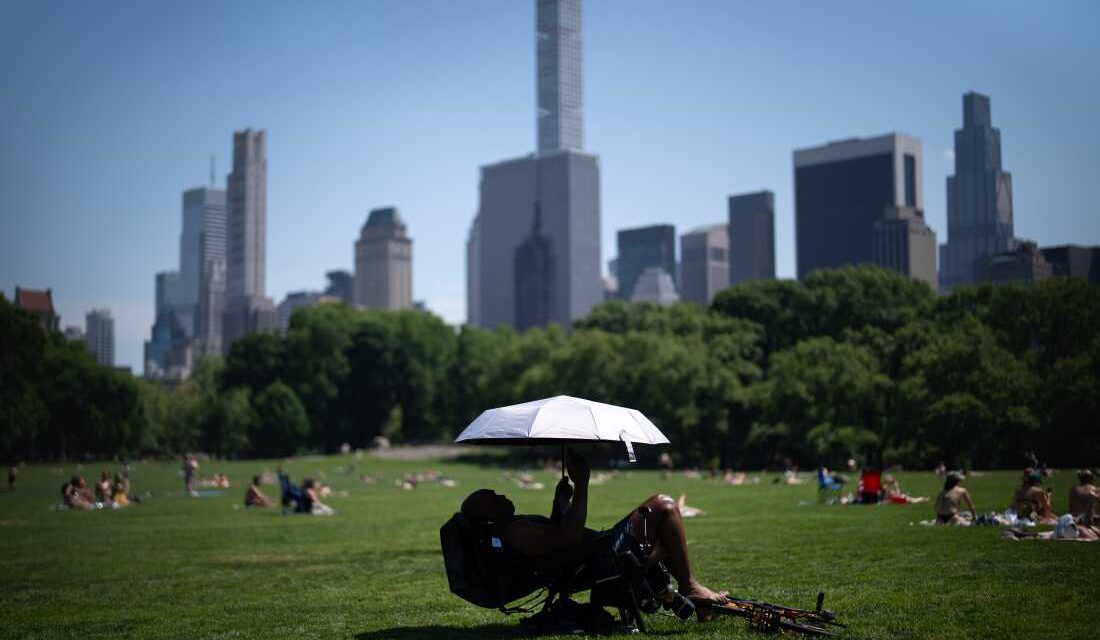
An umbrella provided shade during a heat advisory in New York City’s Central Park on May 19. This week, most U.S. states will experience extreme heat through the July 4 weekend, according to forecasters. The National Weather Service (NWS) reported that ‘dangerous to record-setting heat will expand across the eastern two-thirds’ of the country. Areas such as Ohio, parts of North Carolina, and Washington, D.C., will see severe impacts, particularly on individuals with respiratory problems and the elderly.
The NWS warned that combined high humidity levels could result in heat indices reaching between 100-110 degrees. ‘Much of the central and eastern U.S. is under a Moderate to Major HeatRisk, posing health risks for those lacking hydration or cooling.’ Parts of Iowa, Missouri, and Kansas are under extreme heat warnings.
A heat dome is the cause, trapping hot air over the region. This occurs when an intense air mass remains stationary, covered by a ‘lid’ above Earth’s surface. Bryan Putnam, NWS forecaster, explained that temperatures in the 90s to low 100s, combined with humidity, will make temperatures feel even hotter.
Extreme heat risks are expected to persist beyond July 4 and affect the West. Daytime temperatures may feel between 100 to 105 degrees as high temperatures persist into nighttime hours. Putnam advised vigilance for those gathering outdoors during July 4 festivities, including evening fireworks displays.
‘Evening temperatures might remain in the 80s and 90s, with added humidity keeping heat indices high,’ he said. ‘The absence of sunlight won’t necessarily bring relief.’
Precautions and Preparedness
Officials warn those in the heat’s path to take precautions and prepare for several days of excessive heat. The Missouri State Emergency Management Agency recommended everyone ‘plan accordingly and limit prolonged outdoor exposure if possible.’ Immediate action should be taken if signs of heat-related illness appear.
According to the Centers for Disease Control and Prevention (CDC), heat-related illnesses include heat exhaustion, heat rash, and heat stroke. Symptoms range from nausea, headaches, confusion, and dizziness. Alister Martin, New York City’s Health Commissioner, emphasized the preventable nature of heat strokes.
‘As an ER doctor, I’ve seen heat strokes occur on days like these,’ Martin shared through social media. The CDC notes that without emergency treatment, heat stroke can be fatal or lead to permanent disability. Symptoms include confusion, altered mental state, slurred speech, and loss of consciousness.
Martin urged the use of air conditioning, staying hydrated, and checking on neighbors during heatwaves.
 Details Emerge on Trump’s Response During WHCA Dinner Incident
  Ohio Governor Race: Ramaswamy’s Chances Decline on Prediction Markets
  FAA Ground Stops, Paramount Settlement, and ICE Shooting Incident
  Details Emerge on Shooting of Venezuelan by ICE Officer in Austin
  Controversial Removal of ‘The Bluest Eye’ from Georgia School Libraries
  Legal Battle Over Media Ban at White House