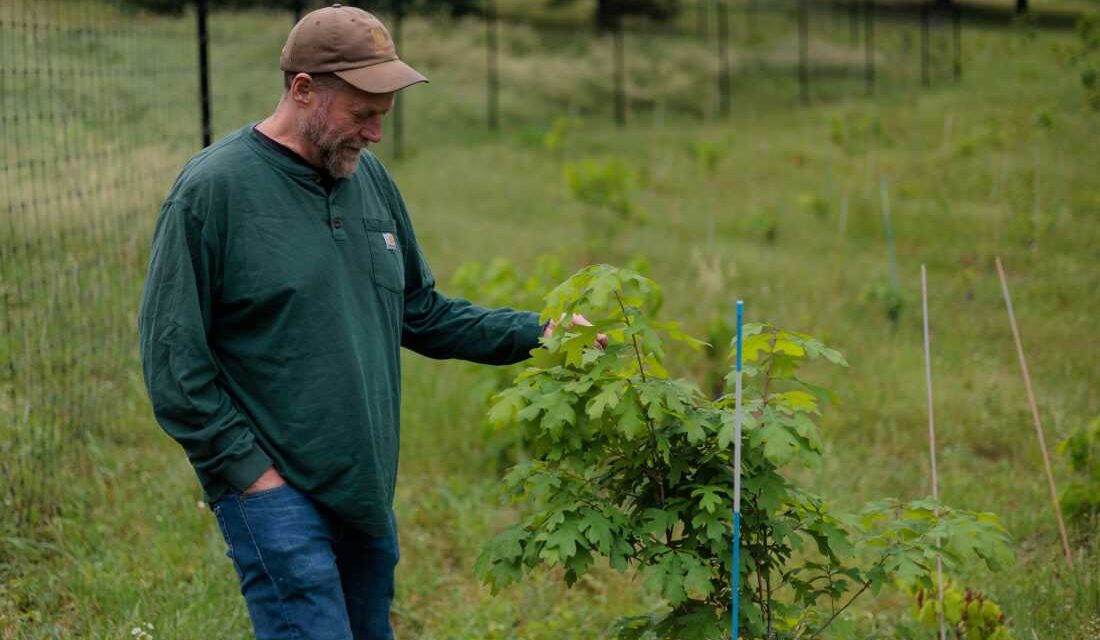
Morgan Grove, a former Forest Service researcher, examines a white oak tree at the Cylburn Arboretum in Baltimore, planted by agency scientists. In Baltimore, unlike in some other cities, when dead trees fall, they are not dumped in landfills; instead, they are sent to a sorting and recycling facility. This facility turns old wood into furniture, flooring, and other products, generating revenue for the city and becoming a model for others. However, Shaun Preston, manager of Camp Small, the facility, notes that it might have failed without support from U.S. Forest Service scientists.
Preston states, “When this program started, the U.S. Forest Service was right there to offer expertise to help us with research and develop ideas. And then the Forest Service suggested exploring how we could grow Camp Small and elevate it.” Over 1,000 Forest Service employees work in multiple research and development facilities across the United States. They work on diverse projects, such as restoring native trees in Hawaii and preventing wildfires in Montana.
On March 31, the Forest Service announced a reorganization, potentially closing facilities for research, including the Baltimore one. President Donald Trump’s 2027 budget proposed reducing Forest Service research funding from $309 million in 2026 to $0. More than 100 facilities are currently evaluated for closure, according to NPR analysis.
Forest Service Chief Schulz stated at a budget hearing on April 16, “We aim for fiscal responsibility and bringing employees closer to the land they manage.” Plans involve relocating the agency’s headquarters from Washington D.C. to Salt Lake City, Utah, and closing regional offices. Schulz emphasized, “We prioritize managing national forests for their intended purposes and ensuring maximum value to taxpayers.” The closures impact 229 employees, and the Forest Service intends to consolidate them into one location in Colorado.
NPR obtained documents revealing that the government already owns most facilities proposed for closure. Leased buildings, sometimes at minimal cost, risk closure despite cheap research and local benefits. Notably, one facility costs the Forest Service $1 million annually in rent.
Dr. Paul Hessburg, a Senior Research Ecologist, describes how his lab in Wenatchee, Washington, owned outright, remains cost-effective. Deferred maintenance costs for facilities owned by the agency total nearly $3 billion, while maintaining assets like roads and trails costs over $8 billion.
Employees worry the reorganization may lead to job losses. Some threatened to quit if relocated, halting long-term regional research vital to localized ecological studies and leading to loss of irreplaceable data.
Morgan Grove, retired in 2025, said research reliant on local conditions cannot easily transfer to new sites. He emphasized the importance of relationships between federal scientists and local partners, claiming relocation disrupts essential community integrations.
Union representatives assert the reorganization violates legislative conditions on government fund reprogramming without committee approval, arguing the proposal threatens the Forest Service’s research legacy.
Scientists stress the organization’s importance, with the potential dissolving affecting information on forest health, wildfire protection, and urban green spaces.
NPR invites information on federal agency reorganizations and the Forest Service. Contact Chiara Eisner at [email protected].
 Winter Heating Costs: EIA’s 2026 Forecast
  Tropical Storm Rachel Approaches West Coast with Potential Hazards
  Storm Updates: Isaias and Pacific Developments
  California’s Coastal Flooding Highlights El Niño Challenges
  Supreme Court Debate on Climate Change Lawsuits Poses Economic Risks
  Southern California Braces as Tropical Storm Rachel Approaches