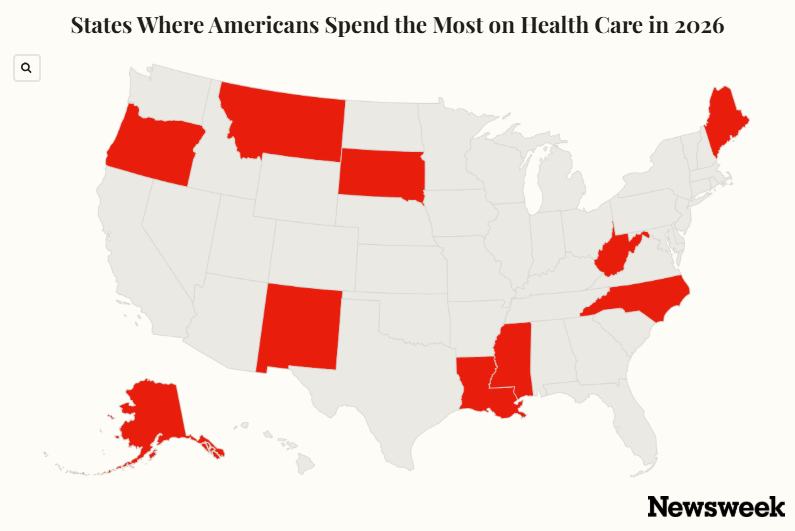
Americans are spending an increasing portion of their income on healthcare. Over the past two decades, costs have surged dramatically, affecting states differently. A new WalletHub report highlights these disparities. In some states, healthcare takes up more than 10% of income, while in others it is half that. Nationwide, average annual out-of-pocket healthcare spending rose from $811 to $1,514 over 20 years, surpassing inflation and straining household budgets.
Why It Matters
Rising costs force many Americans to rethink financial decisions, sometimes leading to delayed or skipped care. Even in less expensive states, incomes often fail to alleviate the burden, especially with broader inflation impacting housing and food.
What To Know
WalletHub ranked all 50 states on the share of median household income spent on medical services and medications.
Top 10 States Where Americans Spend the Most on Health Care:
- Alaska — 10.08%
- Oregon — 9.32%
- Maine — 9.30%
- Mississippi — 9.18%
- West Virginia — 9.14%
- New Mexico — 9.07%
- North Carolina — 8.78%
- Montana — 8.62%
- South Dakota — 8.60%
- Louisiana — 8.13%
States Where Americans Spend the Least on Health Care:
- Utah — 5.11%
- Virginia — 5.62%
- California — 5.64%
- New Jersey — 5.81%
- Nevada — 5.87%
New York ranks 15th overall, with residents spending about 7.98% of their income on healthcare.
What’s Driving the Differences
Higher spending isn’t always linked to lower incomes. Often, it results from high medical costs. Analyst Chip Lupo from WalletHub noted that sharp cost increases hinder access to essential care. Even with lower-than-average prices, lack of income growth makes it hard for residents to cope, especially with inflation affecting all budget aspects.
Alaska: Residents spend 10.1% of their income on healthcare. This correlates with some of the highest U.S. prices for doctor visits and medications. Despite having a relatively high median income, costs outweigh those in other states.
Oregon: Spending in Oregon is around 9.3%. This primarily stems from high service costs, such as doctor and optometry visits.
Maine: As the third highest, Maine faces high medical prices combined with lower-than-average incomes. This raises the percentage of income spent on care.
How the Rankings Were Calculated
The WalletHub report analyzed five key spending elements: doctor, dentist, optometrist visits, and prescription costs for ibuprofen and insulin glargine. Researchers compared these costs to each state’s median household income to assess care’s financial burden. Data came as of April 30 from the Council for Community and Economic Research and the U.S. Census Bureau.
Analyst Michael Ryan commented that averages mask those at the bottom of income distributions, who may spend much higher percentages on healthcare.
What Americans Can Do To Lower Health Care Costs
While location significantly influences healthcare costs, there are strategies to mitigate expenses. By maintaining health insurance and using preventive services, you may reduce long-term costs. Experts also recommend building an emergency fund and leveraging tax-advantaged health savings accounts.
Alex Beene of the University of Tennessee at Martin notes that reduced healthcare facilities diminish competition and increase travel distances for care. Moreover, being insured doesn’t cover all healthcare costs, highlighting the complexity of budgeting for medical expenses.
What Happens Next
Regional differences in healthcare affordability may prompt policy focus as costs rise. Without pricing, insurance, or income improvements, high-cost states might see a greater portion of income dedicated to medical care.
Kevin Thompson of 9i Capital Group stated that healthcare inflation extends beyond insurance premiums. It’s embedded in the system and reflects back on consumers.
 New Insights into Suicide Prevention Strategies
  Philadelphia Reports Measles Exposures at Airport and Hospital
  Legal Challenges Arise Over GLP-1 Receptor Agonists and Vision Loss Risks
  States Move to Restrict Tianeptine Amid Growing Concerns
  Potential Changes in Medicare Reimbursement for Lab Tests
  Understanding and Addressing the Complexity of Suicide