Healthcare workers in eastern Congo expressed concerns over inadequate protection and training amid a rapidly spreading Ebola outbreak. This outbreak involves a rare strain of the virus in a remote, vulnerable area. The region’s ongoing conflict with armed groups complicates the crisis further. Local leaders reported that militants linked to the Islamic State killed at least 17 people in Alima village, located in the Ituri province, the epicenter of the outbreak.
The World Health Organization (WHO) has assessed the global risk as low, yet the identification of ‘patient zero’ remains elusive. A local resident, Justin Ndasi, lamented, “It’s truly sad and painful because we’ve already been through a security crisis, and now Ebola is here too.”
In Bunia, the city where the first known Ebola death in this outbreak was reported, health supplies are being brought in by air. Despite this, residents face shortages. Masks are scarce, and the price of disinfectants has quadrupled, reaching 10,000 Congolese francs (about $4).
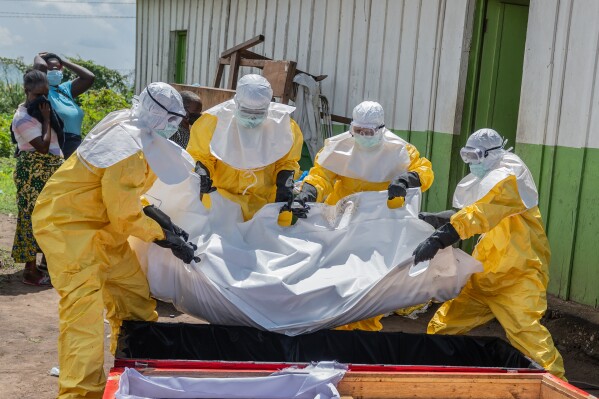
At a treatment center in Rwampara, grieving families witnessed healthcare workers in protective gear conducting burials for suspected Ebola victims. This follows a sudden onset of symptoms that were initially thought to be other illnesses, such as malaria.
“He told me his heart was hurting,” shared Botwine Swanze, a mother who lost her son. Symptoms of Ebola include fever, vomiting, diarrhea, muscle pain, and potential internal and external bleeding. The virus spreads through contact with bodily fluids like vomit, blood, or semen.
WHO Declares Global Health Emergency
The WHO declared the outbreak a public health emergency of international concern due to its size and speed. WHO’s official warns the outbreak might last at least two more months. The Bundibugyo strain of Ebola spread undetected for weeks, confirmed in Congo’s Ituri and North Kivu provinces, and also in Uganda.
Anaïs Legand from the WHO emergencies program remarked, “given the scale, we are thinking that it has started probably a couple of months ago.” They have confirmed 51 cases, with 139 suspected deaths and nearly 600 possible cases. Yet, experts believe these figures underestimate the true number of infections.
While Congo’s health ministry has the experience to manage outbreaks, previous ones predominantly involved more common Ebola strains. A vaccine for the Bundibugyo strain may take another six to nine months, said Dr. Vasee Moorthy, WHO adviser.
The Strain on Eastern Congo’s Health System
Eastern Congo faces challenges due to conflict, displacement, and a failing health system. Dr. Lievin Bangali of the International Rescue Committee noted that underfunding has weakened response efforts.
Adding to the issue, funding cuts from the Trump administration have hampered foreign aid. U.S. Secretary Marco Rubio announced plans to fund 50 emergency clinics in affected zones, pledging $23 million in support.
Struggles in Affected Regions
In Bunia, daily activities at schools and churches continue, yet mask-wearing is common. In other parts of Ituri, suspected Ebola patients share hospital wards with other patients.
Trish Newport of Doctors Without Borders reported no isolation wards at Bunia’s Salama hospital amidst a growing number of cases. “Every health facility they called said, ‘We’re full of suspect cases. We don’t have any space.'”
In Mongbwalu, where the first death occurred, life seems normal, but public hygiene measures are lacking. Dr. Didier Pay reported roughly 30 patients in Mongbwalu General Hospital. They face staffing shortages and inadequate training, according to Dr. Richard Lokudu, the hospital’s medical director.
In Goma, where conflict complicates the situation, WHO’s Anne Ancia remarked on the challenging environment.
International Response
Meanwhile, a U.S. national diagnosed with Ebola is isolated in Germany. The patient’s condition remains confidential as a comprehensive examination continues. The U.S. is coordinating with various agencies for patient care and transport.
 Pope Leo XIV Undergoes Successful Lung Surgery
  Joe Manganiello’s Struggle with a Life-Threatening Health Condition
  Illegal Immigrant Couple Accused of Jewelry Thefts Across Four States
  Pennsylvania at the Center of U.S. Measles Outbreaks
  Hurricane Simon and Storm Rachel Cause Destruction in Mexico and the U.S.
  U.S. Officials Reassess Timeline for Potential Chinese Invasion of Taiwan