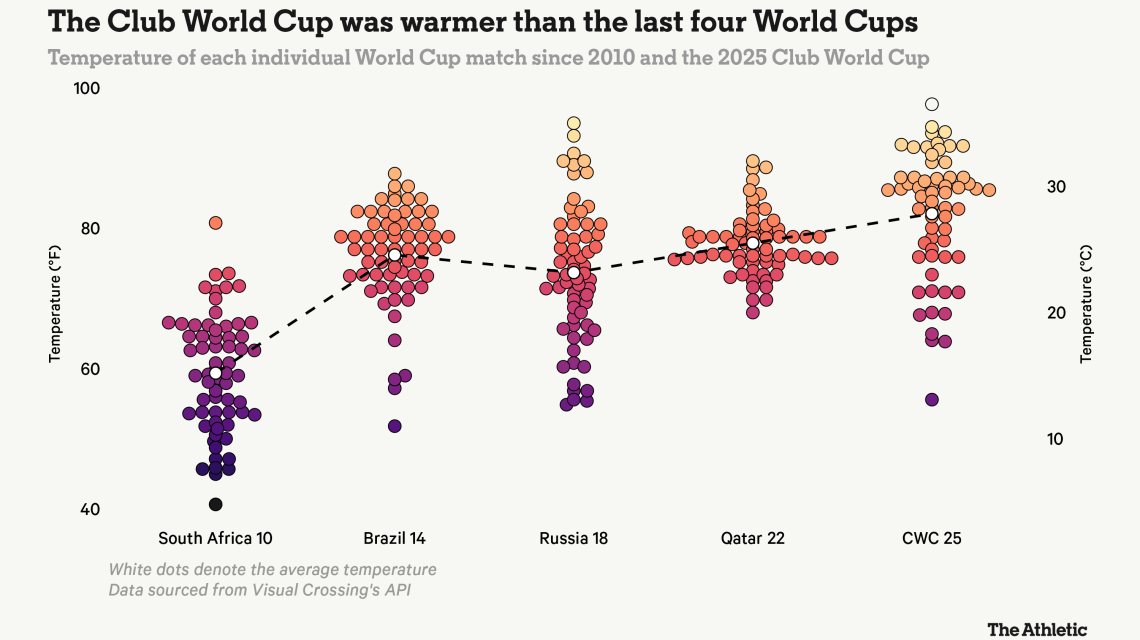
The World Cup is expected to bring intense heat, with many games projected to occur above 90F (32C), making it potentially the warmest edition since the United States hosted the tournament in 1994. During that event, over 80% of matches took place before 5pm local time, under a scorching afternoon sun, infamously leading to draining conditions. A notable instance was Mexico’s victory over the Republic of Ireland in Orlando, where the temperature reached 117F at pitch level.
Recent experiences suggest the upcoming tournament will be similarly challenging. Last summer’s Club World Cup in the U.S. acted as a preliminary test, indicating warmer conditions than the previous four World Cups. However, only five stadiums from that event will be used for the upcoming World Cup, which is spread across the U.S., Mexico, and Canada.
The Athletic examined a decade of hourly weather data for each fixture’s scheduled kick-off time, plus an hour on either side, during a seven-day window around the match dates. For example, analysis for a quarter-final in Kansas City on July 11 at 8pm considered the weather between July 8 and July 14 across the past ten years.
AT&T Stadium in Dallas tops the temperature charts at an estimated average of 90F (32C), closely followed by Estadio BBVA in Monterrey. The peak is expected on July 14, with a semi-final match at AT&T Stadium estimated at 93F (34C). However, Dallas, Atlanta, and Houston offer closed roofs with air conditioning, easing conditions.
Open-air venues pose more challenges, with temperatures hitting 100F at six of the 16 stadiums during kick-off time at least once in the past decade. As Aaron Mentkowski, chief meteorologist for WKBW-TV Buffalo, notes, conditions intensify at pitch level, especially with light winds and full sunshine. Fields absorb solar radiation and radiate heat back, while stadiums protect fields from wind, leading to stagnant heat.
The Athletic collaborates with Mentkowski as the weather expert throughout the tournament, offering daily forecasts and analyses of key weather events affecting games and teams.
Extreme heat hinders performance levels, complicating high-energy play styles. Germany’s forward Jurgen Klinsmann recalled how challenging it was to maintain rhythm under such conditions during their 1994 Chicago match against Bolivia.
Teams take unique preparation measures. Norway’s players, pictured training in North Carolina’s sun, adapted to conditions starkly different from their Nordic climate. Despite this, Mentkowski suggests players from cooler climates can acclimate after residing briefly in hotter conditions. Most Norwegian players train outside their home country, used to similar weather most of the year.
Thunderstorms present logistical difficulties. U.S. thunderstorm protocol mandates suspending matches if lightning occurs within an eight-mile radius of a stadium, triggering a 30-minute countdown reset with each additional strike.
Mentkowski identifies Miami and Mexico City for frequent afternoon storms and lightning, while Kansas City risks severe storms during the severe weather season. Boston, Philadelphia, and New York might experience increased heat and humidity, with occasional storms.
Such breaks during matches disrupt team momentum, challenge concentration, and complicate nutrition and hydration strategies.
Adapting to environmental factors is critical for World Cup success, perhaps as vital as player quality, team cohesion, or tactical arrangements.
 Steve Lotysz: From Medinah’s Gates to Presidents Cup Artistry
  Calls Grow for Ireland’s Soccer Team to Boycott Matches Against Israel
  Is NHL Preseason Necessary?
  Impact of World Baseball Classic on Paul Skenes’ Performance
  Ronald Acuna Jr. Suffers Injury During Game Against Cincinnati Reds
  Joe Burrow’s Unexpected Post-Game Recovery