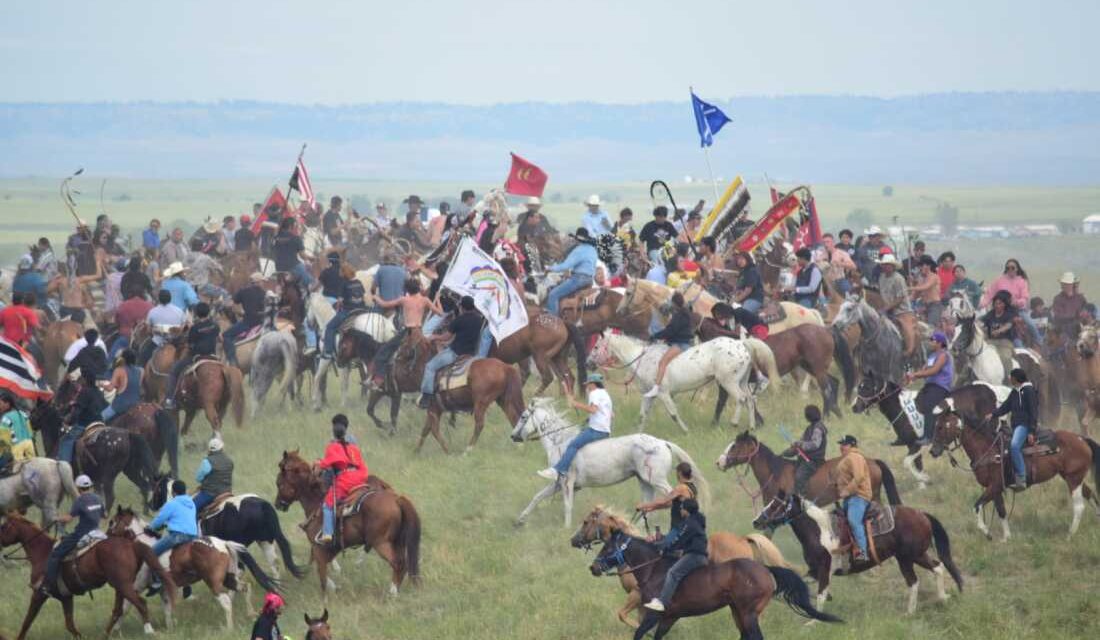
Under the broad Montana sky, numerous members and descendants of 19 tribal nations recently gathered at one of America’s historic battlefields, the Little Bighorn Battlefield National Monument. They came to witness Native American riders on horseback navigating the terrain where their ancestors once triumphed against the U.S. Army’s 7th Cavalry, led by Lt. Col. George Armstrong Custer, 150 years ago.
The scene mirrored history as riders in headdresses, regalia, tank tops, and T-shirts raced across the dusty land, circling atop a hill. They carried tribal flags, symbolizing unity, reflecting the solidarity that led to their ancestors’ victory on June 25, 1876. Gaby Strong, of Sisseton-Wahpeton and Mdewakanton descent, stated, “It was so important then, 150 years ago. It’s important today still. Our victories are still possible.”
Custer’s mission aimed to confine Native Americans to reservations. Following the 1874 gold discovery in the Black Hills, Indigenous people outside reservations were ordered to report to U.S. field offices or face hostile action. Leaders, including Crazy Horse and Sitting Bull, organized resistance, resulting in several battles in present-day Montana and South Dakota.
Christopher Eagle Bear from the Sicunga Lakota, Rosebud Sioux Tribe explained, “Crazy Horse went from band to band, leader to leader, sharing this idea of coming together for a bigger cause.” In 1876, Custer pursued a camp comprising the Oceti Sakowin (Sioux), Cheyenne, and Arapaho, aided by Arikara and Crow scouts.
Custer divided his 700-man force into three columns to encircle the village, which had grown to around 8,000 people by June 25. He opted for a premature attack, fearing the tribes would disperse. This decision proved fatal. “It was early morning when Custer’s platoon appeared over the ridge,” Eagle Bear recounted, referencing the battle, known to the Lakota as the Battle of Greasy Grass.
“They say the battle lasted as long as it took you to make a cup of coffee and drink it,”
Eagle Bear noted. Custer’s troops were outnumbered, with 268 casualties including Custer. On the Native side, fewer than 100 were killed, among them women and children. Custer’s defeat spurred fear and outrage across the country, prompting a U.S. government change in Indian policy towards forced assimilation.
Within three years, the first off-reservation federal Indian Boarding School opened in Carlisle, Pennsylvania, beginning a century of effort to erase Native traditions. “They realized they couldn’t destroy us head on. So they took our children,” Eagle Bear explained.
Youth Leaders and the Future
At the site, commemorations included an encampment along the Little Bighorn River, drawing tribal members for storytelling and ceremonies. Eagle Bear camped there to set an example for future generations from the Rosebud Sioux Tribe. “In time, these kids will celebrate the 200th anniversary and recall their experiences,” he stated.
Around the camp, traditional activities and gatherings reflected the event’s significance. Children played lacrosse with traditional sticks amidst drumming sounds. The Sicunga Youth Council organized these activities. Ashlen Bonshirt noted their efforts, “We’ve planned activities like lacrosse and yoga, ensuring everything runs smoothly.”
The camp aimed to educate the younger generation about history beyond the typical school curriculum. Thirteen-year-old Gianna Larocque-Mahto expressed, “We didn’t learn the Dakota perspective in school. It’s crucial to learn from all viewpoints.”
Champion Marquez, an 18-year-old from the Cheyenne, volunteered in various roles, expressing optimism for future generations learning about the Battle of Little Bighorn. “Seeing everything here reassures us that we’re still here,” he added.
 Cindy Crawford’s Son Presley Gerber Dies at 27
  Navy Veteran Generald Wilson Reflects on Emotional National Anthem Performance
  Fat Bear Week: A Unique Annual Tradition at Katmai National Park
  Lucas Museum of Narrative Art: A New Cultural Landmark
  Northlight Theatre’s ‘The Front Page’: A Satirical Nod to Chicago’s Journalistic Past
  Monday Screencaps: Musings and Sports Insights