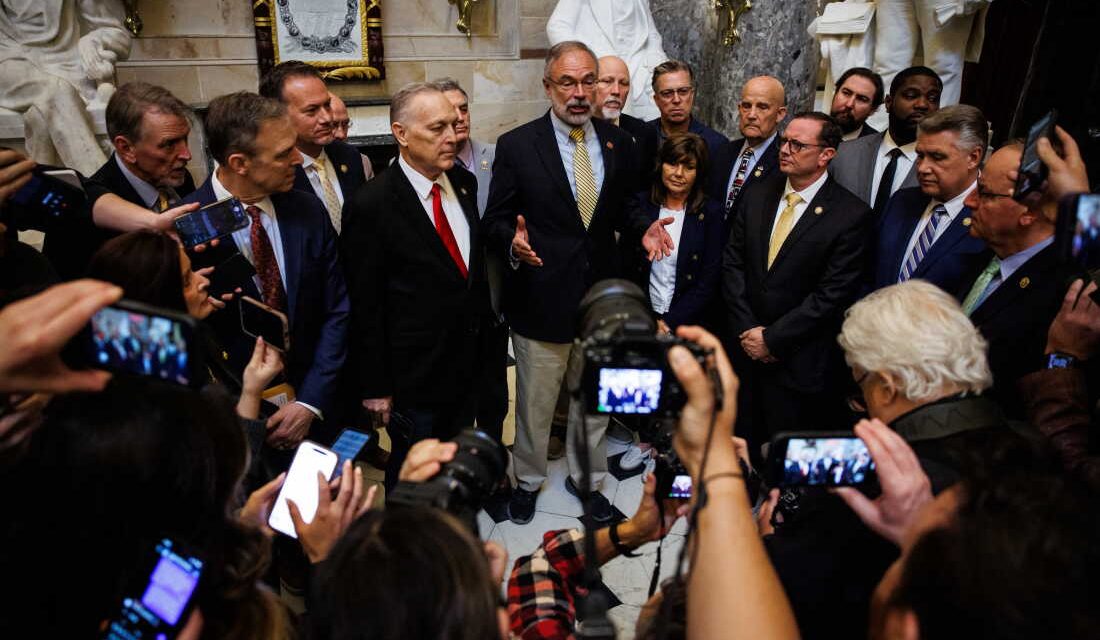
The House Freedom Caucus, a prominent group of conservative lawmakers, is currently experiencing significant changes. Some of its key members are leaving, which has sparked interest in how the group will evolve. Formed over a decade ago by Tea Party conservatives, the caucus aimed to shift the Republican Party’s policies further to the right. Despite changes in legislative priorities, its influence remains strong.
Under President Trump, the group’s members were elevated to top roles, with Mick Mulvaney and Mark Meadows serving as White House chiefs of staff. John Fleming also held a senior position. Many founding members have left or are not returning next term; the caucus will soon lose about ten members.
Matthew Green, an academic who studied the group, noted its resilience despite losing members after recent elections. A central principle is involving rank-and-file lawmakers in policymaking, which often frustrates Republican leadership. Initially, executive branch accountability was a focus, especially under former Speaker John Boehner, who allegedly worked too closely with Democrats.
With Trump in office, the caucus aligned closely with his administration, although there were instances of dissent, such as on issues like federal surveillance and deficit-expanding legislation. Fleming claimed the group laid the groundwork for Trump’s rise.
Political figures like Florida Governor Ron DeSantis emerged from the group, reflecting its combative style. Currently, three members are running for governor with Trump’s endorsement.
Former Speaker John Boehner criticized the group as chaotic, while Fleming defended its approach against traditional party actions. Under Boehner, members felt excluded from the decision-making process, leading to the caucus’s formation. Since then, the group has leveraged parliamentary tactics to influence legislation.
Rep. Chip Roy emphasized the group’s commitment to delivering on promises. He highlighted their unity on maintaining accountability. As some members leave, internal disagreements have emerged over aligning with Trump’s policies.
Former member Matt Salmon expressed disappointment in the caucus’s shift towards supporting Trump, contrasting it with its founding objectives. Green noted that the group’s evolution sparked departures among members who prioritize party principles.
Tensions exist between maintaining influence and pursuing policy goals, particularly in relation to executive power. Green emphasizes this ongoing struggle within the caucus as members face choices about their roles.
Turnover in Congress brings an opportunity for the group’s renewal. Rep. Ralph Norman believes the caucus can enhance its value, particularly through attention to budget issues. New leadership offers fresh perspectives, despite the loss of seniority.
Fleming speculated that future Republican leaders might return to more traditional party norms. Roy remains optimistic about influencing politics from outside Congress. The transition suggests ongoing challenges and opportunities for the House Freedom Caucus in shaping the Republican Party’s ideological direction.
 FBI Investigation Into Alleged Pay-to-Play Scheme Involving Sen. Susan Collins
  Trump Pressures Senate Republicans to End Filibuster to Prevent Democratic Dominance
  Jared Golden Endorses Mike Lawler for Re-election
  Data Centers and Their Role in the Midterm Election
  Jewish Democrats in Michigan Show Support for GOP Candidate
  Mayor Mamdani and President Trump Discuss Housing and Immigration in NYC Meeting