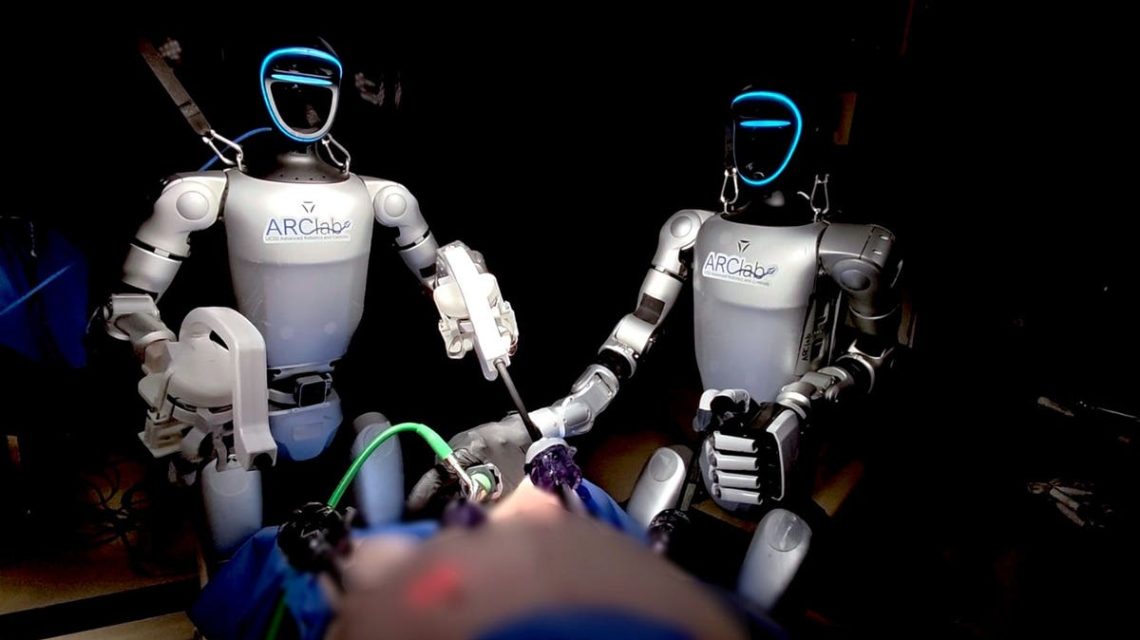
A groundbreaking medical event unfolded as UC San Diego doctors utilized humanoid robots to perform remote gallbladder surgery on a pig. Valued at $20,000 each, these robots marked a significant stride towards addressing surgeon shortages and enhancing global healthcare access. Yet, this advancement also sparked discussions about AI privacy concerns, particularly with the emergence of an $8,000 home robot designed for chores.
During a preclinical trial, surgeons successfully guided robots through two gallbladder procedures. These robots mimicked the surgeons’ movements rather than making autonomous medical decisions, and no human patients were involved. Unlike traditional bulky robotic systems, these five-foot humanoid machines employed standard surgical tools within a typical operating room environment. The experiment provides insight into how specialists might use mobile robots to operate in remote or underserved locations.
An AI may identify heart risks during a routine ECG.
Mobile humanoid robots may soon offer specialist surgical care in remote clinics, field hospitals, or other isolated areas. UC San Diego’s Jacobs School of Engineering facilitated robots in two live surgeries on pigs. The outcomes, reported this month in the journal Nature, involved the robots conducting gallbladder removal with precision, handling delicate tasks efficiently.
The trial aimed to test whether these humanoid robots can manage standard surgical tools with sufficient control to complete operations, and it succeeded. Nonetheless, it revealed areas needing improvement before human trials commence.
Researchers developed ‘Surgie,’ a modified Unitree G1 humanoid robot, for these surgeries. Standing five feet tall and weighing 60 pounds, Surgie’s compact size contrasts sharply with existing robotic systems reaching up to 1,800 pounds. Large systems often necessitate extensive setup and space. Surgie fits seamlessly into rooms designed for human medical staff, thanks to adapters allowing it to grip laparoscopic instruments.
A surgeon can control Surgie remotely, aligning its movements with familiar workspace and workflow. Surgeons operate the robots from a console, ensuring they replicate movements accurately at the operating table. Mobile robots could transfer between rooms or smaller facilities, enhancing flexibility, especially in areas with limited medical resources.
The cost of the base Unitree G1 robot is approximately $13,500, excluding surgical adapters and remote-control equipment. In contrast, specialized surgical systems such as Da Vinci robots range from $700,000 to over $3 million.
Modern robotic systems facilitate precise surgical tasks but often remain in fixed locations and require specialized equipment. Humanoid robots offer versatility, operating in human-designed spaces and using standard hand-held tools. They could enhance access to surgical procedures globally where specialists are scarce.
UC San Diego researchers believe remotely operated humanoid robots could bring critical procedures to communities with minimal medical staffing. While human operators control robots currently, future versions could function as autonomous assistants, capable of supporting tasks or retrieving tools during surgeries.
Challenges remain, including latency, reliability, and responsiveness. A delay between a surgeon’s actions and robot response could jeopardize precision, particularly over long distances. Researchers must refine these systems to ensure reliable performance across numerous procedures and establish backup contingencies.
Autonomous robots could one day manage surgical tasks independently. However, this presents complex challenges, especially regarding accountability and safety. Protocols and security measures must address unauthorized access and ensure uninterrupted operations.
Understanding the potential benefits and safety measures of humanoid robot-assisted procedures is crucial. While they can offer the convenience of accessing specialist care without long travel, ensuring safety remains a priority. Patients need assurances regarding operational control and contingency plans during robot-assisted surgeries.
Two humanoid robots completing surgery may seem unsettling, but such technology addresses critical healthcare needs. This experiment is an initial step toward deploying compact, flexible robotic systems to enhance surgical care access. Improving system reliability and safety measures is imperative before considering human trials.
Would you consider a surgery performed via humanoid robot if it significantly reduced your waiting time for care? Your thoughts are valuable, and we welcome them at CyberGuy.com.