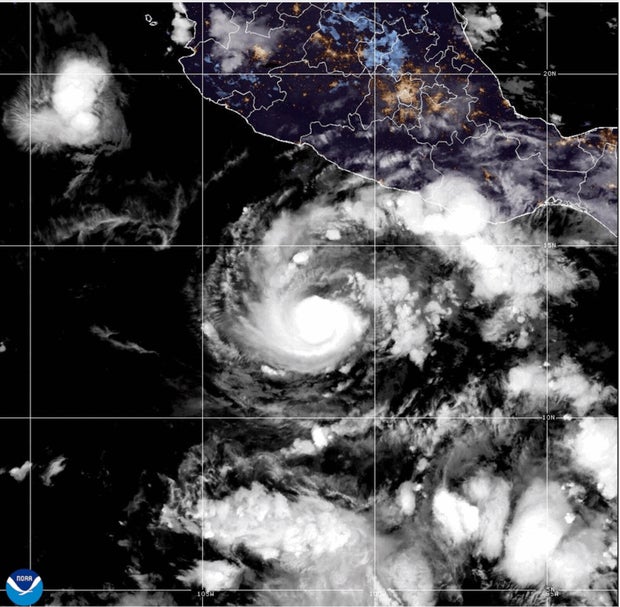
Hurricane Trudy brought significant rain and strong winds to Mexico’s Pacific coast on Sunday. It affected parts of the country’s western and southwestern states that were already hit by Hurricane Simon the previous week. The National Hurricane Center, based in Miami, alerted that hurricane and tropical storm conditions might arise in areas under weather alerts on Sunday morning and afternoon. Coastal regions in Michoacán, Colima, and Jalisco were advised to prepare for potentially life-threatening flooding and mudslides due to the expected rain.
A hurricane warning remained for the area from Manzanillo in Colima state to Cabo Corrientes in Jalisco. In the latest early Sunday update from the hurricane center, Trudy had maximum sustained winds of 105 mph, classifying it as a Category 2 hurricane. It had earlier reached a Category 3 status late last week but has since weakened. By Sunday, Trudy was positioned about 135 miles west-southwest of Manzanillo and was moving northwest at 10 mph.
The storm’s center was anticipated to stay near the Mexican coast through Sunday evening before going south of the Baja California Peninsula. A tropical storm warning was still in effect for Las Islas Marias, but a warning for the coast east of Punta San Telmo to Lazaro Cardenas was canceled. The Mexican Navy urged caution due to high waves and heavy rain, which could heighten the risk of rising rivers, flooding, and landslides, especially in vulnerable areas.
Colima authorities indicated that while the risks were manageable, the ground’s saturation from earlier storms could lead to damage. Trudy was expected to bring 4 to 8 inches of rain through the weekend, with isolated amounts reaching up to 12 inches along the coast of Michoacán, Colima, and Jalisco. Steep terrain areas were particularly susceptible to severe flooding and mudslides.
Other Pacific Storms
Elsewhere, Typhoon Champi was moving past Guam as a massive super typhoon with fierce winds reaching Category 4 strength. By Sunday, Champi was 200 miles west of Guam, moving westward at 14 mph, according to the National Weather Service. There was a possibility it could intensify to a Category 5 super typhoon by early Monday.
Guam and Rota continued under a typhoon warning, though the tropical storm warning and typhoon watch for Tinian and Saipan were canceled. The governors of Guam and the Northern Mariana Islands asked for emergency disaster declarations on Friday.
On Saturday, President Trump approved an emergency declaration for Guam to enable the Federal Emergency Management Agency (FEMA) to coordinate federal disaster relief efforts. FEMA noted that federal disaster assistance was prepared to support the territory of Guam’s response following Typhoon Champi.
Airports, harbors, and some health facilities in Guam and nearby territories were closed, with resources unlikely to arrive for three to five days, according to Saturday’s FEMA updates. These territories are still in recovery from earlier super typhoons Sinlaku and Bavi, which occurred in April and July.
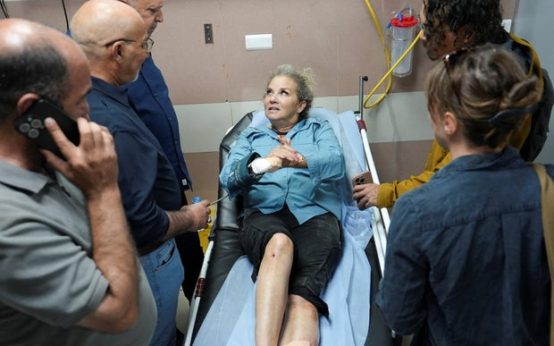 U.S. Ambassador Condemns Attack on American Journalist in West Bank
  Trump’s Diesel Deal with Russia: Analyzing the Impact and Opposition
  European Parliament Takes Action Against Muslim Brotherhood
  Pope Leo XIV Thanks Faithful Following Surgery
  Tragic Incident in Ecuador: Priest Dies During Mass
  Incident at Alberta Military Base