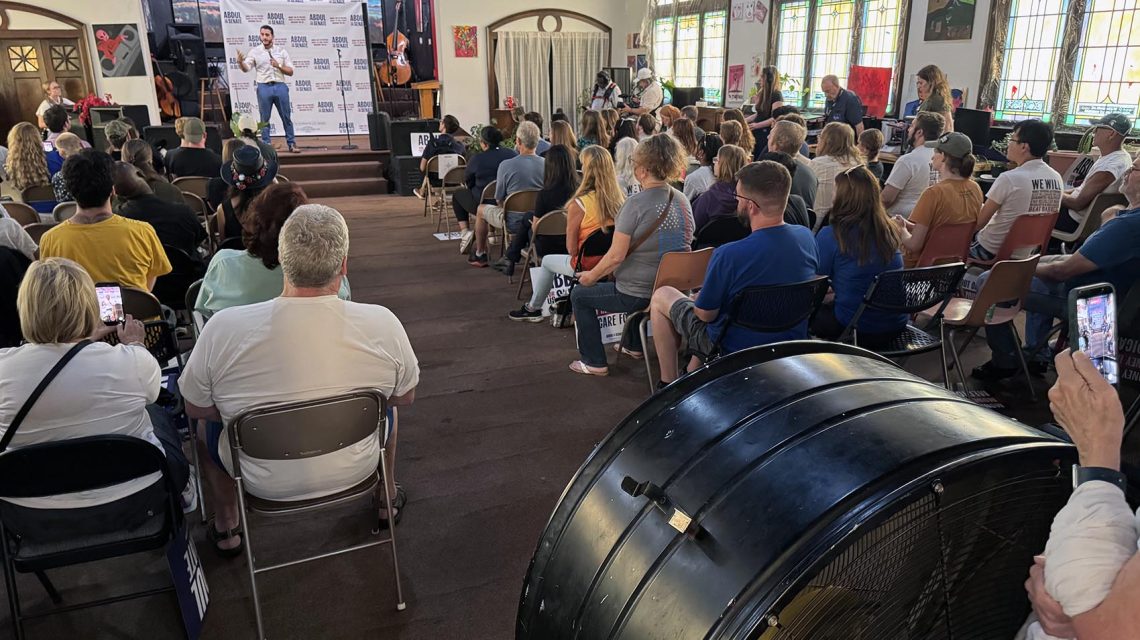
For two days last week, I experienced the intensity of the Michigan U.S. Senate Democratic primary. The contenders were centrist Congresswoman Haley Stevens and progressive former public health director Abdul El-Sayed. Producer Sam Weber and I traveled to Detroit to learn more about this high-stakes race. We wanted to understand how these candidates measure up on the ground, the key concerns in Michigan, and the implications for Democrats in the upcoming general election.
How Do the Candidates Compare?
Both Stevens and El-Sayed presented themselves better in-person than in media portrayals. Stevens demonstrated remarkable stamina. This aligns with her main promise to tirelessly advocate for Michigan. El-Sayed brought vibrant energy, appealing to young and progressive voters with his intelligence and enthusiasm.
We observed El-Sayed speaking at The Fledge, a community space inside a converted church. Around 100 people attended, amid an eclectic setting of art and a unique ambiance. In contrast, Stevens addressed a local Chamber of Commerce crowd of 23 people. Later, she met with the ‘Blue Brigade,’ a group of Democratic women, in a more intimate setting of 16 participants.
Key Concerns for Michigan Voters
Three major issues emerged for the voters: money in politics, the economy, and Israel. Among El-Sayed’s supporters, United Auto Workers member Jason Peck emphasized economic challenges. Dorice Steiner from the University of Michigan expressed her frustration with political funding, calling for an end to big money’s influence. First-time canvasser Andy Rogers noted the need to shift control away from those with financial power.
Supporters of Stevens voiced similar concerns. Carpenter Tyler McCastle highlighted ongoing struggles with healthcare. Cindy Groene, a Detroit-area homeowner’s association president, acknowledged the necessity of campaign funding despite her distaste for it. She wished Stevens would avoid AIPAC support. Zach Nessel, the attorney general’s son, raised concerns about rising antisemitism affecting the party.
According to Doug Mulkey, owner of The People’s Kitchen in Lansing, working to pay fair wages while dealing with inflation has made him a keen observer of the race.
Another topic gaining traction is data centers, impacting political dynamics in central and southern Michigan. This issue looms over the 7th Congressional District race, where progressive William Lawrence seeks victory against expectations.
Impact of the Centrist-Progressive Divide
Despite a clear division between centrists and progressives, only one Democrat we met refused to support the other candidate in the general election. The divide seemed less hostile in person compared to online discourse, and less entrenched than past Democratic rifts.
The looming threat for Democrats is Republican candidate Mike Rogers. He has navigated his campaign to gain Trump’s endorsement without fully embracing MAGA Republicanism.
Implications for the Future
Observers will rush to interpret the primary’s outcome as indicative of the Democratic Party’s future. In Michigan, this race serves as an interesting data point. Progressives and democratic socialists continue to gain ground nationwide. While the primary adds to these trends, it doesn’t define the party’s direction.
Supporters from both sides recognized valuable ideas in their opponents. The dual paths presented on the ballot suggest Democrats are evaluating potential winners alongside desired qualities in candidates. There is a call for change and new strategies, with El-Sayed seemingly benefiting from this desire.
The question remains: Post-primary, can Democrats unite on common ground?
Support a free press and civil discourse for a healthy democracy.
 Republican Senator Criticizes Trump’s $5,000 Check Proposal
  Trump’s Approach to Iran at the United Nations
  Trump’s Triumphal Arch Controversy
  Concerns Over Abdul El-Sayed’s Potential Senate Role and National Security
  Kentucky Governor Andy Beshear Discusses Tariffs, Faith, and Political Ambitions
  Sunday Highlights: Lane Kiffin, Nancy Mace, and College Football Drama