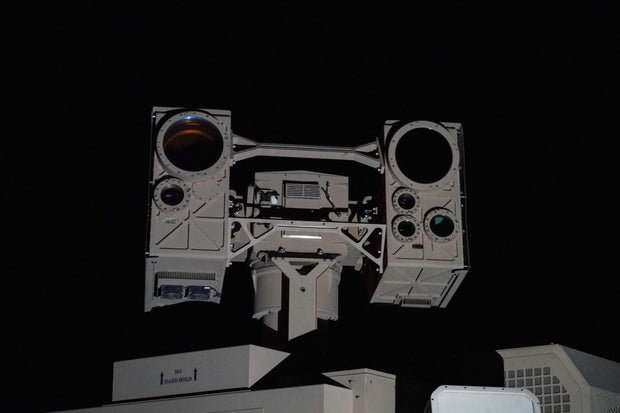
McAllen, Texas — Military officials have observed a notable decrease in drone activity at the southern border following the deployment of a high-energy laser weapon system. Released by CBS News, this technology saw a 75% reduction in drone incursions in the Rio Grande Valley since its debut on August 25-26. It followed months of preparation which included an incident leading to the temporary closure of El Paso’s airport earlier this year. Coordination with the Federal Aviation Administration ensures civilian safety during the use of the laser.
Function and Deployment of the Laser System
The U.S. military currently employs jamming technologies to redirect numerous daily drones. However, the new laser can effectively disable drones considered threats. Since January, over 300 drones linked to cartels have been neutralized, with eleven taken down by lasers within ten days. Army Col. Robert Felicio acknowledged the significant change in activity since the system’s introduction. Though he did not specify drone activity levels, Air Force Gen. Gregory Guillot disclosed approximately 1,000 monthly drone incursions at the border.
Col. Felicio noted other factors could have influenced the recent dropdown, such as cartels shifting routes. Still, the reduction coincided with the laser’s deployment. An exclusive test observed by CBS News showed soldiers dispatching a quadcopter over a field near the border wall. Inside a vehicle equipped with the laser, they tracked the drone using an Xbox controller and visual feed until they deployed the laser, which caused a brief flash upon contact.
Operational Features and Limitations
The laser, a version of the LOCUST system from AeroVironment, is deployed along the border, emphasized by a $465 million contract awarded to the company for its high-energy laser systems. Army Lieutenant Owen Farquer noted the controller’s intuitive design for soldiers with gaming experience. However, the laser has limitations and is less effective during atmospheric disturbances like rain. Navy Admiral Daryl Caudle advocates for increased investment in laser weapons, citing cost-effectiveness. Despite potential civilian risks, such as aircraft misfires, careful coordination with the FAA ensures safe deployment.
Strategic Impact Against Cartels
Cartels commonly utilize drones to scout U.S. personnel positions for drug and human smuggling across the border. Army Lt. Col. Ray Richards reports that disrupting drones financially impacts cartels. He highlighted the significance of a 75% reduction in the drones’ capabilities. The National Counterterrorism Innovation, Technology, and Education Center identified 221 incidents involving drones between 2021-2025, resulting in 77 fatalities across Mexico.
Military officials consider the potential drone threat to 8,000 U.S. service members and law enforcement at the border. Felicio and Richards demonstrated the minimal separation between U.S. positions and drone activity in the Rio Grande Valley. Drones often return multiple times, where lasers offer long-term solutions by permanently disabling them. Felicio underscored the laser’s impact, preventing repeat incursions from cartel drones.
 Israeli Ambassador Criticizes NYC Mayor’s Protest Calls Ahead of Netanyahu’s UN Visit
  Reflecting on U.S. Withdrawal and Afghanistan’s Transformation
  Diplomatic Efforts Amid Ongoing Conflict: Witkoff’s Strategy in Ukraine
  Royals Maintain Composure Amid Return of Harry and Meghan
  AfD Claims Electoral Victory in Saxony-Anhalt
  Diplomatic Efforts in Ukraine Following Kushner and Witkoff Meetings