New Yorkers are being advised to stay indoors and limit outdoor activities. This is due to a dangerous combination of extreme heat and heavy smoke from Canadian wildfires, which has worsened air pollution across the state.
The Air Quality Health Advisory is active as smoke from multiple Canadian wildfires travels south, covering parts of the state with haze. This has led to a rise in fine particulate pollution known as PM2.5. The National Weather Service (NWS) has alerted that these conditions coincide with a heatwave, pushing temperatures to nearly 100 degrees Fahrenheit and heat index values above 100 in parts of the New York City area.
Weather and Air Quality Alerts
The New York State Department of Environmental Conservation and Department of Health have widened air quality advisories across the state. As the smoke moves east, the most significant impacts are expected in Western New York, Central New York, and the Eastern Lake Ontario region. New York City, Long Island, the Lower Hudson Valley, and adjacent downstate areas are anticipated to face “unhealthy for sensitive groups” conditions. Some upstate areas may encounter more severe “unhealthy” air quality.
New York City’s Emergency Management has projected that air quality levels could reach unhealthy thresholds by Thursday. Forecasts estimate the Air Quality Index (AQI) could rise to about 200, indicating that adverse health effects are possible for all individuals.
Health Risks and Recommendations
Forecasters and health officials warn that fine particle pollution from wildfire smoke can cause coughing, dizziness, fatigue, and shortness of breath. It can also exacerbate asthma, heart disease, and other chronic ailments. The NWS and public health authorities have recommended residents reduce or avoid outdoor activities, keep doors and windows closed, use air conditioning or air purifiers if accessible, and wear N95 or KN95 masks if exposed to the outdoors.
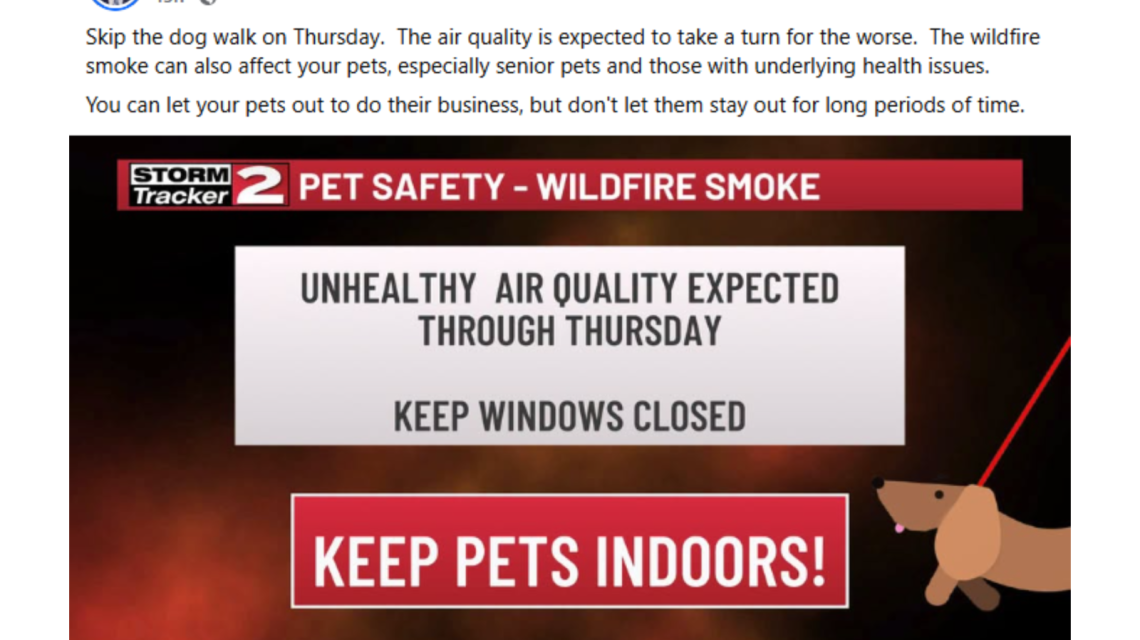
Meteorologists caution that routine activities like outdoor exercise or pet walking may increase smoke exposure during poor air quality periods. They emphasize that air quality could decline rapidly if smoke descends closer to the ground.
City’s Response to Crisis
New York City officials have activated extensive measures to help residents handle the dual heat and smoke crisis. The city’s heat emergency plan is sustained, with “hundreds of cooling centers” operational across the five boroughs. Residents can find nearby centers through an online locator or by calling 311.
The city has also expanded free KN95 mask distribution, enhancing protection against smoke particles. Masks are available at Brooklyn and Queens public library branches, select Manhattan, Bronx, and Staten Island libraries, and stations for the subway, Long Island Rail Road, and Metro-North.
City agencies have adjusted operations in response. New York Mayor Zohran Mamdani announced increased outreach for vulnerable populations. Meanwhile, schools, parks, and other departments have rescheduled events and moved activities indoors as conditions evolve.
Residents are encouraged to register for Notify NYC emergency alerts and to check on elderly neighbors and others who might be vulnerable. Mayor Mamdani and state officials stress treating the heat and smoke combination as a serious health threat. Residents are advised to stay in cool, air-conditioned spaces, remain hydrated, avoid vigorous outdoor activity, and closely monitor air quality updates until conditions improve.
 Far-Left Groups Allegedly Organize Protests in Austin
  Austin Police Release Footage of Arrest After ICE-Involved Shooting
  Himalayan Pilgrimage: A Couple’s Narrow Escape and Lingering Questions
  Religious Trends: Decline in Affiliation with LDS Church
  UC Berkeley Student’s Harrowing Encounter Raises Questions About Safety and Legal Protections
  Tinley Park Updates Downtown Parking Rules Amid Increased Congestion