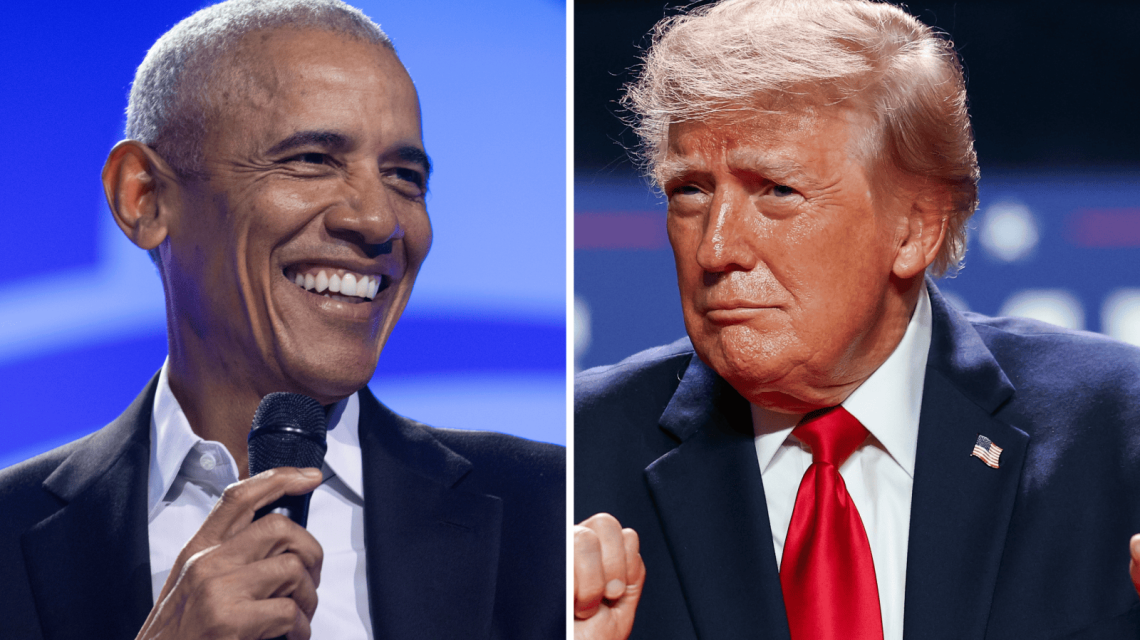
Former President Barack Obama is unveiling new campaign initiatives as President Donald Trump travels the country ahead of the 2026 midterm elections. With November 3 fast approaching, both Democrats and Republicans strive to sway undecided voters and boost enthusiasm within their own ranks to secure majorities in the House of Representatives and the Senate.
Current polling gives Democrats an advantage in the House, while control of the Senate is seen as a fiercely contested race, potentially hinging on a few states. Democrats are optimistic about the national climate, believing that Trump’s low national approval ratings and economic issues related to living expenses might favor them in these elections. Historically, the incumbent party tends to lose seats in the midterms when it faces unpopularity.
Conversely, Republicans aim to strategically leverage Trump, whose popularity remains strong among Republicans despite slipping overall approval, to galvanize turnout among the conservative base. Polls indicate that enthusiasm has waned among their supporters. Natalie Baldassarre, Press Secretary for the Republican National Committee, conveyed to Newsweek that the midterms focus heavily on turnout, asserting, “There’s no one who energizes and engages voters like President Donald J. Trump.” Republicans are exploring unconventional strategies to challenge typical midterm precedents, with the president traveling extensively to promote his historic achievements and provide candidates a boost to defy historical trends.
As of now, Trump has conducted rallies in nearly two dozen states this year, covering both primary and general election periods. His recent rallies have occurred predominantly in conservative states such as Nebraska, Oklahoma, and Tennessee. Nevertheless, appearances have also been made in crucial battleground states like Ohio and North Carolina, both engaged in intensely competitive Senate races.
Throughout the week, Trump has scheduled several rallies, including those in Youngstown, Ohio on Monday; Wasilla, Alaska on Tuesday; Bullhead City, Arizona and Kalispell, Montana on Wednesday; and Dalton, Georgia on Friday. In September, Senate Majority Leader John Thune from South Dakota highlighted that Trump’s presence in Republican territories aids in mobilizing voters. He acknowledged that, across the nation, Trump’s rallies are pivotal in turning out voters under his influence.
Obama approaches his campaigning with more selectiveness. Despite endorsing numerous candidates, he currently plans a single rally in Detroit, Michigan, to support Democrats Jocelyn Benson and Abdul El-Sayed in gubernatorial and Senate races. He is also featured in advertisements for El-Sayed and Scott Colom, contesting for the Mississippi Senate.
Earlier this year, Obama surprised constituents by appearing alongside Democratic candidates James Talarico and Gina Hinojosa in Texas’ Senate and governor’s races. Last week, Obama joined a private fundraiser with Democrats, reported by The Washington Post. During the event, Obama admitted, “There are states right now in play that I would not have imagined being in play.” He exhibited surprise at polling showing James Talarico ahead of Ken Paxton.
Anticipated are additional campaign activities involving Obama. The Associated Press reports that he has recorded over two dozen advertisements, set for release with more campaign stops soon to come.
Meanwhile, former President Joe Biden has endorsed candidates ahead of the midterms but hasn’t publicized involvement in campaign events.
Regarding Democratic prospects in the House, flipping a few seats would result in a congressional majority, given Republicans hold 218 seats while Democrats possess 214. According to a Reuters/Ipsos poll conducted between September 30 and October 5, Democrats lead by 7 points on the generic ballot, a primary measure for House control assessment. Out of 3,526 registered voters, 44 percent intended to vote Democratic versus 37 percent Republican. The poll’s margin of error is plus or minus 1.7 percentage points.
Further, a poll by YouGov and The Economist, surveying 1,173 likely voters from October 2 to 5, gives Democrats an 11-point lead. Democrats were favored in prediction markets for securing the House, possessing a 90 percent probability on Kalshi and 91 percent on Polymarket.
In the Senate, Democrats face a challenging path to victory, requiring four seat flips against a Republican majority of 53-47. The GOP holds seats in Maine and North Carolina amidst traditionally competitive states, requiring Democrats to reverse losses in states where Trump won by double digits in 2024 to secure a Senate majority.
Polling indicates competitiveness among Democrats in traditionally Republican territories like Alaska, Iowa, Kansas, Ohio, and Texas. RealClearPolitics’ averages show promising Democratic standings in crucial races.
Prediction markets provide Democrats a 62 percent chance of Senate victory on Kalshi, with a 64 percent probability on Polymarket.
Upcoming campaign events and activities involving Obama and Trump may unfold shortly as candidates execute final outreach efforts amid actively started early voting.
 Elon Musk’s Political Contributions and Their Impact on Upcoming Elections
  Republicans Eye Michigan Senate Seat in Tight Race
  James Talarico’s Campaign Launches TV Ads Targeting Biden and Paxton
  President Trump Considers Firing Ambassador Kimberly Guilfoyle
  Georgia Gubernatorial Debate and Election Dynamics
  Katie Zacharia Begins Her Role as New White House Press Secretary