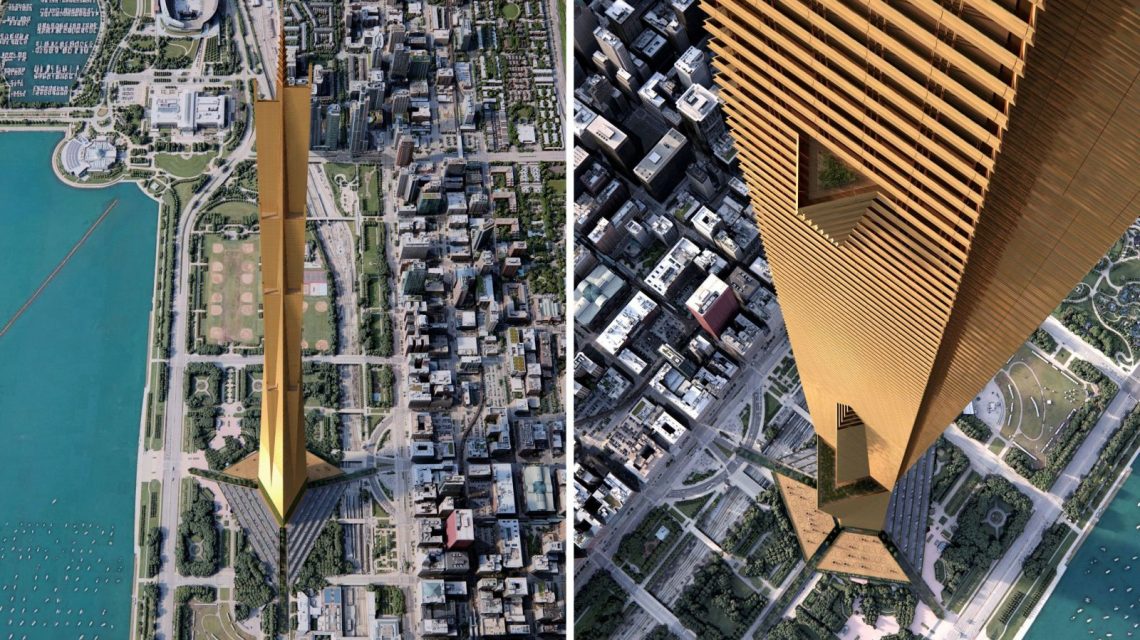
Nearly 70 years ago, Frank Lloyd Wright introduced an ambitious concept for a skyscraper a mile high, a structure that would have overshadowed every building on Earth. Known as “The Illinois,” this design envisioned a 528-story “city in the sky,” poised to redefine urban living and architectural possibilities. Although it was never constructed, Spanish architect David Romero has brought this concept to life through detailed 3D renderings. These renderings were created for the Frank Lloyd Wright Quarterly magazine, shedding new light on the visionary project.
Romero’s reconstructions of The Illinois offer a detailed look at what the megastructure might have resembled over the Chicago skyline. This revived interest arises amid debates about the future of architecture. Gordon Gill, responsible for Jeddah Tower, soon to be the world’s tallest building, suggests the future is not in building higher but in revitalizing existing structures. He emphasizes updating buildings to ensure longevity. The American Institute of Architects echoes this, noting that reusing buildings can prevent up to 75 percent of the carbon emissions related to new construction due to the absence of embodied carbon in new materials.
Reviving Wright’s Vision
David Romero, working on a project called Hooked on the Past, focuses on recreating unrealized architectural designs. “I’d wanted to tackle the Illinois for a long time; it’s Wright’s most famous unbuilt design,” Romero shared. He approached this project only after studying completed Wright towers like the S.C. Johnson Research Tower and Price Tower. These studies offered the references needed to complete Wright’s vision.
The project was vast, requiring months of effort during Romero’s spare time. It represents the second-largest model in his project portfolio. Romero aimed to position the tower realistically within the Chicago skyline rather than in isolation, enhancing the realism of his renderings.
Intricacies of The Illinois
Creating the renderings revealed new insights into the structure’s internal logic. “What surprised me most is how uncompromising the scale actually is once you model it against real dimensions,” Romero noted. The tower’s design wasn’t merely about height; it embodied a thoughtful architectural rationale. Wright’s unique tapered tetrahedral form wasn’t decorative but functional, addressing wind forces at towering heights. This design was an extension of principles Wright had previously tested in smaller structures.
Romero believes some of Wright’s engineering concepts are surprisingly relevant today. The taproot foundation and tripod-shaped design model modern principles used in supertall buildings. However, other elements, such as the atomic-powered elevators, wouldn’t comply with current building standards. Romero perceives The Illinois as a conceptual exploration rather than a feasible project for today’s construction environment.
Lessons for Modern Urban Planning
Wright’s vision offers valuable lessons for urban planning. The Illinois envisioned combining housing, offices, commerce, and transportation within a singular vertical development. Such a model aligns with contemporary arguments for high-density, mixed-use developments over suburban sprawl. Wright’s idea of a “city in the sky” packed diverse urban amenities into a self-sufficient vertical footprint, advocating for transit-oriented development over horizontal expansion.
As for its potential impact on Chicago’s skyline, Romero believes The Illinois would have been transformative. “At a mile high, it wouldn’t have shared the skyline with anything—it would have redefined what the skyline was,” he asserted. This explains why the design continues to capture architects’ imaginations, challenging modern perceptions of height, density, and urban development.
 Florida Startup Develops AI Bot to Reduce Construction Dispute Costs
  Tuya Smart’s Doova Robot: Enhancing Senior Care at Home
  Growing Concerns Over AI in the Tech Community
  Challenges in Robot Food Delivery: A Day in Washington, D.C.
  Understanding Google’s New Gmail Verified Sender Program for Political Emails
  FAA Tests Elroy Air’s Chaparral Drone for Rural Delivery Solutions