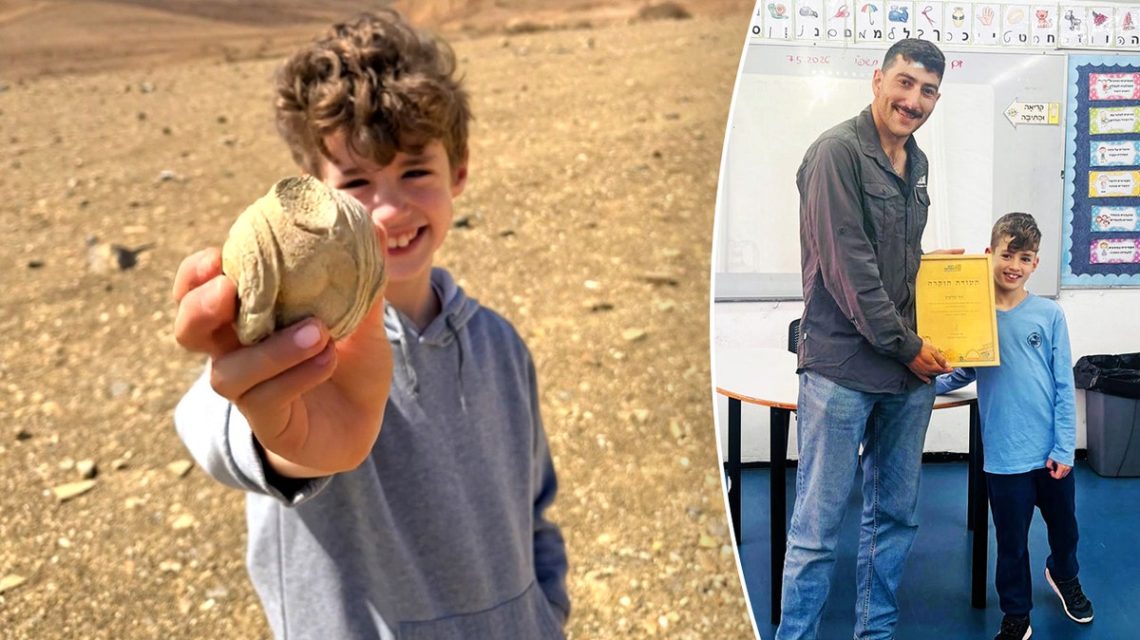
An 8-year-old boy from Rehovot, Israel, made an unusual discovery during a family trip to the Ramon Crater in the Negev Desert. Dor Wolynitz found a fragment of a 1,700-year-old Roman statuette, according to a release by the Israel Antiquities Authority (IAA) on May 11.
During the weekend retreat, organized by a paratrooper reserve unit, Wolynitz encountered the fragment dating to the fourth century A.D.
Amazing Christian figurines unearthed in 1,500-year-old desert graves.
Wolynitz explained to the IAA, “I was searching for special items on the ground to present in class. I suddenly noticed an intriguing stone with stripes and picked it up.”
The boy shared the find with Akiva Goldenhersh, an archaeologist from the IAA’s Antiquities Theft Prevention Unit, who was part of the trip. Goldenhersh described the artifact as depicting part of a human figure with carefully sculpted fabric folds.
The fragment measures six by six centimeters and is made from phosphorite, a mineral found in the Negev, suggesting local production.
Goldenhersh initially thought it resembled a fossil, but realized it had sculpted fabric details. The artifact, discovered on the Negev Desert’s surface, is considered rare due to its casual discovery outside of controlled excavations.
The statuette potentially represents the Roman god Jupiter or the Nabatean god Zeus-Dushara. The finding reflects a mix of local traditions and classical world influences.
The area around Ramon Crater was a crucial section of the ancient spice route during the Roman and Nabatean eras, facilitating cultural exchanges.
Erosion or natural shifts likely caused the fragment to move from its original site. Desert conditions in the Negev sometimes preserve artifacts, making surface discoveries possible.
Test your knowledge with our latest lifestyle quiz.
Wolynitz turned the artifact over to Israel’s National Treasures Department, receiving a certificate for “good citizenship.” Goldenhersh praised the boy and his family’s actions, stressing their role in cultural asset preservation.
Dor Wolynitz is considered a model of civic responsibility.
 Alan Ritchson Faces Backlash Over Political Remarks
  Himalayan Pilgrimage: A Couple’s Narrow Escape and Lingering Questions
  Former CEO Sentenced for Bank Fraud and Sanctions Evasion
  Russia’s Potential Incursion Into Estonia: NATO’s Resilience Under Scrutiny
  Senators Urge Action to Free Imprisoned Journalist in Iran
  Trump’s Address at UNGA and Key Political Developments