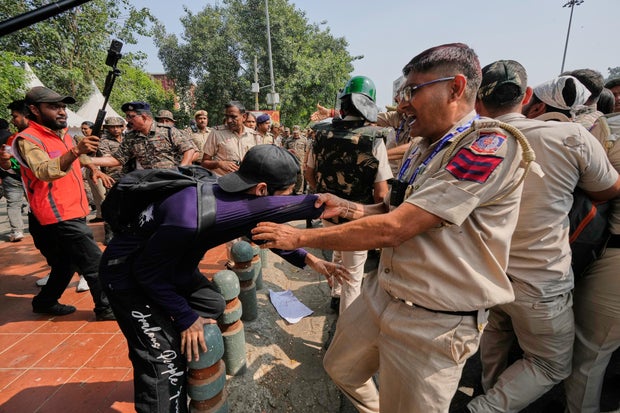
Indian authorities implemented a broad security crackdown in New Delhi on Saturday, detaining thousands of protesters. The action was aimed at the youth-led “Cockroach” movement opposing a controversial revision to the voter list that has sparked anger towards Prime Minister Narendra Modi’s government and election authorities.
Security Measures and Detainment
Police disrupted the protests before they commenced, intercepting participants heading to Jantar Mantar, the designated protest location. Many were chased, detained, and transported to temporary detention centers. Key leaders of the movement, opposition politicians, and student activists were detained en route, effectively hindering the protest’s start.
Efforts to stop the demonstrations spilled beyond the intended venue, with police stopping vehicles at checkpoints entering Delhi. Jantar Mantar was fortified with barricades, while anti-riot vehicles with tear gas launchers were stationed strategically. Mobile internet restrictions and blocked city access added further obstacles for the protesters.
The police stated that permission for the protest was denied as the request was submitted late. A spokesperson for Modi’s party described the protesters as “anarchic elements,” asserting that their efforts were suppressed.
The Scale of Government Crackdown
The vastness of the crackdown highlighted government intent to suppress the rapidly growing protest movement involving thousands of youths, supported by opposition parties. Previous demonstrations by the “Cockroach” movement over exam paper leaks prompted the resignation of Modi’s education minister in July.
Leaders such as Abhijeet Dipke, Saurav Das, and Ashutosh Ranka were detained upon arriving in Delhi from Mumbai. A video showed authorities boarding their flight to detain them, preventing leadership of the protests.
“The planned interception by Delhi Police aims to cripple today’s peaceful demonstrations before reaching the protest site,” stated the movement.
Authorities imposed restrictions on gatherings and activities near the protest site, even affecting journalists covering the event.
Democracy Concerns Amid Protests
Still, some protesters managed to break through police barriers, voicing dissent against Modi and election officials. Tanya Negi, who traveled from Mumbai, stated, “We are in a democracy, yet peaceful protests are crushed by force. Shouldn’t we fight for our rights?”
The police’s forceful response was notable in a country where Modi’s administration has recurrently employed arrests and limits on public gatherings to control dissent.
Oppositional Criticism of Government Actions
Opposition leaders renewed their critique of the government’s actions, alleging suppression of dissent and questioning the presence of democracy in the nation. Lawmaker John Brittas stated, “Total siege over the city. Citizens are being driven out,” and was later detained.
The opposition sees the Election Commission’s Special Intensive Revision as disenfranchising millions. They demand the resignation of the Chief Election Commissioner and an end to the voter list changes which reportedly removed over 130 million names. The government refutes these claims, arguing the revision targets duplicate and invalid entries.
Implications for Modi and Future Elections
For the “Cockroach” movement, the voter list dispute represents a chance to advance its cause further. Originating online in May, the movement has gained traction through visible protests, ending with the unprecedented resignation of a minister.
While Modi’s government contends with these protests midway through his third term, the political impact remains unclear. Although national elections are scheduled for 2029, upcoming state elections will assess the ruling party’s standing amid ongoing dissent.
 Israeli Advances in Battlefield Medicine Aid U.S.
  Hurricane Isaias Impact and Related Events
  White House Press Secretary Calls Out Michigan Senate Candidate
  Democrats Consider Impeachment if They Win the House
  DSA-Aligned Candidates: A New Trend in State Legislative Races
  Senator Fetterman’s Complex Political Alignment