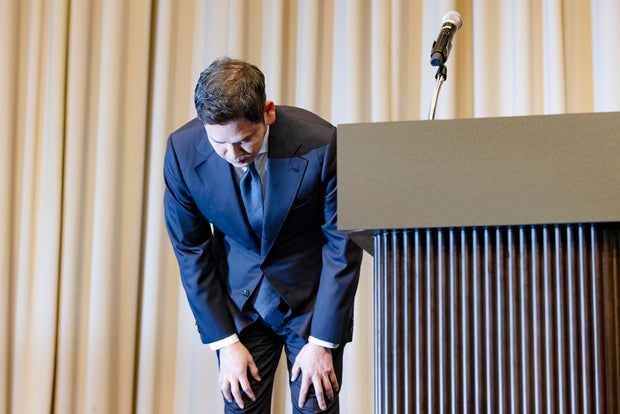
Seoul, South Korea — South Korean retail tycoon Chung Yong-jin, chairman of Shinsegae Group, issued a second apology following a public backlash against a recent Starbucks marketing campaign. The controversy emerged as the campaign seemed to mock victims of a 1980 military crackdown on pro-democracy protesters.
During a televised statement, Chung bowed three times and asked for forgiveness from the families of democracy activists killed by the former military regime, as well as the general public. Shinsegae Group holds a 67.5% stake in Starbucks Korea.
I take … very seriously the fact that many people felt deep pain and anger because of Starbucks Korea’s inappropriate marketing campaign,Chung stated.
The controversy began when Starbucks attempted to promote a large tumbler size, referred to as a “tank,” by designating May 18 as “Tank Day.” This date coincides with the anniversary of a democratic uprising in Gwangju, which was violently suppressed by military forces, resulting in hundreds of casualties.
The marketing campaign further fueled outrage with the slogan “Thwack it on the table!,” perceived as an allusion to a 1987 police statement attempting to cover up the torture death of student activist Park Jong-chol. In response, Shinsegae promptly canceled the campaign and dismissed the chief executive of Starbucks Korea. The police have also launched an investigation following complaints from families of Gwangju victims.
Chung pleaded with the public not to target Starbucks staff, emphasizing that management, not employees, bear responsibility. No major incidents at Starbucks locations have been reported.
Jeon Sangjin, a senior executive at Shinsegae Group, indicated the company has not found conclusive evidence of deliberate intent to mock the pro-democracy movement. However, some employees declined to surrender their smartphones during an internal review. Any staff found acting with malicious intent will face dismissal, pending results from the police inquiry.
The public outrage has spurred calls for boycotts, supported by officials like Interior and Safety Minister Yoon Ho-jung, who stated Starbucks products would be excluded from government events due to the company’s “anti-historical behavior.” According to a Shinsegae official, sales have significantly declined amid the controversy.
President Lee Jae Myung criticized the campaign on social media, condemning the “inhumane and disgraceful behavior” that disregards community values, human rights, and democracy.
The Gwangju crackdown happened months after General Chun Doo-hwan’s coup in late 1979. While official records attribute around 200 deaths to the incident, activists claim the true figure is much higher. Chun’s authoritarian rule incited mass protests in 1987, eventually leading to South Korea’s transition to democracy through constitutional reform and direct presidential elections.
 Trump Administration’s Plan to Resettle Afrikaners as Refugees
  Trump’s Vision on Iran, AI, and Global Security at the UN
  Lithuanian Leader Seeks U.S. Military Commitment Amid Rising Russian Threats
  Italian PM Giorgia Meloni Skips UN General Assembly Amid Growing Tensions
  Calls Grow for Ireland’s Soccer Team to Boycott Matches Against Israel
  New U.S. Military Bases Planned in Greenland Amid Strategic Security Deal