Washington — The Supreme Court’s conservative justices appeared supportive of Catholic preschools challenging Colorado’s preschool funding requirements.
These preschools refuse to sign a pledge welcoming students with transgender or gay parents, raising questions about religious freedom and state conditions for taxpayer funds. Colorado’s Universal Preschool Program, launched in 2023, offers 15 tuition-free hours weekly to every 4-year-old in the state. It’s accessible to public, private, and religious schools, contingent on a nondiscrimination agreement regarding sexual orientation and gender identity.
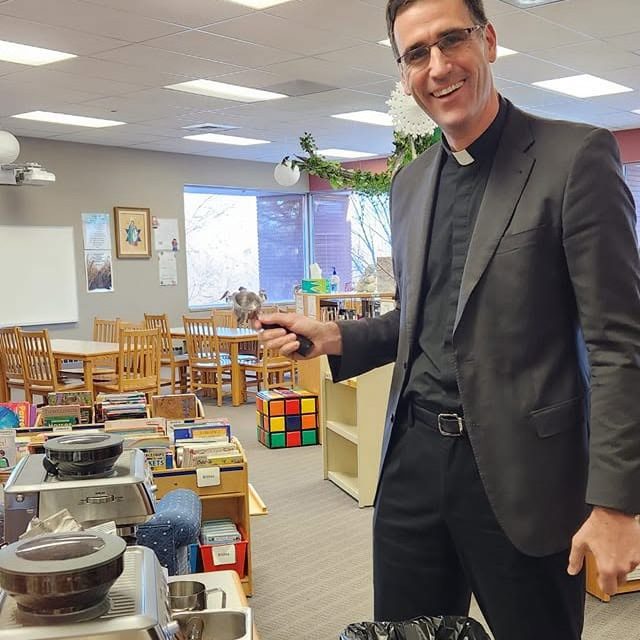
Fr. James de Cendra, principal of St. Mary’s, highlights the parish’s involvement in the lawsuit.
The court’s conservative justices—Samuel Alito, Neil Gorsuch, Brett Kavanaugh, and Amy Coney Barrett—questioned Colorado’s requirements. Meanwhile, Justices Sonia Sotomayor, Elena Kagan, and Ketanji Brown Jackson warned against granting religious schools an exemption not available to secular institutions. Chief Justice John Roberts, potentially the deciding vote, explored both sides.
Roberts referenced past rulings that benefited religious schools where laws explicitly targeted religion, which Colorado’s doesn’t. He queried Nicholas Reaves, the parishes’ lawyer, about expanding the principle to other areas like driver’s licenses and employment benefits.
“I’m not quite sure how you limit the applicability of your principle,” Roberts stated.
Roberts also engaged Colorado’s attorney, Helen Norton, noting her eagerness to move past certain precedents.
The conflict centers on precedents from Sherbert v. Verner and Employment Division v. Smith. Sherbert prohibits denying benefits due to religious practice unless meeting strict scrutiny, while Smith upholds laws generally applicable despite impacts on specific beliefs.
The parishes sought to overturn Smith, but the court declined. Alito, who previously advocated this, refrained from pushing for an overruling during Tuesday’s argument.
Gorsuch pointed out that Colorado could be circumventing recent favorable rulings for religious schools.
He stated, “The Constitution tends to deal in substances, not in shadows and procedures.”
Kavanaugh observed Colorado’s allowance for secular enrollment preferences.
“You can have a vegetarian school, but you can’t have a Catholic school,” he remarked.
Barrett probed the necessity of the rule, questioning its intention.
“It’s just hard for me to imagine that this kind of discrimination is a problem in Colorado,” she asserted.
Sotomayor asked Reaves directly if schools reject children because of homosexual parents.
Reaves acknowledged that such rejection, if religiously motivated, might be permissible.
Sotomayor compared this to racial discrimination, which Reaves denied.
The schools may deny enrollment in specific instances, not automatically reject children of gay couples, Reaves clarified.
“The principle at issue here is, do you have to treat them better?” Kagan inquired.
Jackson discussed the line of argument with the DOJ’s lawyer, Sarah Harris, considering the lack of distinction between objections to gay or black parents.
Harris indicated racial exclusion may not pass strict scrutiny.
Norton emphasized Colorado’s intent for equal, not unequal, opportunity, stating, “Colorado welcomes religious preschools.”
The Trump administration backed the parishes’ stance. Harris criticized the existing religious liberty precedents, advocating for stronger protections for religious believers.
Erika Nagle, a mother, highlighted the financial impact of choosing Catholic education.
Her family lost $12,000 in preschool benefits over their choice.
St. Mary Catholic Parish, St. Bernadette Catholic Parish, the Archdiocese of Denver, and Daniel and Lisa Sheley, sued following a denied request for religious exemption from Colorado. The archdiocese, managing 34 preschools, seeks to admit families adhering to Catholic teachings, conflicting with Colorado’s nondiscrimination requirement.
The parishes argue that the requirement breaches the First Amendment’s Free Exercise Clause due to selective provider exceptions.
Lower courts denied plaintiffs’ request for an injunction against Colorado’s nondiscrimination condition.
Since 2018, Colorado’s LGBT protections faced Supreme Court challenges thrice, all resulting in losses for the state.
Notable decisions include the court’s backing of objections to conversion therapy regulations, web design mandates, and custom cake refusals based on religious beliefs.
Reaves emphasized the financial shortfall faced by the Sheleys due to policy.
A decision in the St. Mary Catholic Parish v. Roy case is anticipated by June’s end.
 Supreme Court Considers Religious Rights in Colorado Pre-K Case
 Raymond Wright Jr. Faces Life Sentence
 ICE Officer Faces Charge for Alleged Assault
 Retrial Consideration in Lindsay Clancy Case: Legal and Personal Battles
 McDonald’s Faces Lawsuit Over McRib Sandwich Misleading Claims
 Supreme Court Considers Religious School Admissions