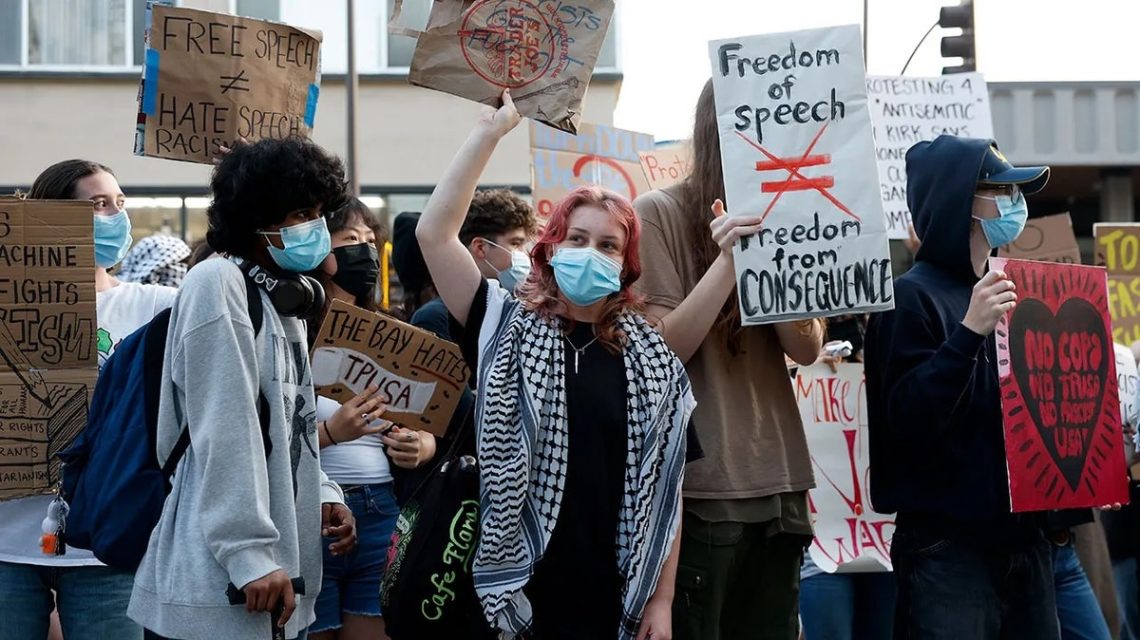
A recent survey highlighted troubling beliefs among undergraduate students regarding the justification of violence to curb hate speech. The Buckley Institute’s 2026 National Undergraduate Student Survey indicated that 45% of students believe physical violence can be acceptable in stopping what they perceive as hate speech. Specifically, 54% of liberals, 36% of moderates, and 30% of conservatives held this view.
The study also found that a significant percentage of students support shout downs and criminal prosecution for offensive speech. 46% approve of shout downs, and 40% think offensive speech should face legal consequences. Additionally, 42% express a preference for living under a socialist system, while 28% choose capitalism, and 22% believe the U.S. deserved the September 11, 2001 attacks.
The findings indicate more of a “moral formation issue” rather than a free speech matter, according to Cornerstone University President Dr. Gerson Moreno-Riaño. He warned of a “violent entitlement” developing among students.
The Department of Education is being asked to act to protect students from political violence on campuses. Dr. Moreno-Riaño argues that American colleges fail to form students morally, instead teaching resentment, grievance politics, and violent entitlement. He believes graduates leave these institutions with resentment rather than moral development, and this concerns employers.
Dr. Moreno-Riaño stated that the focus is not just on “worthless degrees,” but on what’s taught behind them. He criticized the ideological training that leads to resentment, anger, entitlement, and violent actions.
The perceived moral failure in higher education extends back decades, with institutions being described as “godless.” Dr. Moreno-Riaño claims ideologies like communism and socialism fill the moral void, leaving students unaware of the harm these ideologies can cause.
Employers are questioning the value of college degrees and considering alternatives, such as training high school graduates. Concerns about “worthless degrees” and ideological leanings further affect their expectations from recent graduates.
This shift might lead employers to seek skills development directly at the high school level, bypassing universities deemed to bankrupt morality. The intersection with artificial intelligence complexities also poses challenges, as sharp minds without a moral compass are deemed dangerous.
For the health of democracy, a workforce capable of reasoning, deliberating, and engaging in constructive dialogue is critical. This change is necessary to avoid violent confrontations and ensure productive societal development.
Dr. Moreno-Riaño emphasized the need for higher education to refocus on moral formation, moving away from entitlement and grievance culture.
The Buckley Institute survey involved 803 undergraduate students, all under the age of 25, attending four-year colleges. The survey was conducted online from September 5 to September 14.
 A Comprehensive Approach to Preventing School Gun Violence
 Assessing School Safety Measures: A Look at Active Shooter Drills and Threat Assessment
 Addressing School Shooting Anxiety: Guidance for Parents
 Adapting School Designs for Enhanced Safety
 Evanston/Skokie School District 65 Plans Major Changes Amid Financial Challenges
 Suburban School Districts Face Budget Challenges Amid Record Diesel Prices