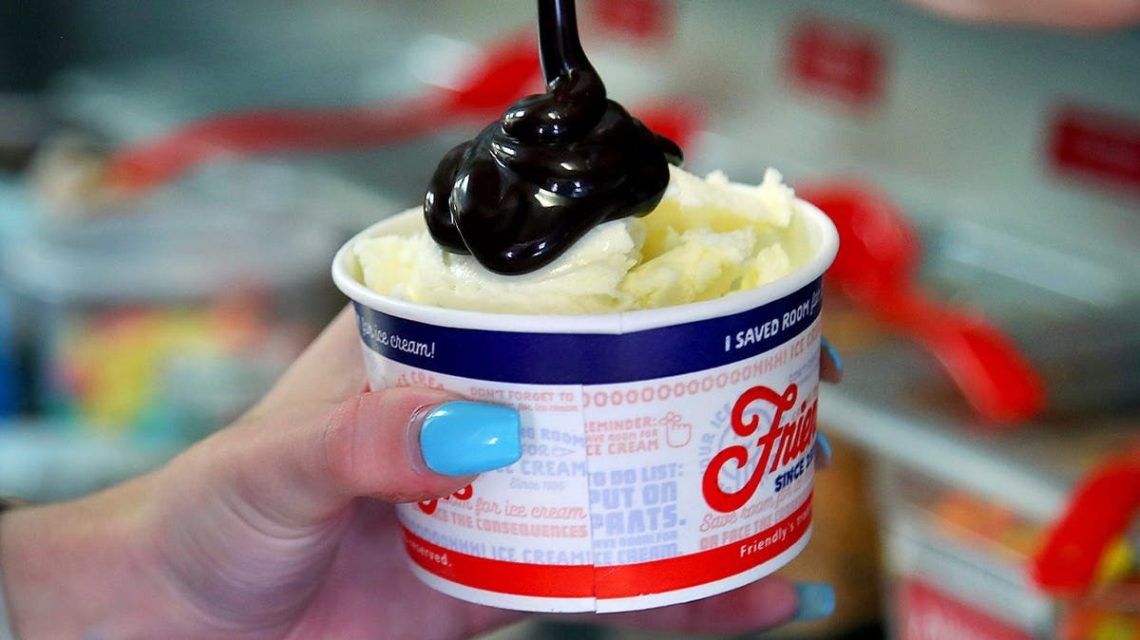
Friendly’s, a well-known casual dining chain famous for its ice cream desserts and family-friendly atmosphere, once operated nearly 850 restaurants. Today, the chain has reduced its presence to fewer than 100 locations across 11 states.
Historical Beginnings
The chain began as “Friendly” ice-cream shop in Springfield, Massachusetts, in 1935. It was founded by brothers Prestley and Curtis Blake during the Great Depression. The two young entrepreneurs, with Prestley at 20 and Curtis at 18, initially sold double-dip cones for 5 cents.
In 1940, the Blakes opened a second location and expanded the menu to include hamburgers. By 1951, 10 Friendly restaurants were operating in Massachusetts and Connecticut. This number grew to 500 by 1974, extending throughout the Northeast and Mid-Atlantic regions.
Expansion and Recognition
The brand, celebrating its 90th anniversary in 2025, became known for its ice cream desserts and welcoming environment. Over the decades, Friendly’s introduced new menu items and began distributing ice cream in supermarkets. It set a Guinness World Record for the largest sundae in 1980 and adjusted its name to Friendly’s in 1989.
Ownership Changes and Financial Struggles
Ownership of Friendly’s changed multiple times. Hershey’s purchased it in 1979 and later sold it to Tennessee Restaurant Company. The company faced financial difficulties, leading to bankruptcy filings in 2011 and November 2020.
Despite efforts to rejuvenate the brand, the impact of COVID-19 disrupted progress. George Michel, then CEO, highlighted how the pandemic affected revenue as dine-in operations halted and later resumed with restrictions.
Current Status and Future Outlook
In 2021, Amici Partners Group, LLC acquired Friendly’s, aiming to revitalize its 130-store chain. Presently, 87 locations remain, mostly on the East Coast, according to The Takeout.
Many Friendly’s branches appeared outdated and failed to align with modern trends, noted Barbara E. Kahn, a marketing professor at the Wharton School. However, Kahn also emphasized Friendly’s positive legacy and potential to adapt and thrive by leveraging nostalgia and incorporating contemporary consumer preferences.
Kahn suggested that offering more non-meat options, healthy grains, and salads could attract new customers. She cited McDonald’s as an example of a brand that successfully evolves while maintaining its core appeal.
 The Rise of Pickle-Flavored Snacks in America
  Unexpected Surprise for Photographer with Amazon Purchase
  Addressing Concerns over Parental Guidance
  Trace Gallagher’s Insights on Parenting in a Modern World
  Historic Los Angeles Building Transformed into Boutique Hotel
  Music, Culinary Heritage, and the Legacy of Bayou Bar