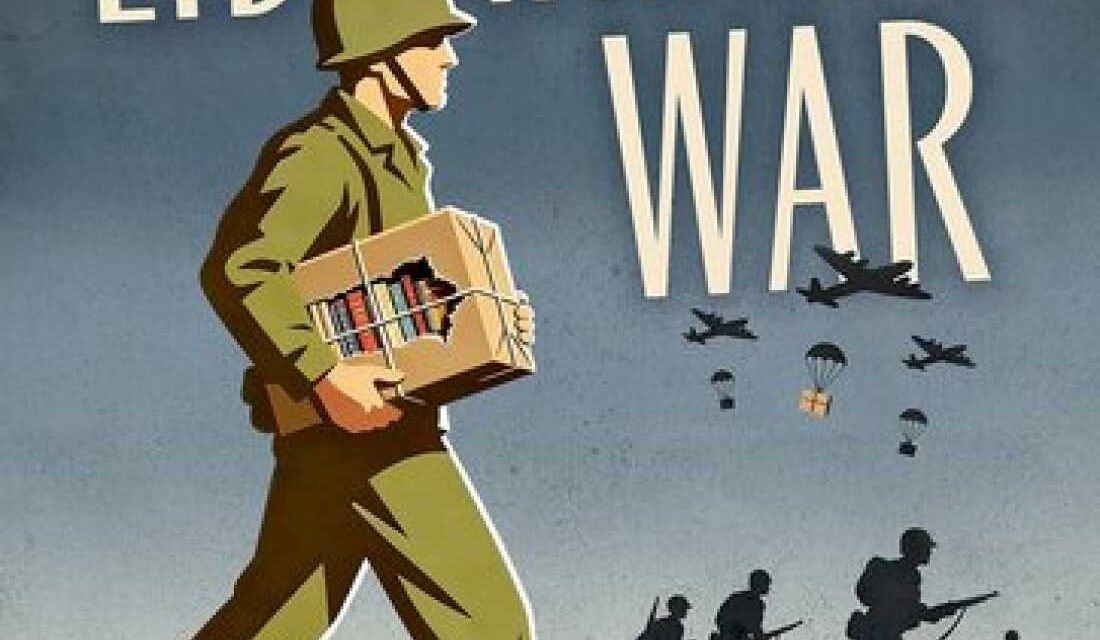
Growing up, I often heard of World War II from the fathers in my neighborhood. Despite having served, they rarely spoke of their experiences. Bits of information surfaced in unexpected ways. My friend’s father, an Air Force veteran in China, taught us how to say ‘hot water’ in Mandarin. Another veteran confessed to burning his uniform upon returning home. My own father mentioned ‘funny paperbacks’ from the war era.
While researching a book on The Great Gatsby, I realized my father had received books from what is considered history’s largest book giveaway. When the U.S. entered World War II, efforts began to provide servicemen with books to relieve their boredom. These books needed to be light and pocket-sized. This was one of several challenges faced by the Council on Books in Wartime, composed of publishers, librarians, and booksellers.
“Books Are Weapons in the War of Ideas.” – Council on Books in Wartime
The program sharply contrasted with the Nazi book burnings of 1933. The U.S. aimed to support servicemen’s freedom to read. Col. Ray Trautman played a key role. Molly Guptill Manning’s upcoming book, A Librarian’s War, highlights how Trautman proposed not only distributing but also producing books for troops. The Armed Services Editions (ASEs), the ‘funny paperbacks’ my father referred to, were part of this effort.
Beginning in 1943 and continuing until 1947, about 123 million ASEs were printed on pulp paper. They reached troops across the globe. The largest distribution occurred on the eve of D-Day, with soldiers carrying ASEs in their pockets. Among the titles taken to battle was Betty Smith’s A Tree Grows in Brooklyn. The selection committee chose books that went beyond typical preferences. Popular choices included cowboy stories, Tarzan tales, and suspense fiction, like Kathleen Winsor’s Forever Amber.
The collection also featured classics such as Moby Dick, biographies of figures like Frederick Douglass and Queen Victoria, and poetry by Longfellow and others. The ASEs predominantly featured white authors. Some books faced bans, particularly those thought to favor President Roosevelt during the 1944 election. Editorials and reader letters in newspapers opposed the bans. Troops also protested, recalling how book bans enabled tyrants like Hitler.
If you’re interested in learning more before A Librarian’s War releases, Manning’s earlier work, When Books Went to War, and the Library of Congress’s Books in Action are recommended. In 2012, I visited the Library of Congress to uncover how The Great Gatsby, initially received with mixed reviews in 1925, gained popularity posthumously after F. Scott Fitzgerald’s death in 1940.
The Armed Services Editions were crucial. In 1945, 155,000 copies of The Great Gatsby were distributed to servicemen. The Library of Congress houses the only complete ASE collection, accessible to all. Holding one conjures appreciation for the value these small books provided.
 Digital Divide: America’s Two Economies
  Rose Friedman: A Dedicated NPR Journalist Remembered
  Notable Lost Stories and Objects
  Fat Bear Week: Celebrating Resilient Giants and Ecosystem Conservation
  Controversial Sneaker Ad Sparks Backlash
  New Pub Opens at the British Embassy in D.C.