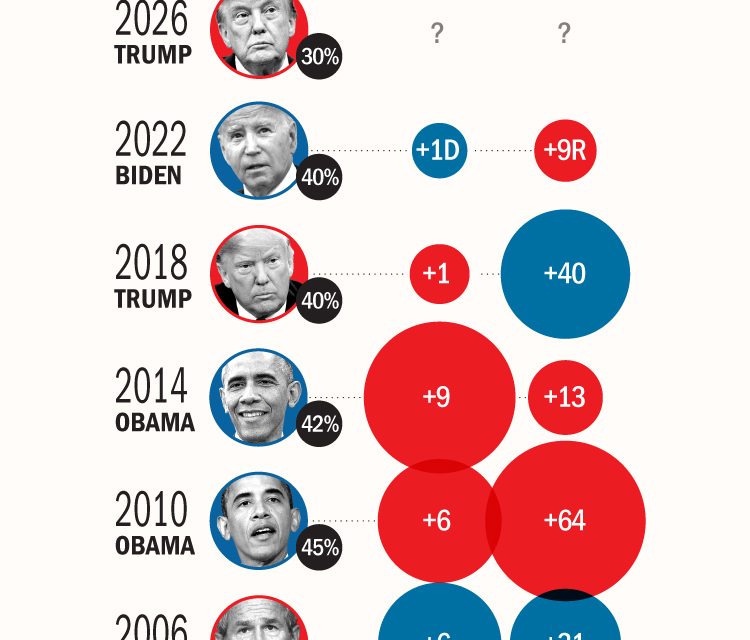
As the November elections approach, President Donald Trump’s approval rating has hit a low point. According to the Pew Research Center, the approval rating dropped to 30% in early October, the lowest for any President heading into the midterms in decades. The last similar instance was President Harry Truman in 1946. Peter Enns, a professor at Cornell University, highlights these ratings as historically low for a President.
Economic dissatisfaction largely drives the discontent with the Trump Administration. A poll from The Associated Press-NORC Center for Public Affairs Research indicates only 26% of Americans support Trump’s economic handling. Moreover, a mere 17% approve of his approach to the cost of living. The public also disapproves of the administration’s actions in Iran; only 28% support Trump’s handling of the issue. Enns notes that these unpopular positions contribute significantly to the low approval ratings.
Heading into the polls, critical issues for voters include the economy and foreign policy. Pew Research Center findings reveal that 84% of registered voters consider the economy a significant concern, while 57% prioritize foreign policy issues. Even without such low approval ratings, midterms typically present challenges for the President’s party.
Midterm Election Outcomes
The President’s party often loses congressional seats during midterms. Enns describes this as a common occurrence due to dissatisfaction among both supporters and opponents of the President. Costas Panagopoulos, a political science professor, suggests voters seek a partisan balance. He states that discontent with current policies often leads voters to support the opposition party. This trend is visible when one party controls the White House and Congress, as Republicans currently do.
However, exceptions exist. In 2002, during President George W. Bush’s tenure, Republicans gained seats. Panagopoulos attributes this anomaly to Bush’s high approval post-Sept. 11 attacks. Conversely, anticipated gains for the opposition party don’t always materialize, as seen in the 2022 midterms for President Joe Biden. Biden’s approval rating was low, yet Republicans didn’t achieve significant victories. Panagopoulos notes that new district lines and events like the Supreme Court overturning Roe v. Wade influenced this outcome.
The Role of Approval Ratings
Michele Swers, a Georgetown University professor, explains that midterms often serve as a referendum on the presidency. Panagopoulos agrees, asserting that approval ratings predict midterm results because they reflect voter sentiment about the incumbent party’s performance. A lower approval rating often results in congressional losses for the President’s party.
Implications for the Republican Party
Experts agree that Republicans face a challenging political climate. Generic ballot polls show Democrats leading Republicans, with Democrats expressing more enthusiasm about voting in the midterms. A recent PBS News/NPR/Marist poll found 91% of Democrats compared to 86% of Republicans feel excited about the midterms. Panagopoulos anticipates Republicans will lose seats in both the House and the Senate. However, flipping the majority in both chambers remains a complex task.
Enns cautions that polling represents a snapshot and not the final outcome. Actual voter turnout will ultimately shape the election results, leaving uncertainties until Election Day.
 Altering Political Paths: Millennials in Politics
 Democrats Anticipate First Congressional Win in 2026 Midterms Following Guam Election Results
 Justice Department Investigates Alleged Ballot Manipulation in Alaska
 Senator’s Warning on Social Security Amid Midterm Elections
 Election Monitoring, U.S.-Israel Aid, Data Center Ballot, Fox News Ratings, UK Adventurer, Harvard Lawsuit, Florida Polling Places
 Midterm Elections: Russia, Ukraine, and American Interests