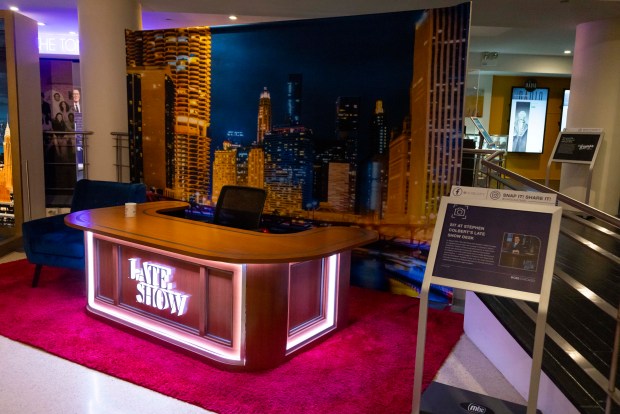
The Museum of Broadcast Communications in Chicago now hosts the set of “The Late Show with Stephen Colbert.” This set, which includes the desk and chairs, made its journey from a New Jersey warehouse to Chicago. This relocation honors Stephen Colbert’s comedic beginnings in the city.
David Plier, the museum’s chairman and CEO, played a significant role in acquiring the set. “The Late Show” achieved immense popularity before CBS decided to cancel it. The series finale attracted 6.74 million viewers, marking a significant moment in Colbert’s career.
The set, donated by CBS, took a day and a half to reach Chicago. It aims to enhance the museum, focusing on late-night TV history. Plier described this addition as a highlight among exhibits primarily centered around Chicago’s broadcasting past.
The intricacies of moving the set included maneuvering Colbert’s desk and other pieces into the limited museum space. The process required a coordinated effort between movers and the museum staff. Despite challenges, the exhibit successfully integrates original items like Colbert’s desk and chairs.
The museum aspires to establish a national presence while still emphasizing Chicago’s role in broadcasting history. Projects like the “Evolution of Late Night Television” exhibit showcase this dual focus.
In the past, the museum faced difficulties, including financial struggles and relocations. However, a recent $2.5 million grant and a $12 million capital campaign aim to revitalize and secure the museum in its Randolph Street location permanently.
The museum also houses exhibits on iconic TV moments and personalities. Visitors can explore artifacts like Johnny Carson’s set and the saxophone played by Bill Clinton on “The Arsenio Hall Show.” These exhibits represent pivotal moments in late-night television and political history.
Recent events raise questions about media responsibility, highlighted by a lawsuit against WGN-TV and other media outlets. The lawsuit alleges that these platforms promoted a financial scheme orchestrated by Brandon Ellington, a convicted felon. This case underscores the importance of scrutinizing who appears on broadcast media.
In Chicago sports broadcasting, the community mourns the loss of Stacey King, a former basketball player turned analyst. Known for his lively commentary and in-depth basketball understanding, King’s contributions to Chicago sports television were profound. His memorable catchphrases and passion for the game left a lasting impact on viewers.
Ryan Baker, a veteran sports anchor, also marks a transition in Chicago media. After years at WBBM-Ch. 2, he will lead First Tee-Greater Chicago, a nonprofit that mentors youth through golf. Baker’s departure closes a significant chapter in Chicago sports broadcasting.
 Chicago Area Historical Events: A Detailed Look Back
  Restoring the Basilica of Saint Francis of Assisi with AI and Technology
  Amir Odom Discusses His Departure from the LGBTQ Movement
  Reviving the Spirit of Ken Kesey’s Iconic Bus ‘Furthur’
  Examining Complex Issues of Sex, Gender, and Consent
  Ancient Roman Artifacts Discovered Off Sardinia’s Coast