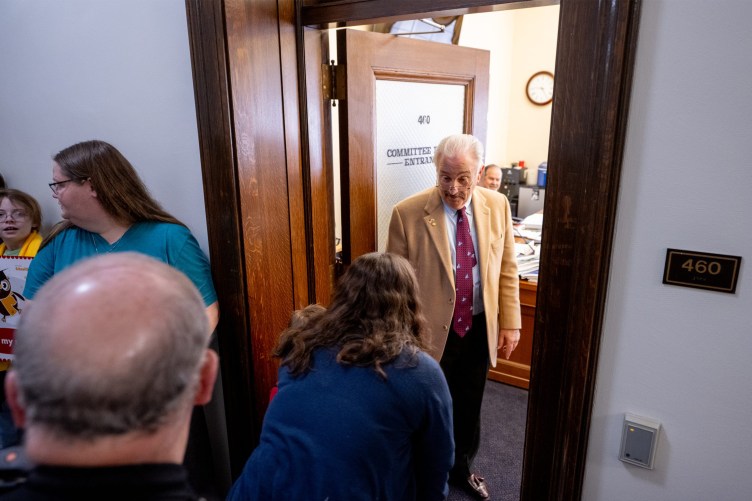
On a cold February morning at West Virginia’s Capitol, children in winter jackets, holding signs and their homework, filled the hallways outside the House Finance Committee room. Delegate Vernon Criss, the chairperson of the committee, briefly stepped out of his office, then returned inside. Just days earlier, Criss, a Republican lawmaker, had suggested limiting payouts from a voucher program that directs public funds to private education. Families started gathering each morning to object, accompanied by lobbyists and organizers claiming the proposal might end the program. This was not Criss’s intention. Five years prior, he voted to create the Hope Scholarship program, the first educational savings account program in the nation without income requirements. Since then, 11 other states passed similar laws. Initially costing the state $9 million, by 2026, projections for the program’s cost soared to $200 million or more annually, alarming Criss who worried about the growing program pushing the state budget into trouble, especially amid recent tax cuts.
That February day, a staffer unlocked the committee room door, allowing parents and media to enter and sit along the benches lining the walls. Children lay on the floor. A delegate asked about discussing the Hope Scholarship bill. Upon hearing it was not scheduled for discussion, parents and children left. Soon after, lawmakers halted efforts to limit spending on vouchers, leaving Criss fighting for his political future.
The campaign against Criss was just a piece of a broader push by local and national “school choice” advocates, with the financial backing to influence outcomes. Their success in installing the Hope Scholarship in West Virginia came as Republicans assumed control of the legislature in 2015. Over time, proponents built substantial support among political nonprofits. The Hope Scholarship debuted with 2,300 students and expanded to 26,000 currently, surpassing enrollment figures of the state’s largest public school district.
West Virginia became integral to a nationwide agenda to use public money for private education, notably supported by billionaire-backed groups, including the Koch family network and Pennsylvania billionaire Jeffrey Yass. Yass has invested over $350 million since 2015 in political activities promoting public funding for private education. Fierce challenges arose from fellow Republicans when concerns about the lack of spending caps or other basic safeguards surfaced.
During the 2026 West Virginia primary, three political action committees heavily invested in advertising, unseating four incumbent Republicans, including Criss, as punishment for their concerns over the Hope Scholarship. One PAC operated by the Koch family and two others supported by Yass—School Freedom Fund and Sugar Maple PAC—led these efforts. Following the outcomes, PAC leaders issued a clear message: opposition to school freedom policies invited political repercussions.
Organizational Influence on Education Policy
In 2021, as West Virginia lawmakers crafted the Hope Scholarship bill, external influences emerged from figures like Jason Huffman, director of Americans for Prosperity-West Virginia. The organization, part of a broader group founded by David Koch, pushed for economic policies favoring lower taxes and school vouchers. Within West Virginia, entities like the Cardinal Institute advocated for private school funding, backed by donations connected to prominent figures like Koch and Yass.
Grassroots advocacy also played a role; parents supporting alternatives to public schools gave testimony and shared personal stories. Katie Switzer, a mother encountering challenges in public education, emerged as a vocal supporter. Her advocacy featured in promotional materials for the Hope Scholarship, and she actively engaged in court challenges protecting the program’s funding from public school detractors.
The battle escalated to the state Supreme Court, where a favorable ruling maintained the Hope Scholarship’s legality. Attorney General Patrick Morrisey defended the program as debate continued; the case attracted substantial political interest with lobbying backing Morrisey’s eventual gubernatorial aspirations.
The Economic Implications of Education Funding
As 2025 began, Morrisey, having won gubernatorial office with significant PAC support, declared plans to advance the Hope Scholarship at his inauguration. Club for Growth Action, receiving substantial contributions from Yass, invested heavily in Morrisey’s campaign.
By 2026, an independent report from the Rand Corporation underscored the urgency of addressing the Hope Scholarship’s financial burden on West Virginia. Initially reserved for public school students or kindergarten entrants, the program later opened to all West Virginia students, including those long attending private institutions. Significant financial ramifications ensued, with estimates for the academic year ranging up to $300 million.
Rand’s recommendations included income caps on scholarships, coupled with increased public school funding, but Criss pursued alternative cost-control measures. As he proposed capping scholarships at around $5,000 yearly, which he believed would stabilize the program’s future, resistance intensified.
Amidst political backlash, Switzer and allies rallied against proposed caps, leveraging platforms like Facebook to mobilize opposition. Discussions with sympathetic lawmakers amplified calls against perceived threats to the scholarship’s viability, strengthening their campaign to retain its current format.
Election Consequences and Political Dynamics
Criss faced considerable pressure amid attempts to legislate scholarship restrictions, leading to increased electoral targeting. In the finance committee’s July caucus with Republican leaders, he failed to gather sufficient support for his proposal or for public school funding initiatives.
As primary elections approached, leading PACs synchronized efforts against legislators not aligning with Governor Morrisey’s agenda, showcasing targeted ads labeling Criss a liberal enemy of conservative values in West Virginia. Intensified advertising aimed to undermine opposition, with narratives suggesting Criss promoted liberal policies contrary to prevailing political ideals.
These coordinated efforts resulted in significant financial deployments. The School Freedom Fund significantly contributed to their campaigns, with Americans for Prosperity echoing these strategies. Sugar Maple PAC, supported by Yass, led charges against Criss, ultimately influencing his primary defeat. The political paradigm shifted further against those doubting the expansion of voucher-based education.
 Voter Mobilization Efforts Face Challenges Amid Social Media Disruptions
 A Hawaiian Naval Firm’s Alleged ‘Pay for Play’ Scheme with South Carolina Politicians
 Unusual Request and Challenges in Election Security
 Ken Paxton’s Impact on Abortion Legislation: A Detailed Examination
 Chicago Mayor Faces Challenges Ahead of Election
 European Right-Wing Politics Shifting Dynamics