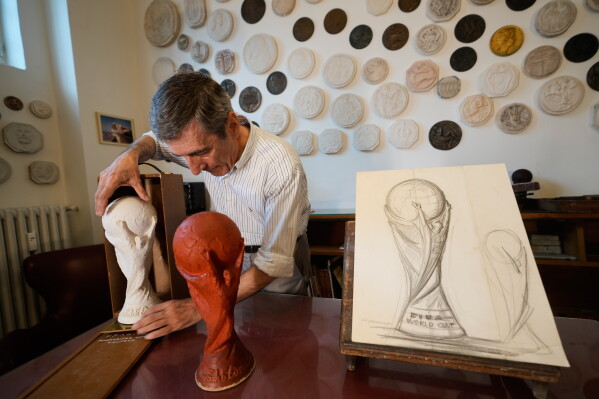
The FIFA World Cup trophy embodies three key sporting emotions: the athlete’s struggle, the fan’s jubilation, and the moment of victory. On Sunday, after the 2026 World Cup final, either Spain or Argentina will lift this trophy.
The Design History
Silvio Gazzaniga, an Italian sculptor, designed the iconic World Cup trophy in his Milan studio, located in the Brera neighborhood. He responded to FIFA’s open call for a new design after Brazil permanently secured the original trophy by winning their third World Cup in 1970. The design features two figures spiraling toward an orb symbolizing Earth.
According to his son, Giorgio Gazzaniga, the elder Gazzaniga began with numerous sketches, ultimately developing a form resembling two DNA spirals ascending. Silvio also crafted other renowned trophies, including the UEFA Cup and the European Super-Cup. He passed away in 2016.
The Fate of the Jules Rimet Trophy
The original World Cup Trophy, introduced in 1930, depicted Nike, the Greek goddess of victory, and was known as the Jules Rimet Trophy. FIFA commissioned a new design after Brazil’s permanent possession of it. The original trophy was infamous for being stolen twice: once in 1966, later retrieved by a dog named Pickles, and once again in 1983 from Brazil’s Football Confederation, never to be recovered and thought to be melted down.
Winning Design
Gazzaniga’s submission stood out among over 50 proposals. It uniquely encapsulated the narrative of the athlete’s journey in its form. The younger Gazzaniga explained that his father’s design illustrates the physical struggle and triumph of the athlete. The athlete’s portrayal within the trophy is rugged, reflecting the effort to achieve victory, which is echoed in the fan’s jubilance.
Gazzaniga’s family maintains his office in a new Milan location, preserving sketches, the original FIFA prototype, and a wax cast of the trophy.
The Trophy’s Legacy
The official World Cup trophy measures 36 centimeters (14 inches) tall, cast in 18-carat gold. It rests on a base with two rings of green malachite, representing the playing fields. The original trophy is kept by FIFA at its headquarters in Switzerland. The victorious team receives a gold-plated replica. The policy no longer allows any team to claim permanent ownership. This design has been used for 14 World Cups, with plans to continue until at least 2038.
Giorgio Gazzaniga recalls the excitement of watching the 1974 World Cup final, the first time his father’s trophy was presented. When West Germany lifted the cup against the Netherlands, the stadium erupted in joy, marking the transition of the trophy from an object to an icon.
 Is NHL Preseason Necessary?
  Impact of World Baseball Classic on Paul Skenes’ Performance
  Ronald Acuna Jr. Suffers Injury During Game Against Cincinnati Reds
  Joe Burrow’s Unexpected Post-Game Recovery
  Rangers Place Players on Waivers Ahead of Season Opener
  Cubs Face Crucial Pitching Decisions Amid Wild Card Race