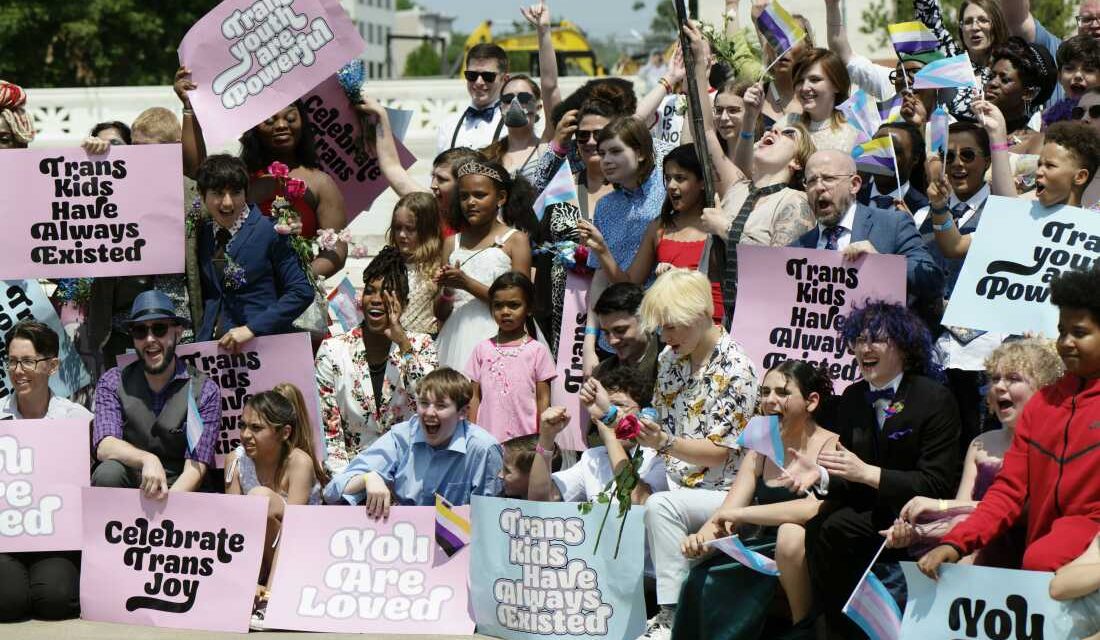
In May 2023, transgender youth and their families gathered outside the Supreme Court in Washington, DC, following an event titled the Trans Youth Prom. This rally came amid significant policy changes impacting access to gender-affirming care.
The Trump administration finalized a health care policy banning federal funding for gender-affirming care for minors covered by Medicaid or the Children’s Health Insurance Plan. For families like that of a California mother, referred to as A.W. for privacy concerns, these changes bring about anxiety and uncertainty. A.W. noted, “Every time you wake up, it feels like, what’s going to happen next?” Her family, now reliant on Medicaid and food assistance after her husband’s loss of employment, is directly affected.
Research by KFF highlights that approximately 130,000 transgender individuals under 18 reside in states where gender-affirming care remains accessible, despite legislative bans in several states. A.W.’s family belongs to this group. They depend on Medicaid after losing their private health coverage when her husband’s company closed. The policy’s impact, although targeting a small population, raises significant concerns. Katie Keith from Georgetown’s Center for Health Policy and the Law emphasizes, “I’m not aware of any other times that the federal government has prohibited federal funds in this way for a specific patient population with a particular diagnosis.” This, she says, is “unprecedented.”
States could potentially backfill the federal funding gap, but policy clarity remains elusive. Lindsey Dawson of KFF underscores the uncertainty: “We’ll have a better understanding of who will be impacted by this when we understand which states are going to continue to offer these services.”
In explaining the policy, Dr. Mehmet Oz from the Centers for Medicare and Medicaid Services cited weak evidence supporting gender-affirming procedures weighed against their potential harms. This reasoning has sparked debate and concern about the motivations behind these policy decisions.
Alongside policy implementation, the Trump administration released a report titled “Wolves in White Coats,” highlighting stories of individuals who have de-transitioned. It accuses medical professionals of prioritizing profit over patient care. This narrative, which has alarmed many families, is contested by those like A.W., who sees such claims as unfounded.
A.W.’s experience with California’s Medi-Cal has been positive, citing thorough and considered medical decisions concerning her transgender child. She deeply disagrees with portrayals of healthcare providers as exploitative and regards them as politically motivated. “The obsession is so weird to me,” A.W. comments on the administration’s focus on her family’s decisions.
Legal challenges to the new rule are anticipated. Jennifer Levi from GLAD Law links the policy to broader strategies affecting transgender rights, like military service bans. She points to the administration’s legal struggles as a sign of overreach.
Democratic-led states have expressed intentions to challenge the rule and potentially compensate for federal funding deficiencies. Keith warns, “It’s going to mean a lot of disruption for states who have to scramble to find money to do this.”
California’s preemptive budget measures provide some relief for A.W., ensuring continued access to essential care. However, practical concerns persist when traveling with a transgender child. Considerations include state-specific restrictions impacting their child’s safety and access to essential facilities.
“These are just kids who want to thrive,” A.W. concludes, voicing the simple aspirations of transgender youth amid shifting political landscapes.
 Young Democrats Favor Kamala Harris for 2028 Presidential Run
  Trump Reduces Military Exercises with South Korea
  Silicosis Risk Among California Workers Cutting Engineered Stone
  Arizona Mom’s Journey with Her Son’s Rare Genetic Disorder
  White House Press Secretary Changes Amid Midterm Election Tensions
  Redistricting Changes Stir Division in California’s Political Landscape