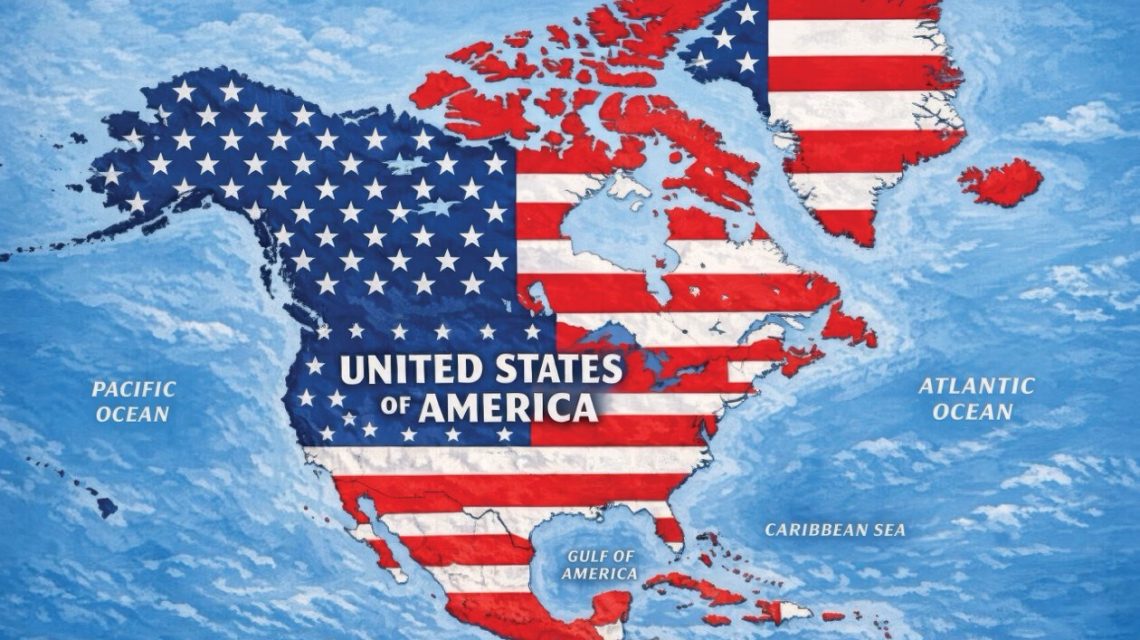
President Donald Trump posted an AI-generated map to Truth Social, implying North America is part of the United States. While it might be seen as commentary on the “America First” policy, the map has stirred real-world tensions between the U.S. and Canada. On the same day, Trump intensified a trade war with Canada, highlighting existing disputes beyond economics.
Trump has joked about Canada as the 51st state and has shown interest in controlling Cuba, Greenland, Mexico, and the Panama Canal. He renamed Gulf of Mexico to Gulf of America in 2022, and Lake Ontario to Lake America in 2023. Beyond these symbolic gestures, unresolved territorial disagreements with Canada predate Trump’s era.
“We have always managed to resolve boundary issues to focus on larger concerns,” said Rob Huebert, director at the University of Calgary’s Center for Military Security and Strategic Studies, to Newsweek.
However, Huebert warns that Trump’s administration seems to underestimate the importance of U.S.-Canada unity. Many Canadians question the Trump’s administration’s objectives amidst these tensions. Nonetheless, Canada is bolstering its defense to address any direct U.S. challenges.
Arctic Tensions
A principal unresolved issue concerns Arctic waters in the Beaufort Sea, rich in oil and gas. The U.S. and Canada clash over the maritime boundary north of Alaska and Canada’s Yukon and Northwest Territories, affecting a 270,000 square kilometer area. This stems from different interpretations of an 1825 treaty between Russia and Great Britain.
The treaty’s boundary, according to Canada, should extend northward. The U.S. suggests an alternate boundary. This disagreement extends to overlapping continental shelf claims in the Arctic Ocean. In 2024, a joint task force of Washington and Ottawa began negotiations, but by October 2025, no additional meetings were scheduled.
A second Arctic dispute arises over Canada’s rights to the Northwest Passage, a significant route linking the Atlantic and Pacific Oceans. While Washington views it as international, Ottawa sees it as Canadian. A 1988 compromise allows U.S. notification and Canadian acceptance for transits. But heightened tensions complicate this historic arrangement.
Active Russian and Chinese interests in the Arctic add pressure. Trump’s Greenland control ambitions, an autonomous Danish territory, bring further scrutiny for U.S. and Canadian Arctic security.
“Canada has significant Arctic capabilities,” said Adam Lajeunesse at St. Francis Xavier University, while noting these are not aimed directly at U.S. forces. A U.S. insistence on international status for the Northwest Passage could permit Russian and Chinese use, which the U.S. currently limits since the 1950s.
Boundary Disputes
Beyond Arctic tensions, an unresolved dispute exists near Canada’s Nova Scotia, New Brunswick, and Maine border involving Machias Seal Island and North Rock. The U.S. claims these from post-war British treaties, while Canada asserts inherited rights through a permanent lighthouse established in 1832. Canada’s Coast Guard continues operations there, with Fisheries and Oceans Canada labeling it a “Grey Zone” dispute.
Further west, unresolved Pacific disputes involve water areas linking the U.S. mainland to Alaska. The Dixon Entrance and Strait of Juan de Fuca disputes hinge on maritime boundary interpretations. Though less volatile than other international disagreements, these issues remain intricate under deteriorating U.S.-Canada relations.
Michael Byers from the University of British Columbia regards these as managed, but acknowledges active disputes in the Beaufort Sea and Northwest Passage. If the U.S. revives them, Canada’s government would likely negotiate, demonstrating good neighborliness.
Canada’s Response
In response to Trump’s assertions, Canadian Prime Minister Mark Carney united the nation, reacting to the expanded map and a derogatory cartoon with tariffs on $20 billion in U.S. goods. Carney emphasized Canada’s resilient history against American aggression in a video message.
Regarding U.S.-Canadian trade and discussions, Carney challenged the U.S. to engage in meaningful discourse rather than memes and shade. He remains unwavering amidst Trump’s tariff threats targeting Canadian goods.
Elsewhere, Mexican President Claudia Sheinbaum affirmed Mexico’s sovereignty. Iceland, not part of North America but included in Trump’s map, summoned the U.S. ambassador. Danish Prime Minister Mette Frederiksen reiterated Greenland’s position against becoming U.S. territory, citing the map as evidence of Trump’s expansionist vision.
 Cacique Cobra Coral Agreement and Weather Concerns in Brazil
  Albania’s Political Challenges and Judicial Reform: In-depth Analysis
  US Military Strikes Near Iran’s Kharg Island
  Drone Incident Brings New Concerns for Zelenskyy
  Spanish Opposition Leader Criticizes Prime Minister Over Migrant Situation
  Uganda Withdraws from Invictus Games to Support UK Monarchy