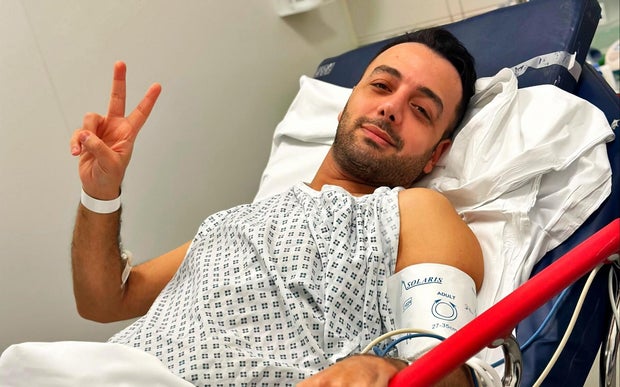
When British Iranian journalist Pouria Zeraati learned about the U.K.’s plan to outlaw support for Iran’s Islamic Revolutionary Guard Corps (IRGC), he felt relieved. “It was the happiest day of my life since I was stabbed,” he remarked. Zeraati’s focus was never on the jail time given to Romanian nationals involved in his 2024 attack. He viewed them as mere mercenaries.
“To counter this threat, we need to address its root: the Iranian regime and specifically the IRGC,” Zeraati stated. “This is a significant step that empowers law enforcement to track and counter the main source in Tehran, not just its proxies across Eastern Europe and elsewhere.”
After both houses of the U.K. Parliament approved it, the IRGC was one of three state-backed groups branded a “threat to national security” by the outgoing administration of Prime Minister Keir Starmer. The new legislation makes it illegal to support or aid the IRGC in the U.K., with penalties up to 14 years in prison. Acts of sabotage linked to the group could lead to a life sentence.
Challenges for Iranian Journalists
Persian-speaking journalists in the West, along with their families in Iran, have long faced threats and intimidation from the Iranian regime. As a prominent TV host for Iran International, a network critical of the Islamic Republic, Zeraati was familiar with threats. His image appeared on billboards in Iran with false accusations. A poster even declared him “Wanted: Dead or Alive.” Iran’s harsh stance against Iran International led to its terrorist label within Iran.
In February 2022, responding to credible threats, London’s Metropolitan Police reinforced security at Iran International’s London studios. Still, by the following year, the channel had to move its operations to Washington, D.C., due to safety concerns. In March 2024, one threat was realized. While walking in south London, two men attacked Zeraati. One restrained him while the other stabbed him in the thigh. They fled in a car with a third accomplice, leaving the U.K. immediately. Zeraati, seriously wounded, needed emergency care but returned to work within a week.
Motivated, Zeraati said, “The aim was to silence me. But it didn’t work. I’m more determined now.” He hosts his show remotely now, residing outside the U.K. for safety. British prosecutors cited months of planning and surveillance before the stabbing. Evidence showed the attackers had financial backing linked to the Iranian regime.
This month, two Romanian men, Nandito Badea and George Stana, received prison sentences for their roles in the attack. A third man is still in Romania facing legal proceedings.
Iran’s Activities and U.K.’s Response
The U.K.’s domestic spy agency, MI5, reported at least 20 Iran-linked plots in the U.K. in the year up to October 2025. Such threats, alongside attacks targeting the Jewish community, influenced the U.K.’s decision about the IRGC.
The IRGC, tightly connected to Iran’s military and the country’s supreme leader, has a history of targeting dissidents abroad. The Quds Force within the IRGC particularly focuses on overseas operations, like the one against Zeraati.
The U.K. designated another group, the Islamic Companions of the Right (IMCR), as linked to the IRGC’s Quds Force. This group had claimed responsibility for several attacks, including one on Jewish sites in the U.K. The British believe IMCR receives direction from the IRGC’s Quds Force.
Global Recognition and Domestic Debate
The U.S. labeled the IRGC a foreign terrorist organization in 2019, Canada followed in 2024, and the European Union in February 2026. Debate in the U.K. over designation persisted due to potential diplomatic fallout, such as the expulsion of the British ambassador from Iran.
Neil Basu, former head of U.K. Counter Terrorism Policing, described the U.K.’s move as significant. He noted, “The new crimes outlined by the designation help law enforcement address the recruitment of petty criminals.” He emphasized the deterrent effect, suggesting would-be recruits would reconsider due to severe punishments.
Zeraati echoed the sentiment, noting that this decision may make criminals think twice about associating with the regime. Regarding his return to the U.K., Zeraati expressed cautious hope. “Once transnational repression threats decrease, I would not hesitate to return,” he stated.
 Debate Heats Up Over Permanent Daylight Saving Time
  Tennessee Prison Chief Resigns After Botched Execution
  Collapse of Hawaii’s Holei Sea Arch Highlights Nature’s Impact
  Destiny Amos’s Medical Journey: From Localization to Recovery
  Abraham Lincoln’s Historic Pocket Watch and Its Secret Inscriptions
  Harriet Hancock: A Pioneer in LGBTQ+ Advocacy in South Carolina