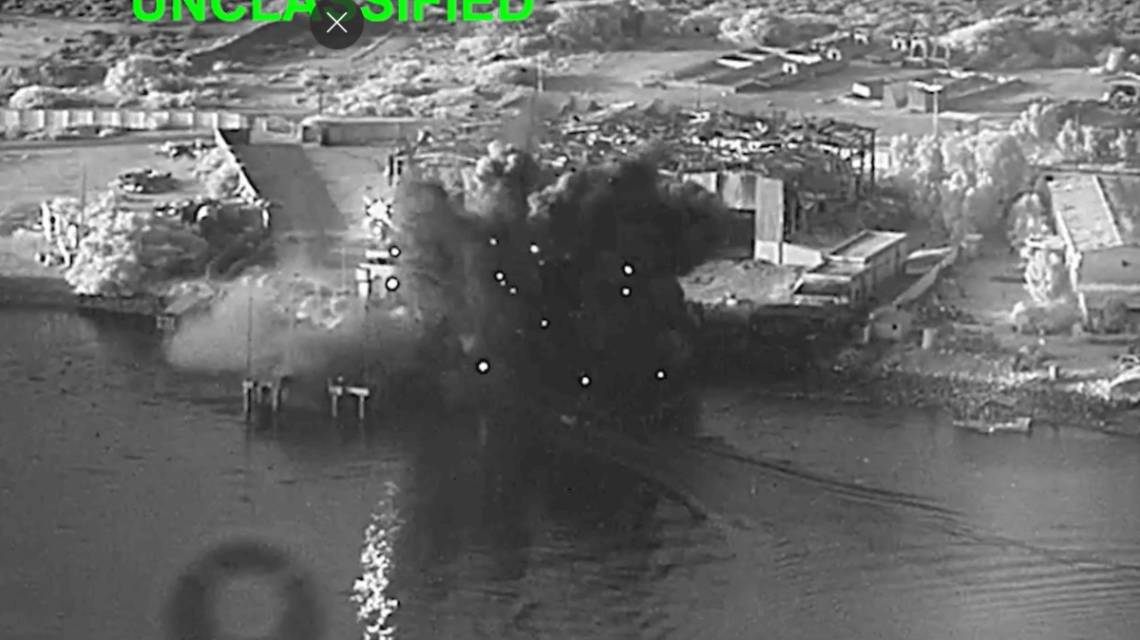
The United States has made history by deploying sea drones in combat for the first time, targeting a key Iranian site used for submarine repairs, as confirmed by U.S. military sources. While Ukraine has frequently used sea drones to attack Russian ports in the Black Sea since 2022, Iran has posed a threat to commercial shipping in the critical Strait of Hormuz with its swift, small boats, drawing the U.S.’s attention.
This marks the inaugural use of explosive naval drones by a major Western military, known as kamikaze one-way attack sea drones, in active missions. The U.S. utilized three Corsair naval drones to strike the port at Bandar Abbas, a coastal city housing significant Iranian naval forces located just north of the Strait of Hormuz.
Saronic, based in Texas, manufactures the Corsair drones and expressed pride in their technology’s role in the mission.
Corsair sea drones measure 24 feet and can travel at speeds of approximately 40 miles per hour over distances of about 1,150 miles (1,852 kilometers), according to Saronic. They constitute the smallest model among the three autonomous surface vessels (ASVs) produced by the company.
In December 2025, the U.S. Navy secured a $392 million agreement with Saronic for Corsair drones. Recently, these drones were instrumental in the rescue of two U.S. soldiers following a helicopter crash near the Strait of Hormuz.
The U.S. Central Command, which manages all U.S. military operations in the Middle East, released video footage on Monday that purportedly shows the moment of impact in Bandar Abbas, with three sea drones seen approaching the port in the overhead clip. A segment of the footage offers a view from the sea drone’s perspective as it collides with a pier, triggering a significant explosion. Newsweek has not independently authenticated this video.
Iranian state-controlled media reported the deaths of three individuals in southern Iran. The U.S. military stated that the sea drone strikes have diminished Iran’s capacity to continue assaults on commercial ships.
The U.S. engaged in a third consecutive night of strikes against Iran leading into Tuesday. Meanwhile, Iranian military sources claimed an attack on two tankers belonging to the United Arab Emirates (UAE) in the Strait of Hormuz, escalating tensions further amidst an already delicate initial memorandum of understanding established between the U.S. and Iran on June 17, aimed at facilitating negotiations for a lasting peace agreement.
The Emirati authorities confirmed one fatality and eight injuries following Iranian missile strikes on the tankers in Oman’s territorial waters, resulting in fires onboard. Iran also reported targeting U.S. military bases in Jordan and Bahrain.
The ongoing conflict between the U.S. and Iran commenced with coordinated U.S.-Israeli attacks on Iran in late February, inciting retaliatory actions from Iran against U.S. allies in the region through drone and missile strikes, alongside disruptions to vessels navigating the Strait of Hormuz.
Efforts by the U.S. to fully reopen the Strait of Hormuz, a vital passage for one-fifth of the globe’s oil and gas, have been unsuccessful for several months. On Monday, then-President Donald Trump announced the reinstatement of a blockade on Iranian ports and introduced a 20 percent levy on all goods traversing the Strait of Hormuz.
The naval blockade originally implemented in mid-April was initially eased under last month’s agreement, facilitating controlled access to Iranian ports. Following the recent ‘downing of U.S. drones,’ a senior Iranian legislator revealed Parliament’s introduction of a bill aimed at strengthening Iran’s hold over the Strait of Hormuz.
 New U.S. Military Bases Planned in Greenland Amid Strategic Security Deal
  Twitch Streamer Hasan Piker Discusses Controversial Commentary
  A Shifting Political Landscape: The Decline of Autocratic Power
  Trump Delivers Warning to Iran, Cuba at UN General Assembly
  Lukashenko and Putin’s Unique Relationship and Belarus’ Strategic Role
  Alan Ritchson Faces Backlash Over Political Remarks