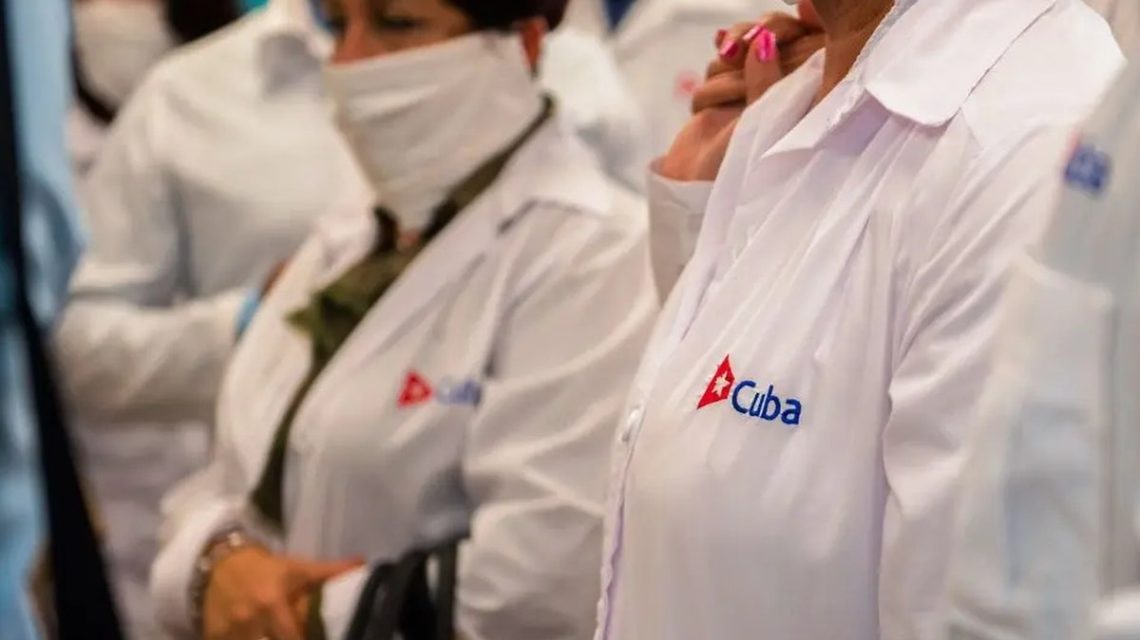
Recently, Congress enacted a law targeting nations involved in the human trafficking of Cuban medical professionals through the Castro regime’s international missions. The legislation, crafted by U.S. lawmakers, was approved in February 2026, with a continuation expected to be voted on soon for fiscal year 2027.
For many years, Cuba has coerced its doctors to work in challenging and unwanted locations under severe labor conditions. The doctors receive a minimal portion of their earnings. The Cuban government reportedly gains $4-8 billion annually, keeping 75-95% of the compensation intended for medical professionals.
The U.S. State Department reports that the Cuban regime confiscates doctors’ passports, retains their families in Cuba as leverage, assigns handlers to supervise them, and punishes families if a doctor tries to defect. Since 2010, the State Department has criticized the missions as exploitative, labeling them as “human trafficking” or “forced labor” in 2020.
A photo captures a member of a Cuban medical delegation wearing an embroidered white coat upon arriving at Martinique-Aime-Cesaire airport in the French Caribbean on June 26, 2020. (Photo by LIONEL CHAMOISEAU/AFP via Getty Images)
The Consolidated Appropriations Act of 2026 introduces measures against countries purchasing Cuban medical services. The State Department will now document and notify countries using this labor. If they remain on the list for two consecutive years, they risk losing all U.S. foreign aid. Officials involved might face entry bans into the U.S., along with asset and financial freezes.
The law is already impacting various countries. Nations like Guatemala, Jamaica, Guyana, St. Vincent and the Grenadines, Paraguay, and Honduras are reducing or ceasing their reliance on Cuban medical staff. The Bahamas is attempting to bypass direct payments to the regime by directly compensating the doctors, though Cuba has rejected such changes before.
The Trump administration supported the implementation of this law by instituting visa restrictions on officials from Brazil, Grenada, and certain African nations linked to the program.
This legislation aims for accountability, countering past Democratic tendencies to overlook such issues. It exposes those exploiting the program and imposes tangible penalties including the loss of U.S. aid, travel bans, and financial sanctions. The law also advocates for Cuban citizens by safeguarding their medical professionals from exploitation while cutting off a key revenue source for the regime.
Rep. Mario Díaz-Balart holds the position of vice chair on the House Appropriations Committee and chairs its Subcommittee on National Security, Department of State and Related Programs.
 Experts Doubt Export Ban Will Lower Fuel Prices
  Trump Delivers Warning to Iran, Cuba at UN General Assembly
  Trump Delivers Stern UN Speech on Iran, AI, and Global Security
  Lukashenko and Putin’s Unique Relationship and Belarus’ Strategic Role
  Harris Discusses Potential 2028 Presidential Run
  Far-Left Groups Allegedly Organize Protests in Austin