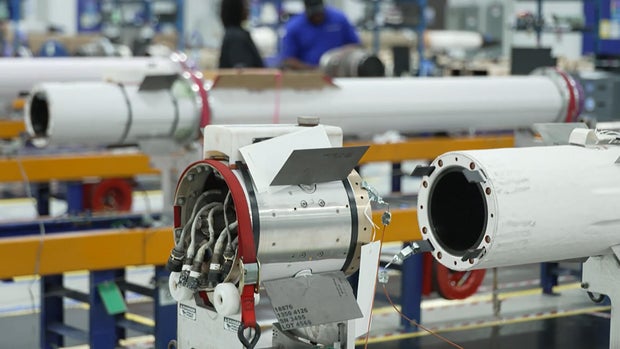
Tim Cahill, head of Lockheed Martin’s missile division, recently highlighted the latest Patriot air defense missile in Camden, Arkansas. The missile targets incoming ballistic threats, designed for impact precision, described as a “bullet hitting a bullet.” The cost per missile is approximately $4 million, with an annual production of 750. This falls short of replenishing the estimated 1,500 used against Iran.
Mark Cancian from the Center for Strategic and International Studies estimates the munitions cost against Iran at $25 billion, including the Patriot and six other critical weapons. He emphasized the need for high-end systems in ballistic missile defense.
The war with Iran has highlighted a shortage of high-tech weapons, unaddressed by prior administrations until U.S. aid increased to Ukraine after Russia’s invasion in 2022. This conflict underscored insufficient inventories for prolonged warfare. In February, the U.S. attacked Iran, striking over 13,000 targets by April, depleting stockpiles significantly.
Cancian believes the U.S. can sustain a war with Iran but faces challenges in a potential conflict with China. The Pentagon disputes claims of munitions shortages, asserting that such claims encourage enemy attacks. Defense Secretary Pete Hegseth pushes for increased production to a “wartime footing,” described by Cahill as “controlled chaos.” Lockheed Martin aims to boost Patriot production to 2,000 annually, enhancing automation to expedite assembly.
Assembling a Patriot takes six weeks, while producing 4,000 components spans two years, dependent on over 500 suppliers. A single missing part can halt production, with reliance on sole-source suppliers. Rocket motors, made nearby by L3Harris, involve time-intensive safety regulations, with curing fuel akin to pottery.
L3Harris is expanding production and automation, but faces supply chain obstacles. Ensuring multiple qualified suppliers is a priority, as some parts are particularly challenging in terms of schedule.
Hegseth’s call for expedited arsenal rebuilding aligns with substantial defense budgets. This revival of the military-industrial complex involves new players like CoAspire in Virginia, led by Doug Denneny. CoAspire’s cheaper cruise missile, priced at a couple hundred thousand dollars, targets enhanced affordability and quantity rather than singularity.
The Pentagon plans to purchase 10,000 low-cost missiles from such innovators. Denneny asserts the cruise missile effectiveness against Chinese defenses due to sheer volume. Their missile includes commercial components like BBs for ballast, originating from hobbyist markets.
As CoAspire works on $400 million contracts, Lockheed Martin’s recent $59 billion contract aims at high-performance Patriots. Restoring stockpiles to pre-Iran war levels could take one to five years, contingent on the munition type. Achieving comfort level inventories for potential war against China will take additional years.
 King Charles III to Convene Meeting on A.I. in Scotland
  Ms. Rachel Criticizes Silence on Palestinian Children’s Deaths
  Trump Sparks Controversy Over Northern Ireland Comments
  Canadian Prime Minister Seeks New Economic Ties with EU Amid U.S. Tensions
  Democrats Criticize Administration’s AI Regulation Stance
  Uncovering a Forgotten WWII Train Liberation