ANKARA, Turkey — The United Nations Educational, Scientific and Cultural Organization (UNESCO) reported that approximately 2.4 million Afghan girls remain barred from secondary education, five years after the Taliban assumed control of Afghanistan. UNESCO has urged for the quick reinstatement of their educational rights.
The Paris-based UNESCO highlighted that the ongoing exclusion of females from education in Afghanistan represents a severe violation of their fundamental rights. Hoda Jaberian, UNESCO’s program coordinator for education in emergencies, stated during a video press conference that Afghanistan is the only nation globally where female education is legally prohibited. Jaberian emphasized, “Five years is not a temporary interruption in a child’s education. It is clearly almost an entire secondary school cycle.”
She continued, “UNESCO continues to call for the immediate and unconditional restoration of girls’ and women’s right to secondary and higher education. It is not negotiable. It’s a basic human right, and we reiterate that there is no substitute for this.”
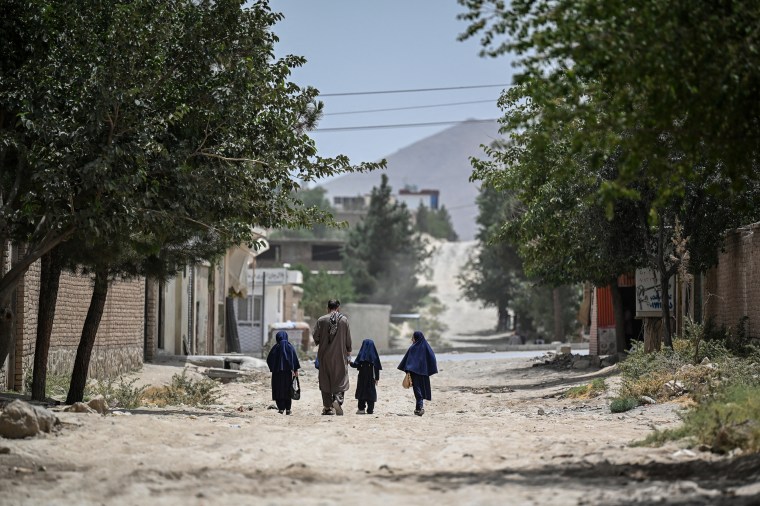
Afghan schoolgirls walking with their father to a primary school in Kabul in July.
Following the Taliban’s seizure of power on August 15, 2021, as U.S. and NATO forces left after a 20-year conflict, the group prohibited girls from attending secondary schools. Restrictions were later extended to higher education and various public sectors, largely excluding females from public life.
Despite numerous appeals from the United Nations, humanitarian organizations, human rights advocates, and several Islamic countries, the Taliban continues to uphold the ban, describing the issue as a domestic matter.
Jaberian remarked that these restrictions undo significant educational progress made over two decades. She pointed out that while girls’ access to education was highly restricted in 2001, by 2021, nearly 1 million girls were enrolled in secondary education. “Afghanistan had made really major progress in expanding girls’ access to education,” she stated, “But unfortunately, much of that progress now has been completely reversed.”
UNESCO has supported education in Afghanistan via community-based programs, literacy, and skills development. These activities often occur in community spaces or the homes of literacy facilitators, with the authorities’ awareness. The agency noted over 1,000 facilitators, most trained by UNESCO and partners.
Jaberian concluded, “While the restriction remains, we cannot abandon Afghan learners. UNESCO works with communities and our partners from the communities to preserve every possible pathway to learning.”
 Democracy Under Threat: The Rise of Politically Charged Messaging
  Trump’s Strategy for Greenland: Military and Resource Expansion
  The Illusion of Ceasefire Between Russia and Ukraine
  U.S. Army Prepares for New Challenges Amid Emerging Threats
  Tropical Depression Champi Threatens Guam and Northern Mariana Islands
  Mass Shooting Attempt at Aurora Hindu Temple Prevented