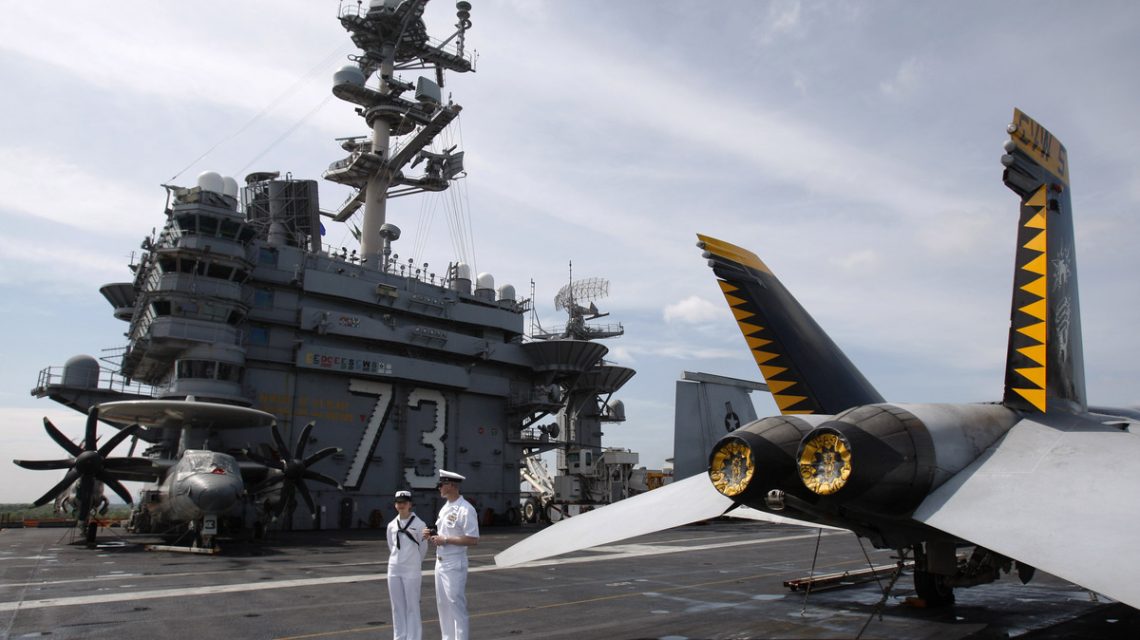
The move of the USS George Washington from the Pacific to the Middle East is raising national security concerns for the United States. Commenting on this, a former commander of the aircraft carrier highlighted the potential risks associated with the redeployment. This transition marks the final U.S. Navy carrier from Asia being involved in the ongoing conflict with Iran.
The plan is for the USS George Washington to take over from the USS Abraham Lincoln. The conditions on the Lincoln have become a focal point of concern. Reports of dwindling supplies and challenges with crew well-being have prompted Democratic calls for investigations. Approximately 5,000 sailors and Marines have remained on board without touching land since December, bringing attention to naval living conditions.
There are also worries about the U.S. Navy’s readiness. The extended commitments in the Middle East might weaken preparations for any future confrontations, particularly with China. Former Rear Admiral Mark Montgomery explained that relocating the Washington to the Gulf will result in reduced U.S. naval presence for over a year. This reduction follows the carrier’s need for maintenance after its Middle Eastern deployment.
“This is a national security risk as it sends a weak deterrence message to China and does not assure America’s allies and partners in the Pacific,” said Montgomery, who now works with the Foundation for Defense of Democracies in Washington, D.C.
The White House referred questions to the Pentagon, which cited operational security to avoid commenting. The U.S. Navy directed inquiries to the U.S. Pacific Command, which Newsweek reached out for remarks.
President Donald Trump’s administration has signaled to U.S. allies the necessity of increasing their defense spending. The aim is to shift resources to address the growing threat from China’s advancing military capabilities. The U.S. has specifically urged Japan, Taiwan, and South Korea to bolster their military investments, which has sometimes unsettled these nations.
Recently, Trump called off U.S. military exercises with South Korea. The cancellation preceded joint maneuvers aimed at addressing North Korea. Trump labeled the exercises as “totally inappropriate and hostile” and critiqued South Korea for not joining the U.S.’s efforts against Iran.
In May, arms sales to Taiwan drew international attention. Trump appeared to use these sales as a negotiation point with China’s President Xi Jinping. Supporting Taiwan, a self-governing island, is a long-standing U.S. policy, albeit without official recognition due to the “One China” policy.
The U.S. expects China to have its military ready for a potential Taiwan invasion by 2027. China maintains a powerful military with a significant naval fleet, equipped with advanced missiles and nuclear capabilities.
The presence of U.S. distractions and allied frustrations pleases Beijing, according to Greg Poling from the Center for Strategic and International Studies.
The Washington’s Voyage
By Thursday, the USS George Washington was passing through the Singapore Strait, revealed the U.S. Navy. According to an anonymous source, the ship was in the Strait of Malacca by Thursday night. This strait connects the Pacific Ocean with the Indian Ocean.
Similar to previous operations, when the Lincoln headed toward the Middle East, it also traversed through the Strait of Malacca. Recently, the U.S. confirmed the Washington’s location in Guam in mid-June, and then the Philippine Sea by early July. The carrier docked in Da Nang, Vietnam, on July 30 to make a scheduled stop, departing less than a week later.
Contact Newsweek editors Ben Kelly and Sam Wilson for further details on this story.
 French AI Entrepreneur’s Warning to American Voters: Avoid Democrat Policies
  Pope Leo XIV Undergoes Successful Lung Surgery
  Illegal Immigrant Couple Accused of Jewelry Thefts Across Four States
  Hurricane Simon and Storm Rachel Cause Destruction in Mexico and the U.S.
  U.S. Officials Reassess Timeline for Potential Chinese Invasion of Taiwan
  President Trump Shares Disturbing Wildlife Incident