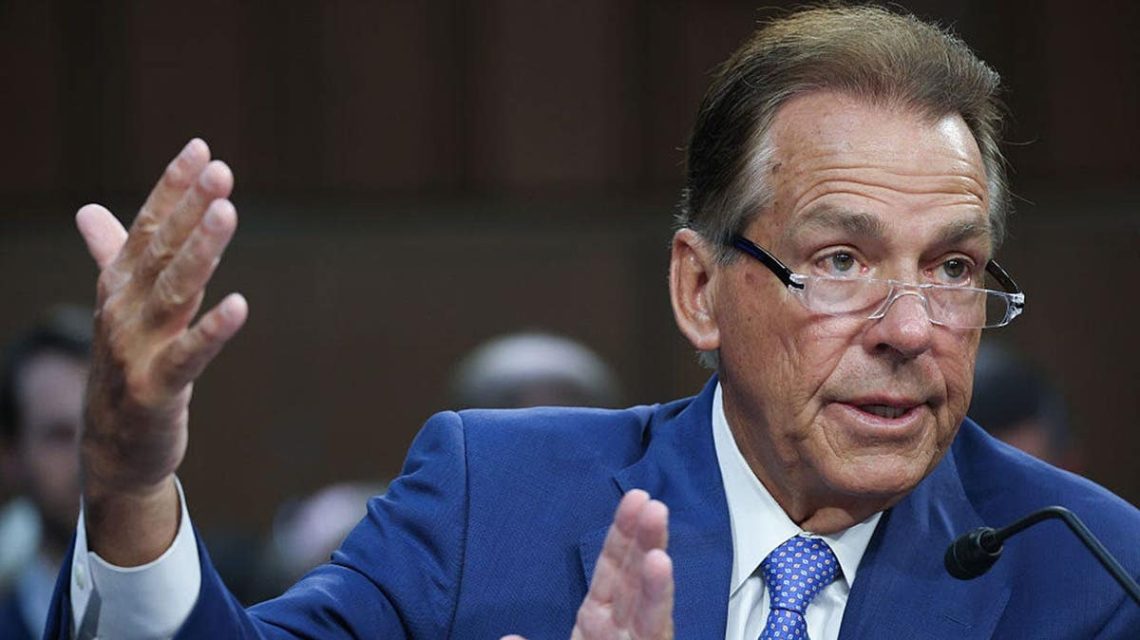
New York Yankees President Randy Levine, who also serves as Vice Chair of the ‘Saving College Sports’ Board, recently joined Brian Kilmeade to discuss the ‘Wild West’ of college athletics. Levine highlighted the issues surrounding name, image, and likeness (NIL) deals, the transfer portal, and athlete eligibility. These challenges create financial strains on universities. He mentioned President Trump’s efforts to find a legislative solution, hoping for bipartisan support within 90 days.
The debate over the future of college football continues, especially regarding NIL and its impact. Former Alabama Crimson Tide head coach Nick Saban recently testified before Congress, sharing his views on the direction of the sport. Saban pointed out that the unrestricted transfer portal and rising spending in major college football are reshaping the sport. He expressed concerns over spending on players and its effect on roster construction. However, he emphasized that NIL shouldn’t turn into a pay-for-play system.
Nick Saban told Congress, “When the system becomes whoever raises the most money gets the best players, then we are no longer talking about college athletics as millions of fans and I have known it.” Similarly, Notre Dame’s Athletic Director Pete Bevacqua stated that focusing resources heavily on football could lead to a small group of super league schools. He fears this transformation could make college football resemble a mini-NFL.
Saban criticized the rising costs, noting, “Now you have schools with close to $40 million rosters.” His concern is that smaller schools may not compete with well-funded programs. However, history shows college football has always been dominated by a few powerhouse teams. Since 2000, champions include Alabama, Ohio State, Georgia, LSU, Florida, Clemson, USC, and others. Smaller programs rarely win titles, with Indiana’s recent win being an exception.
Looking back further, significant titles have consistently gone to large programs like USC, Notre Dame, Alabama, Texas, and Ohio State. Occasional outliers like BYU in 1984 and Pittsburgh in 1976 did win, but these are rare events. The narrative that NIL will push out less prominent teams doesn’t align with historical trends. Indiana’s recent success demonstrates how NIL can serve as an equalizer. High-level recruits often chose powerhouse teams for exposure and NFL prospects. Now, NIL offers a chance for programs like Indiana and Texas Tech to compete nationally.
Not all programs have high NIL budgets. Even with the most expensive roster, Texas missed the playoffs in 2025. College football often romanticizes the past, ignoring real outcomes. While fixing NIL issues is necessary, expecting teams like Rice or Middle Tennessee State to win championships isn’t realistic. Programs could benefit from wealthy donors, similar to what Phil Knight did for Oregon. While coaches and athletic directors may resist, NIL provides opportunities for rising programs.
 Ronald Acuna Jr. Suffers Injury During Game Against Cincinnati Reds
  Joe Burrow’s Unexpected Post-Game Recovery
  Rangers Place Players on Waivers Ahead of Season Opener
  Cubs Face Crucial Pitching Decisions Amid Wild Card Race
  Chicago Cubs vs. Miami Marlins: 12-Inning Game Recap
  Alabama Football’s Comeback and Controversy