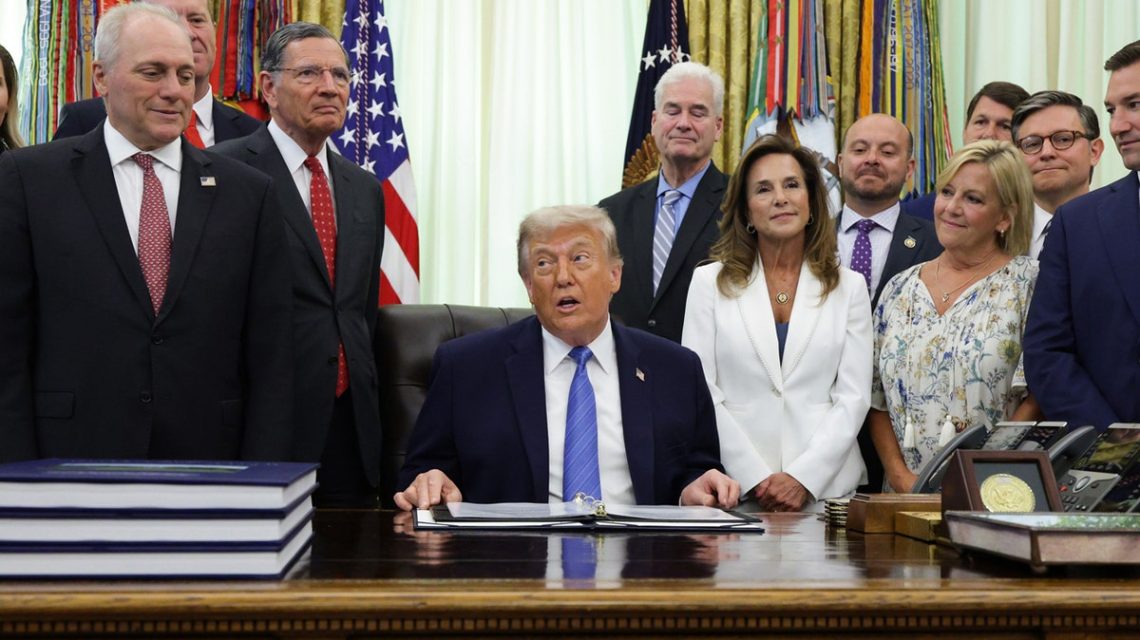
On Wednesday, President Donald Trump signed a $70 billion homeland security bill. The Senate originally crafted the measure, and it passed the House despite the Republican Party’s slim majority. Speaking from the Oval Office with House Speaker Mike Johnson, Senate Majority Leader John Thune, Majority Leader Steve Scalise, and other lawmakers, Trump expressed his satisfaction in providing resources for the Department of Homeland Security, including Immigration and Customs Enforcement (ICE) and Border Patrol.
The president emphasized the importance of funding for domestic law enforcement investigations and efforts to combat child exploitation. He mentioned the government’s commitment to restoring law and order and protecting America’s youth.
Controversy and Challenges
Trump criticized congressional Democrats, accusing them of attempting to block funding for the Department of Homeland Security to disrupt border security. He took aim at former President Joe Biden for his border policies, which he claimed resulted in 25 million illegal migrants entering the U.S. Trump also criticized former Vice President Kamala Harris, who was assigned as border czar, for not engaging ICE and border patrol effectively.
“She never once called them,” Trump said. “She was the border czar for four years, almost four years, and she never went to the border.”
Trump mentioned that law enforcement had cut fentanyl trafficking by almost 60%, with efforts focusing more on land crossings. House Majority Leader Steve Scalise highlighted the importance of the bill amid heightened security threats.
Political Opposition
The $70 billion package faced initial resistance from conservatives who wanted to codify Trump’s immigration-related executive orders. Rep. Keith Self, R-Texas, highlighted the need to enforce these actions to prevent future issues.
All Senate Democrats and Alaska Republican Lisa Murkowski opposed the bill in early June. The Republican party largely favored full funding for ICE and Customs and Border Protection for the remainder of Trump’s term. However, California Rep. Pete Aguilar criticized the funding as giving ICE a “$70 billion blank check,” claiming the agency has a history of misconduct.
Funding Delays and Resolution
Trump had set a June 1 deadline for Republicans to secure funding for ICE and Border Protection. However, internal opposition to the president’s $1.8 billion “anti-weaponization fund” delayed the bill’s approval. The concern was that individuals convicted of violent offenses related to the Jan. 6 Capitol riot might access taxpayer funds.
The bill’s passage follows a government shutdown earlier this year after Democrats opposed Trump’s immigration enforcement actions. Despite the shutdown, ICE had received separate funding through the One Big Beautiful Bill Act in the previous November.
 Italian PM Giorgia Meloni Skips UN General Assembly Amid Growing Tensions
  Calls Grow for Ireland’s Soccer Team to Boycott Matches Against Israel
  Congressman Randy Fine’s Bold Political Stance and Views on AI Regulation
  Political Messaging and Strategy Leading Up to Midterms
  President Trump Proposes ‘Super Intelligence’ as New AI Term
  Trump Administration Considers Diesel Export Ban Amid Rising Prices