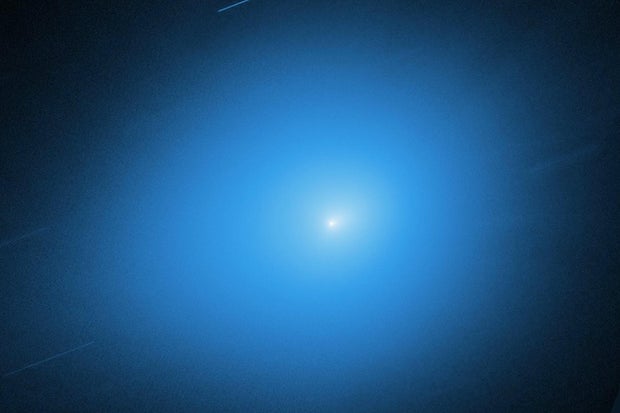
On Monday, a group of astronomers shared fascinating findings about an interstellar comet named 3I/ATLAS. This comet, which passed by the sun and Earth last year, could predate our solar system by nearly three times its age, presenting a unique opportunity for study.
Origins and Observations
3I/ATLAS is only the third observed visitor from beyond our solar neighborhood, distinguished by its unexpected brightness. Spotted initially in July, a Harvard researcher briefly speculated it might be an alien spacecraft, though NASA dismissed this idea.
Recent observations utilizing powerful telescopes continue to unveil its mysteries. A study in the journal Nature reveals that 3I/ATLAS might be around 12 million years old, in contrast to our solar system’s estimated age of 4.5 billion years.
Martin Cordiner of NASA’s Goddard Space Flight Center suggested it could be the oldest object ever observed here. With tools like the James Webb Space Telescope and the ALMA Observatory in Chile, researchers are analyzing the comet’s isotopic composition, setting it apart from any solar system object.
Chemical Composition and Cosmic Clues
Further analysis indicated 3I/ATLAS has high levels of deuterium. Cordiner stated this implies the comet formed in extremely cold conditions, possibly making it one of the coldest seen so far.
The origin within the Milky Way remains a mystery. These interstellar objects might form similarly to those in our solar system but get ejected during planetary formations.
Unbound by stars, 3I/ATLAS likely circled the galaxy on vast trajectories over billions of years. Researchers also noted the comet’s strange chemical attributes, suggesting it was near star-birth regions in its past.
The term ‘cosmic noon,’ referring to a star-formation era about 10 billion years ago, could be relevant to 3I/ATLAS’s history.
Unique Observations and Future Prospects
The prior interstellar comets 1I/’Oumuamua and 2I/Borisov lacked the brightness necessary for thorough analysis.
Nasa has shared multiple images of 3I/ATLAS, illustrating its journey through space at varying distances from Earth and Mars.
Harvard’s Avi Loeb reiterated multiple theories about the comet’s nature, urging open-mindedness until data clarifies its identity. Despite suggestions about alien origins, NASA and the SETI Institute find no signs of extraterrestrial technology.
Looking Ahead
Many astronomers praised the new findings, with Darryl Seligman noting the rarity of such isotopic data from interstellar bodies, though its exact age remains debated.
Peter Veres emphasized that observations will soon become challenging as the comet exits the solar system permanently.
The field is poised for expansion, with expectations of more interstellar discoveries facilitated by the Vera C. Rubin Observatory in Chile. Martin Cordiner views these developments as the start of exciting new research into our galaxy.
Fields marked with the potential for future observations and study could lead to groundbreaking insights.
 Discovery of Tilcayo Tiger Cat, a New Wild Cat Species in Bolivia
  Ancient Egyptian Warhorse Burial Unearthed in Beheira
  Humpback Whale’s Grief Over Stillborn Calf Reveals Emotional Complexity
  Discovery of Massive Lunar Crater Sheds New Light on Moon’s Surface
 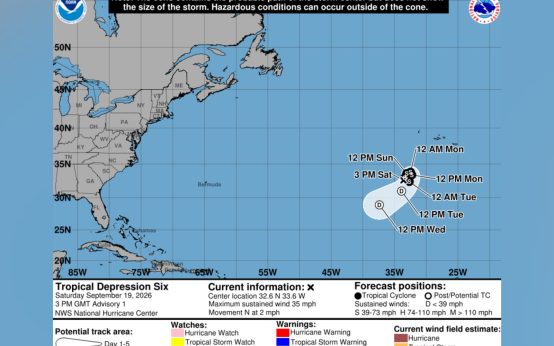 Tropical Depression Six Forms in the Atlantic Amid Quiet Hurricane Season
  Fat Bear Week: Celebrating Resilient Giants and Ecosystem Conservation