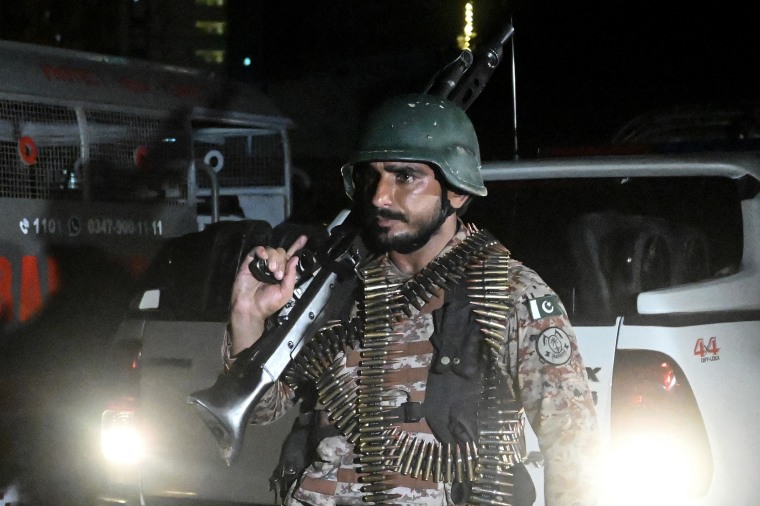
ISLAMABAD — On Sunday, Pakistani security forces executed a ground operation near the Pakistan-Afghanistan border, accompanied by targeted strikes on militant sanctuaries, resulting in the deaths of 29 fighters, according to official reports.
Information Minister Attaullah Tarar announced on X that the mission was initiated following a series of militant assaults throughout the nation. There has been no immediate response from Afghanistan.
In recent years, Pakistan has seen an increase in militant attacks aimed at police and security forces. Authorities attribute most of these incidents to the Pakistani Taliban, Tehrik-e-Taliban Pakistan (TTP), and associated militant groups.
A paramilitary cordon was set up in Karachi Saturday night following an attack on the Security Rangers compound. Rizwan Tabssum / AFP
Security personnel conducted inspections at a compound in Karachi on Sunday. Asif Hassan / AFP
This operation follows the previous day’s incident where militants with firearms and explosives assaulted the regional headquarters of the paramilitary Rangers in Karachi, killing three soldiers. Security forces neutralized three attackers and detained another, reportedly an Afghan national who was wounded.
Jamaat-ul-Ahrar, a dissident group of the Pakistani Taliban, claimed responsibility for the Karachi attack in a statement released Saturday night.
Information Minister Tarar explained that Pakistan’s recent border operation aimed to dismantle the hideouts and sanctuaries of the Pakistani Taliban. The Pakistani Taliban remain distinct from the Afghan Taliban, though they are allies. The Afghan Taliban regained power in Afghanistan in 2021.
These operations are anticipated to exacerbate already strained relations between Islamabad and Kabul.
Continuing Cross-Border Violence
The operation on Sunday represents the latest instance of cross-border hostilities between the neighboring nations. Earlier, less than three weeks ago, Pakistan’s military executed airstrikes targeting alleged militant hideouts in Afghanistan. This followed a month of relative calm that began after Pakistan deemed the situation an “open war,” despite international peace efforts.
Taliban security personnel near the Torkham border crossing in February. Aimal Zahir / AFP
People digging a mass grave for victims of airstrikes in Nangarhar, Afghanistan, in February. Anadolu
Recent months have seen escalating military exchanges between Afghanistan and Pakistan, with hundreds of casualties reported since February. The Afghan forces retaliated to Pakistan’s airstrikes inside Afghan territory.
Efforts at international peace talks have not succeeded in establishing a lasting ceasefire. In April, China facilitated discussions between the two nations, later declaring that Pakistan and Afghanistan agreed to refrain from further escalating their conflict and to seek a resolution.
Since last year, Pakistan has conducted multiple airstrikes near the border and inside Afghanistan, targeting alleged TTP and other militant hideouts. Pakistan accuses the Afghan Taliban government of sheltering militants who attack within Pakistan, particularly those from the TTP, a claim Kabul denies.
 Ukraine Deploys Ground Robots in ‘Operation Vivaldi’
  Understanding AI’s Impact Compared to Historical Threats
  State Department Alerts on Middle East Travel Amid Rising Tensions
  Iran’s Attacks on Bahrain: The Impact on Military Families
  United Russia’s Dominant Election Result: Implications for Putin’s Ukraine Policy
  Canada’s Tariff Reduction on Chinese EVs Raises Security Concerns