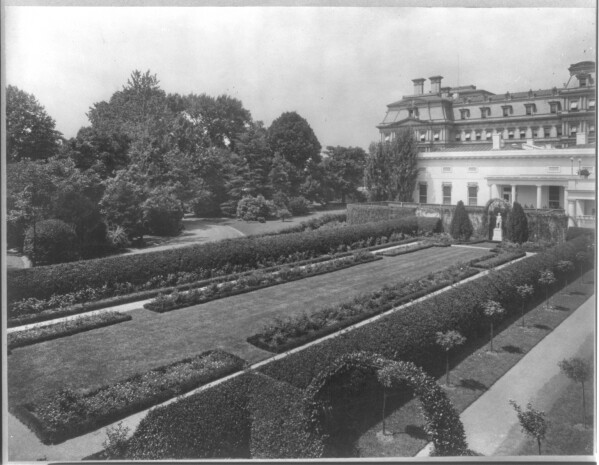
President Donald Trump’s two redesigns of the White House Rose Garden, including transforming its lawn into a patio, have brought renewed focus to one of America’s most iconic gardens. Over the years, the garden has undergone many modifications as presidents and first ladies have altered its design. Let’s delve into the significant changes and history of the Rose Garden.
Early Changes with Ellen Wilson and Jackie Kennedy
The Rose Garden was established during President Woodrow Wilson’s administration by his wife, Ellen Wilson. In collaboration with landscape architect George E. Burnap, she oversaw its creation in 1913, replacing Edith Roosevelt’s Colonial Garden, which had been planted eleven years prior. Initially, the area hosted greenhouses.
For nearly fifty years, the garden retained its original form until 1961. At this point, President John F. Kennedy and first lady Jacqueline Kennedy enlisted their friend Rachel “Bunny” Mellon, a horticulture enthusiast from Cape Cod, Massachusetts, to lead a redesign. Mellon, working with landscape architect Perry Wheeler and White House Head Gardener Irwin Williams, aimed to create a multifunctional outdoor space for press conferences, meetings, and ceremonies. By 1962, the installation of the redesigned Rose Garden was completed.
The updated garden featured a vast central lawn, inspired by a croquet scene from Lewis Carroll’s “Alice in Wonderland.” Magnolia trees were planted at each corner, while roses, culinary herbs, spring-blooming bulbs, seasonal annuals, and young crabapple trees framed the lawn in twelve-foot deep borders.
Since its redesign, the Rose Garden has become synonymous with important presidential speeches and historic events.
The Garden’s Plant Evolution
Flowers blossomed in the garden in 1963, yet Mellon’s choice of muted, classic rose tones eventually encountered issues. The crabapple trees grew excessively, shading the sun-loving roses. In 2003, several trees were removed to improve sunlight exposure. Over time, various perennials were introduced, replaced, and removed. As tree roots expanded, planting annuals in the borders became challenging.
Boxwood shrubs faced threats from boxwood blight disease. The lawn frequently required drainage repairs. Walkway maintenance led to replacements using mixed slabs.
Restoration in 2020
In 2020, first lady Melania Trump commissioned Perry Guillot, Inc. and Oehme van Sweden & Associates to work with the Committee for the Preservation of the White House and the National Park Service to restore the garden’s 1962 aesthetic. The crabapple trees were moved, and the plantings were refreshed with pastel roses such as the tall shrubby “White House Rose,” “JFK Rose,” “Pope John Paul II,” and “Peace Rose.”
Garden infrastructure was enhanced with electricity for television broadcasts and limestone walkways for wheelchair access, complying with the Americans with Disabilities Act. NewGen boxwoods resistant to blight replaced the previous shrubs.
The Transition to a Patio
By 2025, President Trump altered the garden again by substituting the central lawn with a white limestone patio. Solar-powered lighting, tables, umbrellas, and bronze statues of historical figures were added. Trump dubbed the venue the Rose Garden Club, hosting dinners there.
Today, the roses on the perimeter continue to thrive.
Jessica Damiano writes regular gardening columns for The Associated Press and publishes the Weekly Dirt Newsletter. To receive weekly gardening advice and tips, consider signing up for the newsletter at her website.
For more stories on gardening, visit the AP gardening hub.
 Nor’easter Threatens East Coast with Heavy Rain and Strong Winds
  California’s Growing EV Community Faces Challenges
  Massive Boulder Unearthed at O’Hare Airport Becomes Local Curiosity
  Trump’s Greenland Agreement
  Manhunt Underway for Armed Suspect in Placer County
  Midair Brawl Erupts on London-Bound Flight