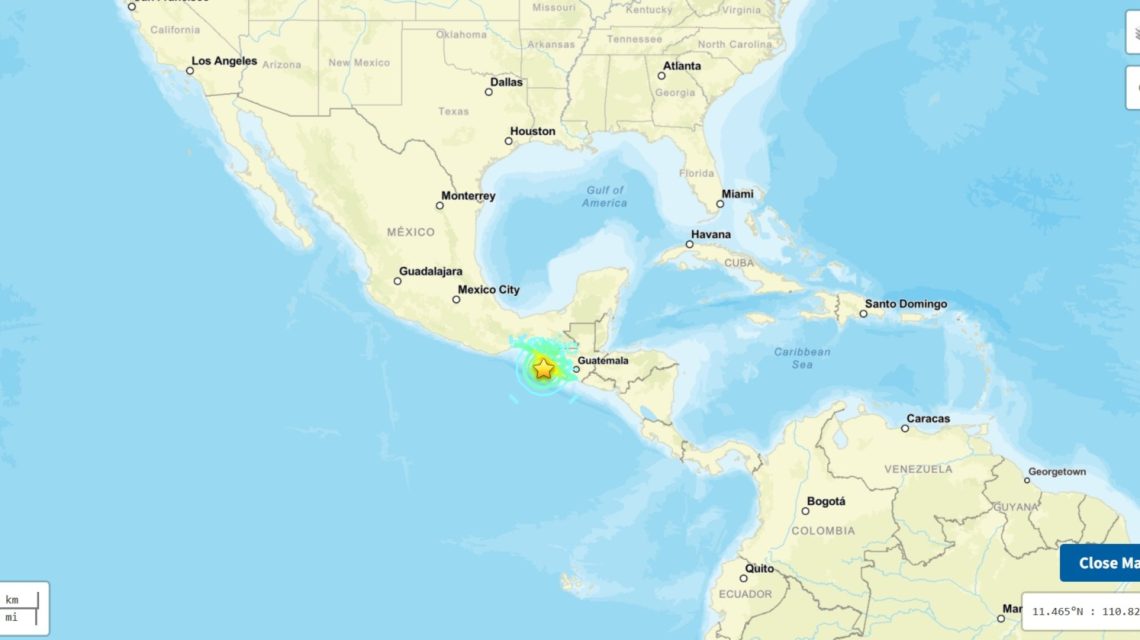
A significant 7.3 magnitude earthquake impacted southern Mexico’s coast early on Friday, prompting immediate infrastructure checks by emergency officials. According to the U.S. Geological Survey (USGS), the quake occurred near Chiapas state’s Pacific coast. It struck at a shallow depth of around 9 miles, intensifying the shaking and broadening the area of impact.
The main quake was linked to a series of seismic activities in the region. Smaller quakes occurred both before and after the main event, including a magnitude 4.7 near Aquiles Serdán, and others measuring 5.1, 5.3, and 6.0 near Puerto Madero.
Location of the Epicenter
Preliminary data from USGS indicated the quake’s epicenter was about 30 miles southwest of Aquiles Serdán and close to Puerto Madero, near the Guatemala border. The earthquake struck at 8:48 a.m. local time.
Potential Damage and Impact
An earthquake of magnitude 7.0 or higher is considered a major event and can cause severe damage, particularly near the epicenter. USGS assessments suggest such earthquakes can lead to significant structural damage, landslides, liquefaction, and widespread infrastructure disruptions.
Though initial reports indicated no immediate deaths or major damage, authorities were expected to assess the infrastructure and monitor coastal regions for potential tsunami impacts. Social media videos captured the severe shaking during the quake.
NWS Tsunami Alerts noted that a tsunami was not expected in the U.S. due to this quake. However, its behavior suggested a possible tsunami risk within 200 miles of the epicenter.
Tectonic Activity and Subsequent Risks
Matthew Cappucci, a senior meteorologist, explained the quake was a thrust earthquake. The Cocos plate is subducting beneath the North American and Caribbean Plates. This up and down motion can create a tsunami threat nearby, and liquefaction could occur, temporarily turning soil into a liquid state, impacting infrastructure stability. More aftershocks are anticipated over the following days.
Historic Context
The September 19, 1985, Mexico City earthquake remains one of the deadliest in Mexico’s history, measuring 8.0–8.1 in magnitude. It caused devastating damage due to amplified shaking over lake-bed sediments, with thousands of deaths and extensive infrastructure damage.
Looking Forward
Officials recommend residents in affected areas follow local emergency guidance and remain vigilant for aftershocks, which can persist for weeks.
 Diplomatic Complexities at the United Nations General Assembly
  Understanding Iran’s Political Struggle: The Path to Transition
  Kate Middleton: The Monarchy’s Brightest Star
  China’s Surveillance in the Red Sea Raises Concerns
  Prince Harry’s London Charity Event Amid Media Spotlight
  Converse Apologizes for Controversial Ad Sparked by Allegations of Racism