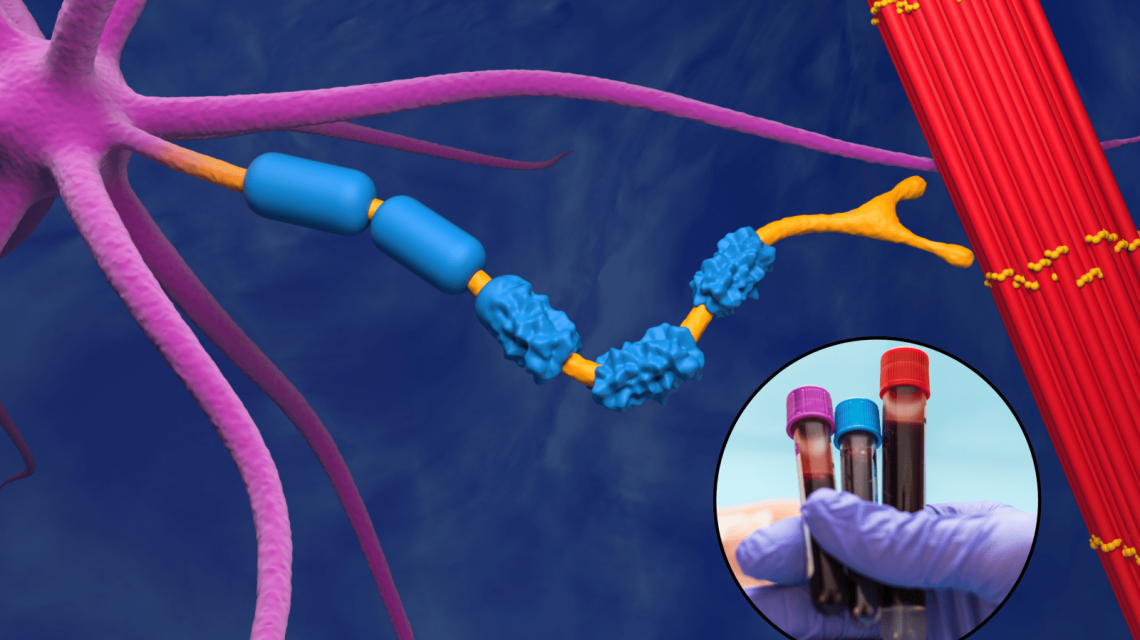
Researchers have made a significant finding in the fight against amyotrophic lateral sclerosis (ALS), offering potential hope for early intervention. A group of proteins in the blood shows changes months or even years before ALS symptoms appear. This discovery raises the possibility of treating at-risk individuals before irreversible nerve damage occurs.
ALS, also known as Lou Gehrig’s disease, is a progressive motor neuron disease that affects nerve cells responsible for movement control. According to the Centers for Disease Control and Prevention (CDC), about 5,000 people in the United States receive an ALS diagnosis each year. The disease typically starts with painless muscle weakness, twitching, and slurred speech, gradually impacting movement, swallowing, and breathing.
Blood Proteins Changed Before Symptoms Emerged
The study analyzed data from the Pre-symptomatic Familial ALS (Pre-fALS) study, funded by the National Institutes of Health (NIH), which tracked individuals with a high genetic risk of ALS for nearly twenty years. Researchers examined plasma samples from 137 participants, including 33 who later developed ALS or frontotemporal dementia symptoms.
Using a proteomic analysis technique called Olink, they measured over 5,000 blood proteins. Ultimately, they identified 92 proteins with altered levels before symptoms developed. Further analysis through machine-learning models narrowed these to a panel of 19 proteins. Among these, the neurofilament light chain (NfL) protein, already noted for rising shortly before ALS symptoms, featured prominently.
Researchers could estimate when individuals would begin showing disease signs, with an average prediction error of about 18 months. The models proved effective across a prediction range of six months to five years before symptom onset.
A Potential Window for Early Treatment
Dr. Michael Benatar, a senior author and professor at the University of Miami, highlighted that this finding provides vital insights for those with ALS-linked genetic variants. “These biomarkers give us a far better idea of the timing, allowing us to estimate the time to symptom onset with an average error of about 18 months. That’s something we can work with,” he stated.
Predicting symptom emergence could be crucial for testing therapies designed to delay or prevent disease before clinical signs appear. The study’s results, replicated with data from the UK Biobank, suggest the biomarkers’ broader relevance beyond inherited ALS cases.
Why the Findings Matter
Amy Bany Adams, acting director at the NIH’s National Institute of Neurological Disorders and Stroke, noted the urgent need for reliable biofluid signatures that indicate near-term onset in those carrying ALS risk genes. “With preventative gene-targeting treatments now available, there’s a particularly pressing need for such indicators,” she commented.
Tofersen, an approved drug for symptomatic ALS, is being tested in the ATLAS clinical trial to assess whether pre-symptom treatment could delay or prevent disease onset.
Dr. Benatar credited the long-term commitment of study participants for making this work feasible. “This is all possible because of the carrier community members who believe in our mission of preventing ALS and have supported and participated in our research,” he acknowledged.
Reference: Ran, X., Wuu, J., Qin, Z.S. et al. Longitudinal plasma proteomics predict phenoconversion to clinically manifest ALS. Nat Med (2026). https://doi.org/10.1038/s41591-026-04528-x
Contact Newsweek editors on this story: Charlotte Nisbet and Sam Wilson.
 Upcoming Concerns and Influence in Health Politics
  Fraud Task Force Saves Billions by Tackling Obamacare Misuse
  Presley Gerber’s Passing Raises Addiction Recovery Concerns
  Understanding October SNAP Benefits: Payment Dates and Changes
  Managing Distress and Discomfort Effectively
  Trump Administration Seeks to Influence NIH Grantmaking